

Archive position — measured, not model output
1 like on Devpost
505 of the 7,850 archived projects have more likes, and 1,758 share exactly 1 — so this project's #1,395 place in the like-ranked listing is a tie-break inside that group, not a ranking.
Projects (log scale)
Likes on Devpost. ▲ marks this project's group.
Show the figures
| Likes | Projects | Share of archive |
|---|---|---|
| 0 | 5,587 | 71.2% |
| 1 | 1,758 | 22.4% |
| 2 | 284 | 3.6% |
| 3–4 | 132 | 1.7% |
| 5–9 | 75 | 1.0% |
| 10+ | 14 | 0.2% |
 User Stories BotA demo video on every pull request
Get a demo video on every new feature
GitHub App that watches your pull requests and records a narrated, captioned demo.
Save time on demo prep and make informed decisions faster with a video walkthrough of every new feature.
Executive Summary
What the company appears to be
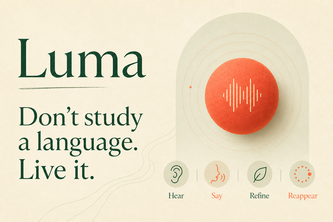
Luma is a self-reported AI language learning product for busy adults. The description states it uses AI to turn real-life moments into three-minute learning loops focused on communication and memory transfer, rather than vocabulary lists or traditional lessons.
What changed
The author reports building a prototype during OpenAI Build Week using tools like Codex, GPT-5.6 Terra, Cloudflare Workers, React, and browser speech recognition. It is presented as a functional demo with no evidence of revenue, customers, or adoption.
Single most important open question
Is there any evidence that busy adults actually want or use this type of language learning experience — or that the described AI coaching mechanism works in practice?
What The Product Actually Is
The description states:
- Luma is a personal AI language teacher for busy adults.
- It turns real-life moments (e.g., ordering coffee, handling an airport change) into three-minute hear-speak-refine-remember loops.
- It supports eight target languages and uses browser-based speech recognition and text-to-speech.
- The system integrates GPT-5.6 Terra to provide structured coaching feedback including praise, one refinement, a natural version of the expression, and a memory hook.
- It includes a visual memory map and stores learning preferences locally on the device.
Inference The product appears to be a browser-based prototype that simulates an AI language coach using voice interaction and AI-generated feedback. It is not described as a commercial service or platform with users or subscriptions.
Positioning & Claim Evolution
The description states:
- Luma began with the question: “What if the learner’s life—not a syllabus—became the curriculum?”
- It positions itself as different from traditional language courses by optimizing for communication and long-term transfer, not lesson completion.
- It emphasizes protecting learner confidence, avoiding overload, and reinforcing learning through context-based repetition.
Inference The positioning is centered on solving adult language learning pain points related to time, recall, and real-world application — rather than content delivery or formal instruction.
Target Customer & ICP
The description states:
- Luma targets busy adults who struggle with fragmented time, weak recall, no language environment, and no patience for long courses.
- It is designed for people who fail at language learning not due to lack of motivation but due to traditional course design.
Inference The ICP appears to be working professionals or learners with limited time and a need for practical, context-based language practice — though no specific persona or segmentation data is provided.
Business Model & Pricing Evidence
Not evidenced.
The description does not mention any pricing model, monetization strategy, or commercial structure beyond the prototype being built during a hackathon.
Technical & Delivery Signals
The description states:
- Built with React, Vite, Cloudflare Workers, browser speech recognition, text-to-speech, and GPT-5.6 Terra.
- Uses structured outputs from OpenAI models via a secure server-side worker.
- Supports fallbacks for microphone or AI service unavailability.
- Learner data is stored locally in browser storage (localStorage).
- The system integrates the Responses API with fallback to Chat Completions JSON mode.
Inference The technical stack suggests a lightweight, browser-based prototype with server-side AI orchestration and local data persistence. It is not described as a scalable or production-ready platform.
Traction & Maturity Signals
Not evidenced.
There is no mention of users, customers, revenue, usage metrics, or product adoption beyond the prototype being built in a hackathon.
Competitive Context
Not evidenced.
The description does not reference competitors, market size, or positioning relative to existing language learning tools.
Open Questions & Risks
Risks
- The product is described as a prototype built in one week — no evidence of long-term development or user testing.
- It relies on GPT-5.6 Terra, which is not independently verified and may not be available for production use.
- No evidence of real-world validation or learner feedback beyond the author’s own account.
Open Questions
- The entire description is self-reported with no external verification.
- No mention of user acquisition, retention, or monetization strategies.
- The claim that “adult language learning is not mainly a content problem” lacks supporting data.
Questions the description leaves open
- What specific feedback have you received from real adult learners about this approach?
- How do you plan to validate the effectiveness of the AI coaching mechanism in practice?
- Are there any plans for user testing or pilot programs with actual language learners?
- What is your roadmap for moving beyond a prototype to a scalable product?
- Do you have any data on how users interact with the memory map or reinforcement features?
- How do you intend to monetize this product, and what pricing model are you considering?
Overall Assessment
Not evidenced.
There is no evidence of funding rounds, valuation, team traction, or commercial viability beyond a hackathon prototype. The description does not indicate whether the project has moved beyond proof-of-concept or whether there is any interest from investors or partners.
Confidence Level Low. This analysis is based entirely on self-reported information with no external validation or evidence of product-market fit, traction, or commercial readiness.
User Stories BotA demo video on every pull request
Get a demo video on every new feature
GitHub App that watches your pull requests and records a narrated, captioned demo.
Save time on demo prep and make informed decisions faster with a video walkthrough of every new feature.
Source
Submitted to the OpenAI 2026 hackathon on Devpost. Project home on Devpost. Back to the full gallery on Devpost.
This competitive analysis was produced by top-founders.com (opens in a new tab)
Generated by a language model from this project's public Devpost page — its tagline, the author's own write-up and any built-with tags listed there — as captured in August 2026. Short quotations are the author's words. It is an opinion on the idea as a business, not on the people behind it, and it reflects the description as published then. If the project has moved on, request a correction below. The analysis is not independent research and contains no verified traction, revenue or customer data.
An independent guide by KFG International LLC — not affiliated with, endorsed by, or connected to Devpost or OpenAI.