

Archive position — measured, not model output
1 like on Devpost
505 of the 7,850 archived projects have more likes, and 1,758 share exactly 1 — so this project's #1,397 place in the like-ranked listing is a tie-break inside that group, not a ranking.
Projects (log scale)
Likes on Devpost. ▲ marks this project's group.
Show the figures
| Likes | Projects | Share of archive |
|---|---|---|
| 0 | 5,587 | 71.2% |
| 1 | 1,758 | 22.4% |
| 2 | 284 | 3.6% |
| 3–4 | 132 | 1.7% |
| 5–9 | 75 | 1.0% |
| 10+ | 14 | 0.2% |
 User Stories BotA demo video on every pull request
Get a demo video on every new feature
GitHub App that watches your pull requests and records a narrated, captioned demo.
Save time on demo prep and make informed decisions faster with a video walkthrough of every new feature.
Executive Summary
What the company appears to be
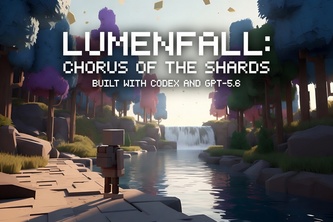
Lumenfall: Chorus of the Shards is a self-developed browser-based low-poly sci-fi survival game built by one developer (Lasa Karu). The project is described as a playable action-adventure with procedural world generation, combat systems, exploration, and early multiplayer capabilities. It was submitted to the OpenAI 2026 hackathon.
What changed
The author states that this is a fully playable game loop, not a demo or prototype. It includes features like first-person and third-person views, enemy waves, resource collection, crafting, building defenses, and mission progression. The project evolved from an idea into a working implementation using tools such as Three.js, JavaScript, HTML/CSS, Codex, and GPT-5.6.
The single most important open question
Is there any evidence of user engagement, monetization, or traction beyond the developer’s own account?
This analysis is based entirely on the self-reported description provided by the author. No external verification or historical data is available.
What The Product Actually Is
- The description states that Lumenfall: Chorus of the Shards is a browser-based low-poly sci-fi survival game.
- It runs in the browser and uses Three.js, JavaScript, HTML, CSS, and procedural generation techniques for its world elements.
- The game includes systems such as:
- First-person and third-person views
- Enemy waves and combat
- Resource collection and crafting
- Building placement and defense
- Rover usage
- Portal destinations and mission progression
- It also features:
- Procedural terrain, shaders, animated grass and water
- AI enemies, weapons, sound effects, and UI elements
- A local Node.js server and early WebSocket multiplayer foundation
This is a self-reported description of the product. No independent validation or technical documentation beyond the author’s account exists.
Positioning & Claim Evolution
- The author positions Lumenfall as an action-adventure game that blends combat with exploration, focusing on restoration and discovery.
- It aims to offer a colorful, approachable experience without requiring large downloads or expensive assets.
- The game is described as being inspired by low-poly sci-fi worlds, including alien landscapes, glowing tech, and explorers discovering places beyond safe zones.
- The author claims that the project shows how a rich interactive world can be built in a browser, using minimal resources.
These are claims made by the author. There is no evidence of market positioning or customer feedback to support these assertions.
Target Customer & ICP
- The description states that Lumenfall targets players who want a colorful, approachable action adventure that works directly in a browser.
- It implies appeal to fans of low-poly aesthetics, exploration-based gameplay, and browser-based games.
- No specific demographic or segment data is provided.
No evidence of target customer segmentation, personas, or user research exists.
Business Model & Pricing Evidence
- There is no mention of a business model or pricing strategy in the description.
- The project appears to be a personal development effort, not a commercial product.
- No revenue streams, monetization plans, or paid features are described.
Not evidenced. No indication of any commercial intent beyond personal creation.
Technical & Delivery Signals
- Built using:
- Three.js
- JavaScript
- HTML/CSS
- Codex (for implementation assistance)
- GPT-5.6 (for planning and design guidance)
- Uses procedural generation for terrain, trees, buildings, creatures, etc.
- Includes:
- Camera modes
- Enemy AI
- Weapons and combat systems
- Save/load functionality
- Audio and visual effects
- Early multiplayer support via WebSocket relay
The technical stack and implementation details are self-reported. No evidence of scalability or production readiness.
Traction & Maturity Signals
- The project is described as a fully playable game loop, not a prototype.
- It includes:
- Mission structure
- Combat feedback
- Progression systems
- Save/load mechanics
- The author notes accomplishments such as:
- Coherent gameplay loop
- Technical achievements (shaders, water, AI)
- Multiplayer foundation
- No evidence of user engagement, downloads, or usage metrics.
Not evidenced. The project is described as complete but lacks any signs of traction or adoption.
Competitive Context
- The author does not reference competitors or similar products.
- The game falls within the browser-based low-poly sci-fi survival genre, which may overlap with indie titles like Terraria, Stardew Valley, or Subnautica in terms of theme and platform.
- No competitive analysis, market positioning, or differentiation strategy is provided.
Not evidenced. No information on existing competition or market dynamics.
Open Questions & Risks
- The project is single-developer, which raises concerns about scalability, maintenance, and long-term viability.
- There is no evidence of:
- Revenue
- Users
- Partnerships
- Funding
- Product-market fit
- The use of AI tools (Codex, GPT-5.6) during development suggests a personal hobby project, not a scalable business model.
- No mention of monetization or distribution strategy.
Risk of lack of traction and sustainability due to single-person development and absence of commercial evidence.
Questions the description leaves open
- What is the intended path from this prototype to a monetized product?
- Are there any plans for community engagement, user feedback, or analytics collection?
- How does the developer plan to scale beyond one person if the project gains traction?
- Has the game been tested with real users outside of development?
- What are the long-term goals for multiplayer and social features?
These questions aim to uncover any commercial intent or future plans that are not evident in the current description.
Overall Assessment
- The project is described as a personal, self-developed game with no evidence of commercial traction or monetization.
- It is presented as a technical demonstration, not a business venture.
- There is no indication of revenue, customers, or market validation.
Not evidenced. No basis for investment or partnership consideration at this time.
User Stories BotA demo video on every pull request
Get a demo video on every new feature
GitHub App that watches your pull requests and records a narrated, captioned demo.
Save time on demo prep and make informed decisions faster with a video walkthrough of every new feature.
Source
Submitted to the OpenAI 2026 hackathon on Devpost. Project home on Devpost. Back to the full gallery on Devpost.
This competitive analysis was produced by top-founders.com (opens in a new tab)
Generated by a language model from this project's public Devpost page — its tagline, the author's own write-up and any built-with tags listed there — as captured in August 2026. Short quotations are the author's words. It is an opinion on the idea as a business, not on the people behind it, and it reflects the description as published then. If the project has moved on, request a correction below. The analysis is not independent research and contains no verified traction, revenue or customer data.
An independent guide by KFG International LLC — not affiliated with, endorsed by, or connected to Devpost or OpenAI.