

Archive position — measured, not model output
0 likes on Devpost
2,263 of the 7,850 archived projects have more likes, and 5,587 share exactly 0 — so this project's #3,358 place in the like-ranked listing is a tie-break inside that group, not a ranking.
Projects (log scale)
Likes on Devpost. ▲ marks this project's group.
Show the figures
| Likes | Projects | Share of archive |
|---|---|---|
| 0 | 5,587 | 71.2% |
| 1 | 1,758 | 22.4% |
| 2 | 284 | 3.6% |
| 3–4 | 132 | 1.7% |
| 5–9 | 75 | 1.0% |
| 10+ | 14 | 0.2% |
 User Stories BotA demo video on every pull request
Get a demo video on every new feature
GitHub App that watches your pull requests and records a narrated, captioned demo.
Save time on demo prep and make informed decisions faster with a video walkthrough of every new feature.
Executive Summary
What the company appears to be
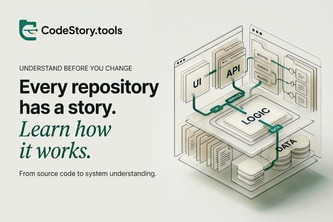
CodeStory.tools is a self-reported tool that claims to transform public GitHub repositories into structured learning experiences using AI. The author states it maps architecture, UI, APIs, functions, and data contracts from source code, with guided questions and safe CodeLab exercises.
What changed
The project description shows an evolution from a general problem (difficulty understanding unfamiliar code) to a specific solution (structured mapping of repositories via static analysis and AI). It reflects a shift toward grounding explanations in source evidence rather than inference or guesswork.
Single most important open question
Is there any evidence of actual usage, user feedback, or traction beyond the author's own submission? The description contains no data on adoption, revenue, or customer engagement — only claims about functionality and design principles.
What The Product Actually Is
The description states that CodeStory.tools turns public GitHub repositories into a structured learning experience. It offers:
- A map of architecture areas (frontend, APIs, middleware, backend services, data, supporting code)
- UI inspector showing elements, components, handlers, props, imports, classes, and nearby source
- Endpoint and data-contract maps from route declarations and schemas
- Function explorer, feature traces, and change-impact views
- Guided learning routes to prove understanding instead of just reading summaries
- CodeLab: a safe reconstruction exercise that does not execute the original repository
It uses static analysis and AI (Codex with GPT-5.6) to process repositories without running untrusted scripts or installing dependencies.
Evidence Self-reported by the author
Confidence Low — no independent verification, no demonstration, no usage data
Positioning & Claim Evolution
The author positions CodeStory.tools as a tool for understanding unfamiliar codebases in a source-grounded way. The initial problem is framed as: “It is easier than ever to generate, clone, deploy, and share a project. But when someone asks, ‘How does this actually work?’ it is still hard to explain the full system.”
The evolution of the claim is from general frustration with code comprehension to a specific product that maps systems using static analysis and AI.
Evidence Self-reported by the author
Confidence Low — no external validation or prior positioning history
Target Customer & ICP
The description does not name specific customers or personas. However, it implies an audience of developers who want to understand unfamiliar codebases quickly and safely.
It is implied that users are likely engineers working with open-source projects, learning new technologies, or exploring repositories for integration or reuse.
Evidence Inferred from the problem statement
Confidence Low — no explicit customer segmentation or ICP defined
Business Model & Pricing Evidence
There is no evidence of a business model or pricing structure in the description. The author mentions that the core experience works without an API key and optionally supports other models like Gemini or local Ollama.
Evidence Not evidenced
Confidence Very low — no commercial details provided
Technical & Delivery Signals
The product is built with:
- Codex
- GPT-5.6 (as development partner)
- JavaScript, Node.js
- OpenAI APIs
- REST API
- Vercel deployment
It uses deterministic static analysis for core functionality and allows optional deeper natural-language explanations via other tools.
Safety features include:
- No execution of untrusted scripts
- No installation of dependencies
- No access to secrets or project services
- Clear distinction between source-proven facts and inferred information
Evidence Self-reported by the author
Confidence Low — no technical architecture diagrams, performance data, or delivery history
Traction & Maturity Signals
There is no evidence of traction, revenue, or user adoption beyond the author’s own submission. The project was submitted to the OpenAI 2026 hackathon on Devpost.
Evidence Not evidenced
Confidence Very low — no metrics, users, or product usage data
Competitive Context
The description does not mention competitors or a competitive landscape. It implies that existing tools either fail to provide source-grounded explanations or rely too heavily on inference and guesswork.
Evidence Not evidenced
Confidence Low — no market analysis or competitive differentiation stated
Open Questions & Risks
- No traction or user feedback: The product exists only as a self-reported concept with no evidence of adoption.
- Unverified claims: All functionality is described by the author without independent corroboration.
- Unclear monetization strategy: No business model, pricing, or revenue path is evident.
- Limited scope: Only public GitHub repositories are supported; no indication of enterprise or private repo support.
- AI dependency: Reliance on GPT-5.6 and Codex may limit scalability or introduce accuracy risks.
Evidence Inferred from lack of evidence
Confidence Medium — based on absence of key signals
Questions the description leaves open
- What is the actual user feedback or usage data you’ve gathered so far?
- How do you plan to scale beyond a hackathon-level prototype?
- Are there any private repositories or enterprise use cases in scope?
- What are your plans for monetization and pricing?
- How do you handle edge cases in repository types (e.g., notebooks, CLI tools, documentation-only repos)?
- Can you demonstrate how the static analysis works with a real example?
Overall Assessment
The description presents a self-reported idea with strong design principles around grounding explanations in source code and safety. However, there is no evidence of traction, revenue, or even basic product usage.
This appears to be an early-stage concept submitted as part of a hackathon — not yet a product with commercial viability or market validation.
Assessment Not ready for investment or partnership without further evidence of traction, user feedback, or business model development.
Confidence Very low — based entirely on self-reported claims and no external data.
User Stories BotA demo video on every pull request
Get a demo video on every new feature
GitHub App that watches your pull requests and records a narrated, captioned demo.
Save time on demo prep and make informed decisions faster with a video walkthrough of every new feature.
Source
Submitted to the OpenAI 2026 hackathon on Devpost. Project home on Devpost. Back to the full gallery on Devpost.
This competitive analysis was produced by top-founders.com (opens in a new tab)
Generated by a language model from this project's public Devpost page — its tagline, the author's own write-up and any built-with tags listed there — as captured in August 2026. Short quotations are the author's words. It is an opinion on the idea as a business, not on the people behind it, and it reflects the description as published then. If the project has moved on, request a correction below. The analysis is not independent research and contains no verified traction, revenue or customer data.
An independent guide by KFG International LLC — not affiliated with, endorsed by, or connected to Devpost or OpenAI.