

Archive position — measured, not model output
0 likes on Devpost
2,263 of the 7,850 archived projects have more likes, and 5,587 share exactly 0 — so this project's #7,284 place in the like-ranked listing is a tie-break inside that group, not a ranking.
Projects (log scale)
Likes on Devpost. ▲ marks this project's group.
Show the figures
| Likes | Projects | Share of archive |
|---|---|---|
| 0 | 5,587 | 71.2% |
| 1 | 1,758 | 22.4% |
| 2 | 284 | 3.6% |
| 3–4 | 132 | 1.7% |
| 5–9 | 75 | 1.0% |
| 10+ | 14 | 0.2% |
 User Stories BotA demo video on every pull request
Get a demo video on every new feature
GitHub App that watches your pull requests and records a narrated, captioned demo.
Save time on demo prep and make informed decisions faster with a video walkthrough of every new feature.
Executive Summary
What the company appears to be
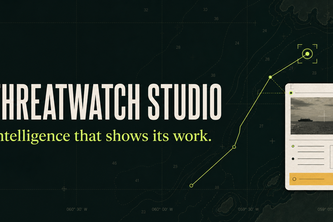
ThreatWatch Studio is a self-reported tool that generates executive intelligence briefs from open-source reporting about fast-moving risks. It claims to make AI-generated summaries inspectable and trustworthy by showing source metadata, reasoning for inclusion or exclusion of evidence, and model method details.
What changed
The author built this during a hackathon (Build Week) using GPT-5.6, with a focus on traceability and transparency in AI workflows. It was designed to show how an intelligence brief can be made trustworthy through visibility into its data pipeline and inference process.
Single most important open question — the commercial due-diligence read
Is there evidence of real-world demand or traction from target users beyond the author’s own use case, or is this a proof-of-concept that has not yet been validated in practice?
What The Product Actually Is
The description states that ThreatWatch Studio:
- Turns open-source reporting into an inspectable executive brief.
- Offers four seeded scenarios: Strait of Hormuz, Taiwan Strait, Gulf Coast hurricane season, and Play ransomware campaign.
- Allows users to inspect claims by clicking on underlined sourced statements or MODELED labels.
- Shows evidence windows including source dates, retrieval metadata, original documents, and model method details.
- Supports recutting the same evidence for different audience profiles (analyst, insurer, travel operator, logistics team).
- Includes a desk-curated watchboard with official-source headlines treated similarly to user-generated content.
- Maps product behaviors to NIST AI Risk Management Framework and NIST AI 600-1 Generative AI Profile.
Inference The tool appears to be an early-stage prototype built for demonstration purposes, likely intended to showcase a new approach to AI transparency in intelligence workflows.
Positioning & Claim Evolution
The author claims:
- The product aims to restore trust in AI summaries by enabling readers to fact-check as they go.
- It distinguishes between sourced facts and modeled judgments.
- Every AI run has receipts — i.e., it shows how the model was prompted, what response was generated, and how tokens were used.
Inference This positioning reflects a shift from generic AI summarization tools toward a more accountable and transparent AI workflow. However, no evidence exists that this is a product already adopted or tested by users beyond the author's own use case.
Target Customer & ICP
The description states:
- The tool supports four audience profiles: analyst, domestic insurer, international travel operator, or logistics and shipping team.
- It was built to support risk, insurance, travel, and logistics teams in a pilot phase.
Inference The target customer segments appear to be professionals working in high-risk environments where decision-making relies on timely, credible intelligence. However, no evidence of actual customers or user feedback is provided.
Business Model & Pricing Evidence
The description states:
- The next step is paid pilot use with a small number of teams.
- Future product work includes customer-configurable curated source packs and organization-scoped workspaces.
- No pricing information or commercial model is mentioned.
Inference There is no evidence of a functioning business model or pricing structure at this stage. The project appears to be in the early validation phase, with plans for pilot testing before full commercialization.
Technical & Delivery Signals
The description states:
- Built using TypeScript, React, Next.js, vinext/Vite, Tailwind CSS, OpenAI Responses API, and Cloudflare Workers.
- Uses GPT-5.6 for core workflows: source triage, structured claim extraction, sourced-versus-modeled classification, BLUF drafting, and estimative-language pass.
- The demo replays audited captures so judges don’t need an API key but keeps response/request identifiers visible.
- Includes deterministic fixtures, tests, setup guidance, and a dated build log.
- Repository is MIT licensed.
Inference The technical stack suggests a modern web application built with AI integration. However, no evidence of scalability, performance metrics, or production deployment beyond the demo exists.
Traction & Maturity Signals
The description states:
- The project was submitted to the OpenAI 2026 hackathon.
- It includes 16 verified GPT-5.6 captures across four scenarios and four profiles.
- A recorded video shows an evidence window ending July 17, 2026.
- The live site has been corrected since that date.
Inference There is no evidence of traction or adoption beyond the author’s own use case or hackathon submission. No revenue, customer base, or usage data are reported.
Competitive Context
The description does not mention any competitors directly.
Inference No competitive analysis or positioning against existing tools in the AI intelligence, risk management, or briefing space is provided. The tool seems to be positioned as a novel approach to transparency in AI-generated summaries, but no market context is given.
Open Questions & Risks
- Lack of traction or validation: No evidence of real-world use or customer feedback.
- Unproven business model: No pricing, revenue, or monetization strategy described.
- Limited scope: Features like organization workspaces and multi-user signals are not yet implemented.
- Self-reported only: All claims are unverified; no third-party validation or independent audits.
- Prototype nature: The tool is presented as a demo and proof-of-concept rather than a production-ready product.
Questions the description leaves open
- What specific use cases have you identified for ThreatWatch Studio beyond the four scenarios described?
- Have you conducted any pilot testing with actual users from your target industries (risk, insurance, travel, logistics)?
- How do you plan to scale the sourcing and curation of content for different risk scenarios?
- What are the key challenges in transitioning from a demo to a full commercial product?
- Are there any legal or compliance considerations around using GPT-5.6 in intelligence workflows?
Overall Assessment
The description states that ThreatWatch Studio is a prototype built during a hackathon, with no evidence of traction, revenue, or customer validation.
Assessment Not evidenced — the project lacks commercial due-diligence signals such as revenue, customers, or adoption. It appears to be an early-stage idea or proof-of-concept, not a validated product or business. Any investment or partnership decision should be based on further validation of market demand and user feedback before proceeding.
User Stories BotA demo video on every pull request
Get a demo video on every new feature
GitHub App that watches your pull requests and records a narrated, captioned demo.
Save time on demo prep and make informed decisions faster with a video walkthrough of every new feature.
Source
Submitted to the OpenAI 2026 hackathon on Devpost. Project home on Devpost. Back to the full gallery on Devpost.
This competitive analysis was produced by top-founders.com (opens in a new tab)
Generated by a language model from this project's public Devpost page — its tagline, the author's own write-up and any built-with tags listed there — as captured in August 2026. Short quotations are the author's words. It is an opinion on the idea as a business, not on the people behind it, and it reflects the description as published then. If the project has moved on, request a correction below. The analysis is not independent research and contains no verified traction, revenue or customer data.
An independent guide by KFG International LLC — not affiliated with, endorsed by, or connected to Devpost or OpenAI.