

Archive position — measured, not model output
0 likes on Devpost
2,263 of the 7,850 archived projects have more likes, and 5,587 share exactly 0 — so this project's #5,076 place in the like-ranked listing is a tie-break inside that group, not a ranking.
Projects (log scale)
Likes on Devpost. ▲ marks this project's group.
Show the figures
| Likes | Projects | Share of archive |
|---|---|---|
| 0 | 5,587 | 71.2% |
| 1 | 1,758 | 22.4% |
| 2 | 284 | 3.6% |
| 3–4 | 132 | 1.7% |
| 5–9 | 75 | 1.0% |
| 10+ | 14 | 0.2% |
 User Stories BotA demo video on every pull request
Get a demo video on every new feature
GitHub App that watches your pull requests and records a narrated, captioned demo.
Save time on demo prep and make informed decisions faster with a video walkthrough of every new feature.
Executive Summary
What the company appears to be
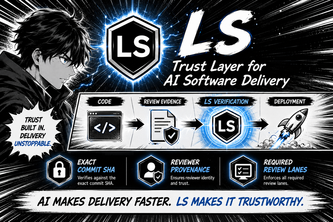
LS — Trust Layer for AI Software Delivery — is a self-reported developer security tool that evaluates trust in software delivery by binding approvals, reviewer identity, and required checks to the exact commit being released. It is described as a "trust layer" that operates within CI/CD workflows, using Python, pytest, Docker, GitHub Actions, and OpenAI Codex with GPT-5.6.
What changed
The project was submitted to the OpenAI 2026 hackathon. The description indicates it emerged from a specific problem: AI-generated software delivery introduces new trust issues where approvals may not be tied to the correct commit or reviewer identity, and checks may be stale or missing. The solution is described as a deterministic, fail-closed verification engine that validates commit SHA, review evidence, reviewer provenance, and required lanes.
Single most important open question
Is there any evidence of real-world usage, adoption, or traction beyond the author’s own development and demo? The description states no revenue, customers, or live deployment data are available. The project is presented as a proof-of-concept or prototype, not a product in production.
What The Product Actually Is
The description states that LS is a trust layer for AI software delivery. It is described as a tool that evaluates delivery evidence before it can influence a release decision. It verifies:
- the exact expected commit SHA;
- whether review evidence belongs to the current commit;
- reviewer provenance;
- required review lanes;
- deterministic reason codes;
- complete PASS, FAIL, and NOT_RUN handling.
It is built using Python, pytest, Docker, GitHub Actions, and OpenAI Codex with GPT-5.6. It operates in a clean-room Docker workflow that resolves the exact source SHA, checks out the commit, runs tests, and builds an image to verify trust decisions.
The system is described as failing closed when evidence is stale, incomplete, or untrusted.
Inference LS appears to be a developer-focused security tool designed to prevent unsafe deployments by enforcing strict verification of code state, reviewer identity, and required checks in CI/CD pipelines. It is not a deployment tool itself but a validation layer that can be integrated into existing workflows.
Positioning & Claim Evolution
The author states that LS was inspired by the problem that AI-generated software delivery introduces new trust issues — approvals may be for older commits, reviewers may lack identity verification, or required checks may not have run. The core idea is to bind approval and check evidence to the exact commit being released.
The positioning is that LS is a trust layer that ensures only trusted code can be deployed, using an “attack → detect → block” model.
It is described as not adding autonomous merge or deployment authority but instead acting as a gatekeeper for trust decisions.
Inference LS positions itself as a security enhancement to AI-driven software delivery pipelines. It is not a full CI/CD platform, nor a deployment tool, but a verification layer that can be integrated into existing workflows.
Target Customer & ICP
The description states that LS is built for developer security workflows, particularly those involving AI-generated software and CI/CD pipelines. It is described as a tool for developers working in environments where trust in code delivery is critical.
It is not explicitly stated whether the target customer is individual developers, teams, or enterprises. However, its integration with GitHub Actions and Docker suggests it targets developers or DevOps teams using modern CI/CD infrastructure.
Inference The ICP (Ideal Customer Profile) likely includes developers or DevSecOps teams working in AI-enhanced software delivery environments, particularly those using GitHub Actions and Docker-based workflows.
Business Model & Pricing Evidence
No evidence of pricing, business model, or monetization strategy is provided. The description does not mention any revenue streams, subscription models, or commercial offerings.
Inference The project is described as a hackathon submission and prototype. No commercial business model is evident from the self-reported description.
Technical & Delivery Signals
LS is built using:
- Python;
- pytest;
- Docker;
- GitHub Actions;
- OpenAI Codex with GPT-5.6;
It uses a clean-room Docker workflow to ensure reproducibility and security.
The system verifies:
- exact commit SHA;
- reviewer provenance;
- required lanes;
- deterministic reason codes;
- PASS, FAIL, and NOT_RUN handling;
It is described as failing closed when evidence is stale or incomplete.
Inference LS appears to be a lightweight, developer-focused tool built for security verification in CI/CD pipelines. It uses modern DevOps tools and AI-assisted development for auditing and hardening.
Traction & Maturity Signals
The description states that LS:
- Passed 17 focused tests;
- Reproduced the project through a clean Docker workflow;
- Verified the exact source SHA before testing and building;
- Completed an independent Codex and GPT-5.6 audit;
- Has a public demo video and repository;
- Was submitted to the OpenAI 2026 hackathon.
There is no evidence of revenue, customers, or live deployment.
Inference LS is at a prototype or proof-of-concept stage. It has not demonstrated real-world usage or traction beyond its own development and demo.
Competitive Context
The description does not mention any direct competitors. However, LS operates in the DevSecOps space, where tools like:
- GitHub Actions;
- GitLab CI/CD;
- Snyk;
- Checkmarx;
- SonarQube;
are used for security and compliance in software delivery.
LS is described as a trust layer that can be integrated into existing workflows, not a replacement for these tools.
Inference LS is positioned as a complementary tool within the DevSecOps ecosystem. It does not appear to directly compete with CI/CD platforms but rather enhances their trust mechanisms.
Open Questions & Risks
- No evidence of traction or adoption: The project is described only as a hackathon submission and prototype.
- Unproven commercial viability: No pricing, revenue, or business model are evident.
- Limited scope: It is not clear how it integrates into existing workflows beyond GitHub Actions.
- AI dependency: Reliance on OpenAI Codex with GPT-5.6 may be a risk if access or performance changes.
- No third-party verification: The only audit mentioned is an internal Codex-based one.
Inference LS is not yet a product in production, and its commercial viability remains unproven. It is a concept that requires further development and real-world testing.
Questions the description leaves open
- What are the specific use cases or workflows where LS has been tested?
- Has it been integrated into any existing CI/CD pipelines beyond GitHub Actions?
- Are there plans to support other CI/CD providers (e.g., GitLab, Jenkins)?
- How does LS handle edge cases like merge conflicts or multi-commit PRs?
- What is the expected performance impact of running LS in a CI/CD pipeline?
- Is there any plan for monetization or commercial deployment?
- How does LS ensure that reviewer identity verification is robust and scalable?
Overall Assessment
Not evidenced.
The description states that LS is a hackathon submission and prototype, with no evidence of revenue, customers, or traction. It is described as a developer-focused security tool for AI software delivery, but there is no indication it has moved beyond the proof-of-concept stage.
Inference LS is not yet a viable investment or partnership opportunity based on the self-reported description. It may be a promising concept, but further development and evidence of traction are required before considering commercial viability.
User Stories BotA demo video on every pull request
Get a demo video on every new feature
GitHub App that watches your pull requests and records a narrated, captioned demo.
Save time on demo prep and make informed decisions faster with a video walkthrough of every new feature.
Source
Submitted to the OpenAI 2026 hackathon on Devpost. Project home on Devpost. Back to the full gallery on Devpost.
This competitive analysis was produced by top-founders.com (opens in a new tab)
Generated by a language model from this project's public Devpost page — its tagline, the author's own write-up and any built-with tags listed there — as captured in August 2026. Short quotations are the author's words. It is an opinion on the idea as a business, not on the people behind it, and it reflects the description as published then. If the project has moved on, request a correction below. The analysis is not independent research and contains no verified traction, revenue or customer data.
An independent guide by KFG International LLC — not affiliated with, endorsed by, or connected to Devpost or OpenAI.