

Archive position — measured, not model output
1 like on Devpost
505 of the 7,850 archived projects have more likes, and 1,758 share exactly 1 — so this project's #1,152 place in the like-ranked listing is a tie-break inside that group, not a ranking.
Projects (log scale)
Likes on Devpost. ▲ marks this project's group.
Show the figures
| Likes | Projects | Share of archive |
|---|---|---|
| 0 | 5,587 | 71.2% |
| 1 | 1,758 | 22.4% |
| 2 | 284 | 3.6% |
| 3–4 | 132 | 1.7% |
| 5–9 | 75 | 1.0% |
| 10+ | 14 | 0.2% |
 User Stories BotA demo video on every pull request
Get a demo video on every new feature
GitHub App that watches your pull requests and records a narrated, captioned demo.
Save time on demo prep and make informed decisions faster with a video walkthrough of every new feature.
Executive Summary
What the company appears to be
GridShatter is a browser-based tool that parses Terraform HCL configurations and CircleCI YAML pipelines into interactive architecture diagrams. It allows developers to visualize cloud infrastructure in real time, simulate security breaches, and run static security checks directly in the browser.
What changed
The project was built as part of a hackathon submission and is described as a proof-of-concept tool with no evidence of commercial traction or product-market fit beyond its author's personal development effort. It is not evidenced to have any revenue, customers, or adoption.
Single most important open question
Is there a viable market need for this type of interactive DevSecOps sandboxing, and does the author have a path to scaling beyond a single-person hackathon project?
What The Product Actually Is
The description states that GridShatter:
- Parses Terraform HCL code and CircleCI YAML pipelines in the browser.
- Converts raw code into dynamic, interactive architecture layouts using SVG.
- Runs threat attack simulations that highlight compromised nodes and network edges.
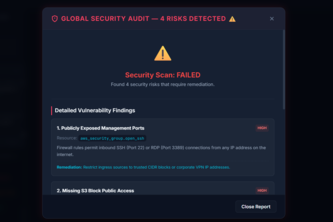
- Provides a static security scanner with diagnostic reports and remediation codes.
- Includes a "Practice Arcade" tab with 14 levels of hands-on cloud security challenges.
It is described as a client-side application built entirely in JavaScript, using technologies such as AST parsing, SVG layout engines, and retro terminal UI components. The tool is said to run entirely within the browser without sending data externally.
Evidence
- Author's own write-up.
- Technology tags: ast, circleci, cloud, css3, devsecops, html5, javascript, static, terraform, vite.
Inference The product appears to be a developer-focused sandboxing tool for visualizing and testing cloud infrastructure security in an interactive way. It is not evidenced to have any commercial deployment or user base.
Positioning & Claim Evolution
The author positions GridShatter as:
- A way to "shatter the cloud grid with breach drills, secure in real-time."
- A tool that makes static HCL configurations come alive and helps developers understand how attackers exploit vulnerabilities.
- An alternative to traditional static analyzers like tfsec or Checkov, which are described as “dry” and ignored by most developers.
The project claims to:
- Visualize infrastructure and security threats dynamically.
- Gamify cloud security learning through a practice arcade.
- Enable real-time breach simulations in the browser.
Evidence
- Tagline: "Shatter the cloud grid with breach drills, secure in real-time."
- Author's write-up: “Seeing an S3 bucket or an EC2 instance turn red and animate the exploit path makes security vulnerabilities real and urgent.”
Inference The product is positioned as a DevSecOps learning and simulation tool aimed at developers who want to understand cloud architecture and security risks visually. It is not evidenced to have evolved beyond a single-person hackathon prototype.
Target Customer & ICP
The description states that GridShatter targets:
- Developers working with Terraform configurations.
- Teams looking for more intuitive ways to visualize and test cloud infrastructure.
- Individuals interested in learning cloud security through interactive challenges.
It is described as being built for those who find static security scanners unengaging or hard to interpret.
Evidence
- “I wanted to see my configurations come to life immediately as I typed.”
- “Most developers ignore them until something breaks.”
Inference The target customer appears to be individual developers or small teams in cloud-native environments, but no evidence of a defined ICP beyond the author’s personal use case.
Business Model & Pricing Evidence
There is no evidence provided about:
- A pricing model.
- Revenue streams.
- Monetization strategy.
- Subscription plans or licensing.
The project is described as a hackathon submission with no indication of commercial viability or monetization.
Evidence
- No mention of pricing, subscriptions, or sales.
- The tool is built to run client-side and does not appear to collect data or charge users.
Inference No business model or pricing evidence exists. The project is self-reported as a personal development effort with no commercial intent.
Technical & Delivery Signals
The author states that GridShatter:
- Uses a JavaScript-based AST parser for HCL.
- Implements a layout engine to position resources on an SVG canvas.
- Simulates breaches using SVG animations and retro terminal logs.
- Runs static security checks against common cloud misconfigurations.
- Is built entirely client-side with no backend or data transmission.
It is described as running in under a second and supporting:
- Single-file Terraform configurations.
- Multi-file workspaces (future goal).
- AWS IAM role trust policies.
- Docker Compose layouts (future goal).
Evidence
- “I built a lightweight AST parser in JavaScript that reads HCL configurations.”
- “The tool is engineered entirely client-side to ensure zero data leaves the browser.”
Inference The technical implementation is described as a client-side, browser-based sandbox. It lacks evidence of scalability or integration with larger platforms.
Traction & Maturity Signals
There is no evidence of:
- Revenue.
- Customers.
- Product usage metrics.
- Adoption.
- Any form of traction beyond the author’s own development.
The project is described as a hackathon submission and not evidenced to have moved past prototype stage.
Evidence
- Submitted to the OpenAI 2026 hackathon.
- Built by one person (Dhruvik Karena).
- No mention of users, feedback, or product releases.
Inference No traction or maturity signals are evident. The project is at a very early stage and not evidenced to have any commercial success.
Competitive Context
The author does not reference:
- Competitors.
- Existing tools in the DevSecOps or infrastructure visualization space.
- Market positioning relative to other platforms.
Evidence
- No mention of competitors or market analysis.
Inference No competitive context is provided. The tool’s place in the market is unknown, and there is no evidence of awareness of existing solutions like Terraform Cloud, Checkov, or other infrastructure visualization tools.
Open Questions & Risks
Key risks and open questions include:
- Single-person development: The project is described as built by one person with no team or support structure.
- No commercial traction: No evidence of revenue, customers, or adoption beyond the author’s own use.
- Limited scope: The tool is described as a hackathon prototype with no clear path to scaling or enterprise integration.
- Unproven market need: There is no evidence that developers or teams actually want or pay for this type of tool.
- Technical limitations: The project is client-side and may not scale well for complex, multi-file configurations.
Evidence
- Team size: 1.
- Submitted to a hackathon.
- No revenue or customer data.
Inference The risk of failure is high due to lack of traction, limited scope, and no clear commercial path. The tool is not evidenced to have addressed a market need beyond the author’s personal interest.
Questions the description leaves open
- What specific problem in DevSecOps or cloud infrastructure are you trying to solve?
- Have you validated this with any developers or teams outside of yourself?
- How do you plan to monetize this tool, and what is your go-to-market strategy?
- What are the technical limitations of running HCL parsing and simulation client-side at scale?
- Are there any plans for integrating with CI/CD pipelines or cloud platforms like AWS or GCP?
- What is your roadmap beyond the current hackathon prototype?
Overall Assessment
There is no evidence to support a commercial investment or partnership opportunity at this time.
The project is described as a single-person hackathon effort with no revenue, customers, or traction. It is not evidenced to have any product-market fit or scalable business model.
Evidence
- No revenue.
- No customers.
- No product adoption.
- No business model.
Inference This is a very early-stage idea with no commercial viability evidenced. It would require significant further development and market validation before any investment or partnership consideration could be justified.
User Stories BotA demo video on every pull request
Get a demo video on every new feature
GitHub App that watches your pull requests and records a narrated, captioned demo.
Save time on demo prep and make informed decisions faster with a video walkthrough of every new feature.
Source
Submitted to the OpenAI 2026 hackathon on Devpost. Project home on Devpost. Back to the full gallery on Devpost.
This competitive analysis was produced by top-founders.com (opens in a new tab)
Generated by a language model from this project's public Devpost page — its tagline, the author's own write-up and any built-with tags listed there — as captured in August 2026. Short quotations are the author's words. It is an opinion on the idea as a business, not on the people behind it, and it reflects the description as published then. If the project has moved on, request a correction below. The analysis is not independent research and contains no verified traction, revenue or customer data.
An independent guide by KFG International LLC — not affiliated with, endorsed by, or connected to Devpost or OpenAI.