

Archive position — measured, not model output
0 likes on Devpost
2,263 of the 7,850 archived projects have more likes, and 5,587 share exactly 0 — so this project's #3,115 place in the like-ranked listing is a tie-break inside that group, not a ranking.
Projects (log scale)
Likes on Devpost. ▲ marks this project's group.
Show the figures
| Likes | Projects | Share of archive |
|---|---|---|
| 0 | 5,587 | 71.2% |
| 1 | 1,758 | 22.4% |
| 2 | 284 | 3.6% |
| 3–4 | 132 | 1.7% |
| 5–9 | 75 | 1.0% |
| 10+ | 14 | 0.2% |
 User Stories BotA demo video on every pull request
Get a demo video on every new feature
GitHub App that watches your pull requests and records a narrated, captioned demo.
Save time on demo prep and make informed decisions faster with a video walkthrough of every new feature.
Executive Summary
What the company appears to be
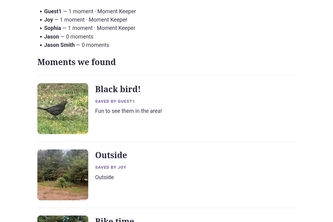
Capsule AI is a self-reported temporary digital experience platform that enables groups to collaboratively collect discoveries, memories, and media during purpose-driven events (e.g., nature expeditions, school trips, family vacations). The platform uses AI to enrich these experiences and generates a final archive before automatically deleting all data upon expiration.
What changed
The project evolved from an initial idea focused on a butterfly-spotting field book into a broader concept of temporary, AI-powered digital spaces for various real-world events. It was built as a mobile-first web application using AI-assisted development tools and cloud infrastructure.
Single most important open question
Does the platform have any evidence of user adoption or revenue generation beyond its initial prototype used during family adventures?
Note: This analysis is based solely on the self-reported, unverified project description provided by the author. No third-party verification, traction data, customer names, or financials are available.
What The Product Actually Is
- The description states that Capsule AI creates temporary AI-powered experiences called "Capsules."
- Participants contribute media and observations during an event.
- AI enriches the experience through identification, summaries, progress tracking, achievements, and story generation.
- At the end of the capsule, a final downloadable memory package is generated before automatic deletion of data.
Inference: The product appears to be a lightweight, temporary digital workspace for collaborative discovery in real-world settings. It is not described as a long-term storage or archival tool.
Positioning & Claim Evolution
- The author claims the platform was inspired by family nature adventures and aims to create "temporary digital spaces" for events with defined beginnings, middles, and ends.
- Initial focus was on a simple field book for butterfly spotting.
- Over time, it evolved into a more flexible model applicable to various event types (school trips, festivals, research expeditions).
- The platform positions itself as an alternative to software that lasts forever, emphasizing the value of closure and meaningful endings.
Inference: The positioning reflects a shift from niche use case to broader applicability across different kinds of temporary experiences. However, there is no evidence of how this positioning has been tested or validated in the market beyond personal use cases.
Target Customer & ICP
- The description mentions that the platform was initially used during "actual family adventures."
- It targets users who participate in events with a clear purpose and duration such as:
- Family vacations
- School excursions
- Scout camps
- Research expeditions
- Festivals and events
- The user base includes both individuals and groups engaging in shared discovery or learning.
Inference: The ICP seems to be primarily families, educators, and event organizers who value collaborative, temporary digital experiences. No specific demographic data or segmentation is provided.
Business Model & Pricing Evidence
- Not evidenced.
- There is no mention of pricing models, monetization strategies, or revenue streams in the description.
- The platform is described as a prototype used during personal events without indication of commercial use or paid features.
Finding: No evidence of business model or pricing structure. The author does not describe any mechanism for generating income from the product.
Technical & Delivery Signals
- Built as a mobile-first web application using:
- HTML, CSS, JavaScript
- Cloud Run deployment
- PostgreSQL database and object storage
- AI services (OpenAI, Claude, etc.)
- Used AI-assisted development to iterate quickly.
- Original proof of concept focused on a butterfly spotting challenge.
- Designed for real-world use with responsive mobile design.
Inference: The technical stack suggests a modern, scalable architecture suitable for web-based collaboration. However, no details are given about scalability, performance, or infrastructure robustness beyond the prototype stage.
Traction & Maturity Signals
- The platform was used during actual family adventures.
- A working application exists and has been tested in real-world settings.
- The team built a functional prototype and demonstrated its utility in nature discovery challenges.
- No evidence of customer acquisition, retention metrics, or user growth beyond personal use.
Finding: Traction is limited to internal usage and early prototyping. There is no indication of external adoption or measurable engagement from users outside the founding team.
Competitive Context
- Not evidenced.
- The description does not reference existing competitors or similar platforms.
- No mention of how Capsule AI differentiates itself from other tools for memory capture, collaboration, or event planning.
Finding: No competitive landscape is described. It's unclear whether there are comparable solutions in the market.
Open Questions & Risks
- The platform is described as a prototype used only during family adventures — no evidence of broader adoption.
- No revenue model or monetization strategy is evident.
- The team size is listed as one person (Jason Smith), raising questions about scalability and execution capacity.
- AI-generated content raises concerns about cost predictability, especially if usage scales.
- The focus on temporary experiences may limit long-term viability unless there's a clear path to recurring value.
Inference: Risks include lack of traction, unclear monetization, limited team resources, and potential technical or financial challenges in scaling beyond the prototype phase.
Questions the description leaves open
- What specific metrics do you track for user engagement or retention?
- How do you plan to scale beyond a single founder and personal use cases?
- Have you identified any paying customers or early adopters outside of family use?
- What is your strategy for managing AI costs as usage increases?
- Are there any legal or privacy considerations around data deletion policies that need to be addressed?
- How do you envision integrating third-party AI services without over-relying on external providers?
Overall Assessment
- Not evidenced.
- There is no indication of funding rounds, valuation, or investment interest.
- No evidence of commercial traction, revenue, or strategic partnerships.
Assessment: Based on the self-reported description alone, there is insufficient evidence to support a conclusion about whether this project warrants further due diligence or investment consideration. The platform shows promise in concept but lacks any measurable progress toward market validation or monetization.
User Stories BotA demo video on every pull request
Get a demo video on every new feature
GitHub App that watches your pull requests and records a narrated, captioned demo.
Save time on demo prep and make informed decisions faster with a video walkthrough of every new feature.
Source
Submitted to the OpenAI 2026 hackathon on Devpost. Project home on Devpost. Back to the full gallery on Devpost.
This competitive analysis was produced by top-founders.com (opens in a new tab)
Generated by a language model from this project's public Devpost page — its tagline, the author's own write-up and any built-with tags listed there — as captured in August 2026. Short quotations are the author's words. It is an opinion on the idea as a business, not on the people behind it, and it reflects the description as published then. If the project has moved on, request a correction below. The analysis is not independent research and contains no verified traction, revenue or customer data.
An independent guide by KFG International LLC — not affiliated with, endorsed by, or connected to Devpost or OpenAI.