

Archive position — measured, not model output
0 likes on Devpost
2,263 of the 7,850 archived projects have more likes, and 5,587 share exactly 0 — so this project's #3,116 place in the like-ranked listing is a tie-break inside that group, not a ranking.
Projects (log scale)
Likes on Devpost. ▲ marks this project's group.
Show the figures
| Likes | Projects | Share of archive |
|---|---|---|
| 0 | 5,587 | 71.2% |
| 1 | 1,758 | 22.4% |
| 2 | 284 | 3.6% |
| 3–4 | 132 | 1.7% |
| 5–9 | 75 | 1.0% |
| 10+ | 14 | 0.2% |
 User Stories BotA demo video on every pull request
Get a demo video on every new feature
GitHub App that watches your pull requests and records a narrated, captioned demo.
Save time on demo prep and make informed decisions faster with a video walkthrough of every new feature.
Executive Summary
What the company appears to be
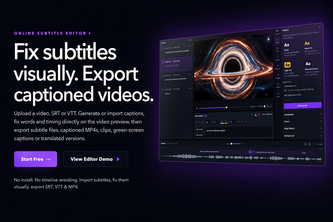
Captn Generative Video Studio is a browser-based video editing tool that allows creators to generate videos from text prompts, refine or extend them shot-by-shot, and then transcribe, style, translate, and export captions — all within one interface. It integrates with generative AI models (Seedance, Kling, Veo) and supports video extension using reference frames.
What changed
The project was submitted as a hackathon entry to the OpenAI 2026 hackathon on Devpost. It is described as a proof-of-concept or prototype built in a short timeframe, not yet a commercial product.
Single most important open question
Is there evidence of traction, revenue, or customer adoption beyond the author’s own description?
This analysis is based entirely on the self-reported and unverified project description provided by the author. No third-party verification, archived data, or independent sources are available. All claims are attributed to the author's own submission.
What The Product Actually Is
The description states that Captn Generative Video Studio:
- Turns a text prompt into an editable, caption-ready video.
- Allows creators to generate shots, make variations or continuations, and store results in a private library.
- Offers a subtitle editor for transcribing, styling, translating, and exporting captions.
- Can extend existing videos using reference frames from the last included frame of a source clip.
- Preserves subject, scene, lighting, camera direction, and motion during video extension when possible.
- Uses GenBlaze to orchestrate generation plans across supported GMI Cloud models.
- Stores media via Backblaze B2 with short-lived authorized URLs for access.
- Builds model-specific prompts that maintain continuity between shots.
The product is described as a browser-based studio integrating generative AI tools and editing workflows. It is not evidenced to have launched or be in production.
Positioning & Claim Evolution
The description states:
- Captn aims to streamline the video creation process from idea to finished, captioned video.
- It positions itself as a tool that "turns an idea into a finished, captioned video" using AI generation and editing features.
- The author emphasizes that generating a clip is only the first step — creators still need to refine, organize, add dialogue, caption, and export.
- Captn is described as offering a complete workflow: generate → refine or extend → caption → translate → export.
These claims reflect a positioning toward content creators who want an integrated AI video editing experience. No evidence of market validation or competitive differentiation beyond the author’s own narrative.
Target Customer & ICP
The description states:
- The primary users are "creators" — people who generate and edit videos.
- It supports both new video generation and extension of existing videos.
- It is designed for use in a browser, suggesting ease-of-access for individual or small teams.
No specific customer segments or personas are defined. The target ICP appears to be general content creators using generative AI tools, but no evidence of segmentation or targeting strategy is provided.
Business Model & Pricing Evidence
The description states:
- Captn uses GenBlaze and GMI Cloud models for video generation.
- It stores media in Backblaze B2 with short-lived URLs.
- It supports private libraries and project management features.
- There is no mention of pricing, monetization, or business model.
No evidence of a business model or pricing structure is provided. The author does not describe how the product would be sold or funded.
Technical & Delivery Signals
The description states:
- Built with FastAPI, React, Python, PyTorch, PostgreSQL, Redis, Remotion, RQ, Tailwind, TypeScript, HTML5, CSS3, and others.
- Uses GenBlaze for orchestration of video generation plans.
- Integrates with GMI Cloud TTS for voice-enabled scenes.
- Supports capability-aware controls that only offer valid settings per model.
- Implements recoverable generation jobs to avoid duplicate work.
- Stores media in Backblaze B2 with short-lived authorized URLs.
- Builds model-specific prompts for continuity.
Technical stack and architecture are detailed, but no evidence of production deployment or scalability is provided. The system appears designed for a hackathon prototype.
Traction & Maturity Signals
The description states:
- This was submitted as a hackathon project to the OpenAI 2026 hackathon.
- It includes accomplishments such as building a complete workflow and making generation jobs recoverable.
- The author notes that they are planning to add richer controls, visual styles, more models, and collaborative libraries.
No evidence of traction, revenue, or user adoption is provided. The project is described as a prototype with future enhancements planned.
Competitive Context
The description states:
- Captn integrates with Seedance, Kling, and Veo — generative video models.
- It uses GMI Cloud for TTS and video generation orchestration.
- It supports extension of existing videos using reference frames.
No competitive analysis or comparison to existing tools is provided. The author does not describe the competitive landscape or how Captn differentiates from other AI video tools.
Open Questions & Risks
The description states:
- Captn is a hackathon project with no evidence of commercial traction.
- It uses proprietary or cloud-based models (GMI Cloud, Seedance, Kling, Veo) — which may not be available long-term or at scale.
- No pricing, monetization, or business model is described.
- The tool is browser-based and uses private storage; it's unclear if this will scale or integrate with existing workflows.
Risks include lack of commercial viability, dependency on third-party models, and no clear path to revenue or user adoption.
Questions the description leaves open
- What is the current status of Captn — is it a prototype, in beta, or live?
- Are there any early users or customers who have tried the product?
- How does Captn plan to monetize its service?
- What are the long-term plans for model support and integration beyond GMI Cloud?
- Is there a roadmap for scaling storage, compute, or user base?
- How is data privacy and ownership handled in relation to generated content?
Overall Assessment
The description states:
- Captn is a hackathon project submitted to the OpenAI 2026 hackathon.
- It is described as a prototype with no evidence of traction, revenue, or customer adoption.
- The author has not disclosed any funding, team size beyond one person, or commercial strategy.
Not evidenced. This is a self-reported prototype with no signs of commercial readiness or market validation. The project lacks any indication of a viable business model or path to monetization. It is unclear whether this will evolve into a product or service.
User Stories BotA demo video on every pull request
Get a demo video on every new feature
GitHub App that watches your pull requests and records a narrated, captioned demo.
Save time on demo prep and make informed decisions faster with a video walkthrough of every new feature.
Source
Submitted to the OpenAI 2026 hackathon on Devpost. Project home on Devpost. Back to the full gallery on Devpost.
This competitive analysis was produced by top-founders.com (opens in a new tab)
Generated by a language model from this project's public Devpost page — its tagline, the author's own write-up and any built-with tags listed there — as captured in August 2026. Short quotations are the author's words. It is an opinion on the idea as a business, not on the people behind it, and it reflects the description as published then. If the project has moved on, request a correction below. The analysis is not independent research and contains no verified traction, revenue or customer data.
An independent guide by KFG International LLC — not affiliated with, endorsed by, or connected to Devpost or OpenAI.