

Archive position — measured, not model output
0 likes on Devpost
2,263 of the 7,850 archived projects have more likes, and 5,587 share exactly 0 — so this project's #5,079 place in the like-ranked listing is a tie-break inside that group, not a ranking.
Projects (log scale)
Likes on Devpost. ▲ marks this project's group.
Show the figures
| Likes | Projects | Share of archive |
|---|---|---|
| 0 | 5,587 | 71.2% |
| 1 | 1,758 | 22.4% |
| 2 | 284 | 3.6% |
| 3–4 | 132 | 1.7% |
| 5–9 | 75 | 1.0% |
| 10+ | 14 | 0.2% |
 User Stories BotA demo video on every pull request
Get a demo video on every new feature
GitHub App that watches your pull requests and records a narrated, captioned demo.
Save time on demo prep and make informed decisions faster with a video walkthrough of every new feature.
Executive Summary
What the company appears to be
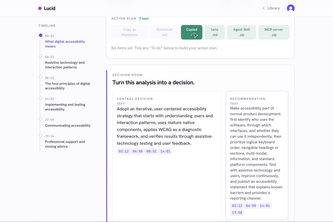
Lucid is a self-reported tool that processes long-form expert video content (e.g., talks) into structured, agent-readable outputs with timestamps, failure modes, and citations. It claims to convert expert thinking into portable "lenses" for use in AI agents.
What changed
The project description indicates this was built during the OpenAI 2026 hackathon, with a focus on improving how expert media is consumed and used by humans and AI systems. The author states it predates the submission window and only the Build Week extension was submitted.
Single most important open question
Is there any evidence of real-world usage or adoption beyond the hackathon context? The description contains no data about revenue, customers, or product traction — all claims are self-reported.
What The Product Actually Is
The description states that Lucid processes expert video content into structured outputs. These include:
- Topic segments
- Insights
- Quotes
- Action items
- Timestamped playback links (to specific moments in the source)
- Decision briefs with central decision, recommendation, evidence, alternatives, risks, next actions, and unresolved questions
It also compiles these into formats suitable for AI agents:
- Markdown
- Claude Agent Skill archive
- Runnable MCP server bundle
The system uses models like GPT-5.6-luna and Claude, with a validator that enforces failure modes on every chunk of content.
Inference The product appears to be a tool for extracting structured knowledge from long-form media and packaging it in ways that support both human review and machine consumption.
Positioning & Claim Evolution
The author claims Lucid addresses the limitations of current summarization tools (e.g., Recall, Findcast, PodPast), which they say are "crowded" and don't capture how an expert thinks or when their thinking breaks down.
Lucid positions itself as:
- A way to turn hours of expert video into a portable way of thinking
- With failure modes attached
- Exportable for use in AI agents
It also claims to distinguish between impersonation and genuine expert knowledge by including guardrails that check whether frameworks apply.
Inference The positioning evolves from a general summarization tool to one focused on thinking rather than just content, and with agent-ready outputs.
Target Customer & ICP
The description does not explicitly name target customers or personas. However, it implies:
- Users who consume expert media (e.g., talks, lectures)
- Developers or teams building AI agents
- Individuals or organizations looking to extract structured knowledge from long-form content
It also suggests a use case where the output is consumed by AI models, implying an ICP centered around technical users and AI developers.
Inference The primary customer segment likely includes AI developers, researchers, and decision-makers who want to integrate expert insights into automated workflows or agent-based systems.
Business Model & Pricing Evidence
There is no evidence of pricing, monetization strategy, or business model in the description. The project is presented as a hackathon submission with no indication of commercial intent or revenue streams.
Not evidenced
Technical & Delivery Signals
The stack includes:
- Next.js on Vercel
- AWS Lambda functions (two)
- DynamoDB and S3 for storage
- Clerk for authentication
- ElevenLabs Scribe for transcription
- Terraform for infrastructure
- Codex on GPT-5.6 for core logic
- React, TypeScript, FastAPI
The system enforces validation rules:
- Failure modes required on every chunk
- Retry mechanism if failure modes are omitted
- Validator rejects bad lenses outright (no degraded storage)
- IAM permissions managed via Terraform but sometimes not applied in production
Inference The architecture is serverless and designed with strong internal validation. It shows attention to correctness and traceability, especially around timestamping and grounding.
Traction & Maturity Signals
There is no evidence of traction or adoption beyond the hackathon context. No customers, revenue, usage metrics, or product-market fit data are provided.
The author notes:
- The project was built during a 2-week Build Week
- Only one team member (Yee Fei Ooi)
- No mention of user feedback or real-world testing
Not evidenced
Competitive Context
The description mentions competitors such as Recall, Findcast, and PodPast — tools that offer summaries plus chat and citations.
Lucid claims to differentiate itself by:
- Providing failure modes
- Packaging content for AI agents
- Ensuring traceability through timestamps and grounding
It also notes that its approach is not just about summarizing but about capturing how an expert thinks, which it says separates it from impersonation.
Inference Lucid positions itself in a niche between generic summarizers and specialized agent-ready knowledge systems. It may compete with tools focused on AI agent integration or expert knowledge capture.
Open Questions & Risks
- No traction or revenue: The project is described as a hackathon submission with no evidence of real-world usage.
- Single founder: Only one team member listed (Yee Fei Ooi), which raises concerns about execution capacity and scalability.
- Limited validation in production: Some issues were only discovered during live testing, such as IAM permissions not being applied or timestamp parsing bugs.
- Agent-ready output limitations:
- MCP authentication uses a shared key
- No hosted MCP endpoint; servers run locally
- Search inside bundles is basic substring scoring
Inference While the technical implementation shows care and rigor, the lack of traction, limited team size, and unresolved issues suggest high risk for commercial viability.
Questions the description leaves open
- What real-world use cases have you identified beyond the hackathon?
- Have you tested this with actual users or teams in production environments?
- How do you plan to scale beyond a single developer working on it?
- Are there any plans for monetization or customer acquisition?
- What are the biggest technical challenges still unresolved in the current version?
- How do you intend to handle data privacy and access control for uploaded content?
Overall Assessment
The project is described as a hackathon submission with no evidence of traction, revenue, or customer adoption. The author claims it addresses gaps in existing tools but provides no proof of real-world utility or demand.
Confidence: Low
This is a self-reported, unverified description of a tool built under time constraints. There is no indication that Lucid has moved beyond prototype or early-stage experimentation.
Not evidenced — No data on revenue, customers, or product-market fit exists in the provided description.
User Stories BotA demo video on every pull request
Get a demo video on every new feature
GitHub App that watches your pull requests and records a narrated, captioned demo.
Save time on demo prep and make informed decisions faster with a video walkthrough of every new feature.
Source
Submitted to the OpenAI 2026 hackathon on Devpost. Project home on Devpost. Back to the full gallery on Devpost.
This competitive analysis was produced by top-founders.com (opens in a new tab)
Generated by a language model from this project's public Devpost page — its tagline, the author's own write-up and any built-with tags listed there — as captured in August 2026. Short quotations are the author's words. It is an opinion on the idea as a business, not on the people behind it, and it reflects the description as published then. If the project has moved on, request a correction below. The analysis is not independent research and contains no verified traction, revenue or customer data.
An independent guide by KFG International LLC — not affiliated with, endorsed by, or connected to Devpost or OpenAI.