

Archive position — measured, not model output
1 like on Devpost
505 of the 7,850 archived projects have more likes, and 1,758 share exactly 1 — so this project's #1,153 place in the like-ranked listing is a tie-break inside that group, not a ranking.
Projects (log scale)
Likes on Devpost. ▲ marks this project's group.
Show the figures
| Likes | Projects | Share of archive |
|---|---|---|
| 0 | 5,587 | 71.2% |
| 1 | 1,758 | 22.4% |
| 2 | 284 | 3.6% |
| 3–4 | 132 | 1.7% |
| 5–9 | 75 | 1.0% |
| 10+ | 14 | 0.2% |
 User Stories BotA demo video on every pull request
Get a demo video on every new feature
GitHub App that watches your pull requests and records a narrated, captioned demo.
Save time on demo prep and make informed decisions faster with a video walkthrough of every new feature.
Executive Summary
Company: GridSignal AI
Self-reported purpose: An explainable copilot for ERCOT power-market analysts, forecasting load, prices, and grid stress while testing scenarios and grounding every insight in transparent evidence.
What changed: The author states that this is a prototype built for the OpenAI 2026 hackathon. It is described as a decision-support tool for ERCOT analysts, integrating forecasting, scenario testing, and explainable AI within a Streamlit interface.
Single most important open question: Is GridSignal AI intended to be a commercial product or a proof-of-concept? The description does not clarify whether the author plans to pursue further development, monetization, or market entry beyond this prototype.
What The Product Actually Is
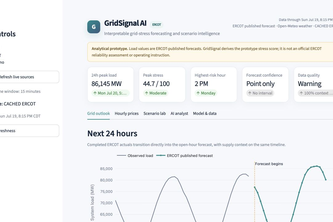
The description states that GridSignal AI is a Streamlit-based application built in Python. It integrates several components:
- A continuous view of recent ERCOT load and forward outlook
- Near-term load and grid-stress forecasts
- 120-hour forecast for HB_NORTH real-time settlement prices
- Hour-by-hour explanations of main stress drivers
- Scenario testing for demand, temperature, renewable output, and outages
- An AI Analyst that answers questions using structured backend tools
The tool is described as a decision-support prototype, not an official ERCOT reliability assessment or a tool for operating the grid.
Inference: The product appears to be a research-grade analytical tool built for internal use by power-market analysts, with a focus on transparency and explainability. It is not a commercial SaaS offering.
Positioning & Claim Evolution
The author states that GridSignal AI was built to explore what an analytical copilot for ERCOT workflows could look like. The goal was not to add a chatbot to a dashboard, but to build a tool that:
- Forecasts near-term conditions
- Shows its work
- Lets users test assumptions
- Uses AI to explain results already calculated and verified
The positioning is analytical support, not automation or replacement of human analysts.
Inference: The author’s intent is to demonstrate a new way of integrating AI into energy-market analysis, emphasizing transparency, grounding, and structured reasoning over generative capabilities.
Target Customer & ICP
The description states that GridSignal AI is built for ERCOT power-market analysts. It is designed to support workflows involving forecasting, scenario testing, and understanding grid stress.
Inference: The target customer segment is energy market professionals, specifically those working with ERCOT data and requiring decision-support tools in a regulated or operational context.
Business Model & Pricing Evidence
The description does not provide any evidence of a business model or pricing strategy. It is described as a prototype built for a hackathon.
Not evidenced: No information on monetization, licensing, subscription tiers, or customer acquisition.
Technical & Delivery Signals
- Built with: Python, Streamlit, Plotly, OpenAI API, scikit-learn, XGBoost, PyArrow, Pydantic, Ruff, uv, structlog
- Data sources: ERCOT public data, Open-Meteo weather forecasts
- Forecasting approach:
- Time-based training/validation/holdout periods
- Seasonal and persistence baselines compared with tree-based models
- Separate modeling for weekdays vs. non-working days (including NERC holidays)
- Scenario testing:
- Deterministic engine that calculates effects of user inputs
- Changes to assumptions are applied to baseline inputs only
- AI Analyst:
- Uses OpenAI API but is constrained not to invent calculations
- Works through typed tools for retrieving forecasts, inspecting stress drivers, etc.
- Numerical claims are checked against backend evidence
Inference: The product shows strong technical grounding, with attention to data integrity, model validation, and deterministic scenario testing. It avoids common pitfalls in AI integration by keeping AI as a navigator rather than a source of truth.
Traction & Maturity Signals
The description states that this is a prototype built for the OpenAI 2026 hackathon, with no mention of revenue, customers, or adoption beyond its own use. It is described as a decision-support prototype, not an official tool.
Not evidenced: No evidence of traction, usage metrics, customer feedback, or product-market fit.
Competitive Context
The description does not provide any information about competitors or market positioning beyond the general context of energy-market analytics and forecasting tools. It is not clear whether similar tools exist in the market or how GridSignal AI would differentiate itself.
Not evidenced: No competitive landscape, no mention of existing tools or platforms in this domain.
Open Questions & Risks
- The product is described as a prototype, not a commercial offering.
- No evidence of revenue, customers, or monetization strategy.
- The author is the sole team member (1 person).
- The tool is built for a specific market (ERCOT) and may not scale easily to other regions or markets.
- AI is constrained to avoid inventing data — this may limit its perceived utility in exploratory or creative use cases.
Inference: The biggest risk is that the project remains a hackathon prototype, with no clear path to commercialization or product-market fit. It also lacks any indication of scalability or broader market relevance beyond ERCOT.
Questions the description leaves open
- What is your plan for transitioning this from a hackathon prototype to a commercial product?
- Are you planning to seek customers or partners in the energy market, and how?
- How do you intend to monetize this tool if at all?
- Do you have any experience working with ERCOT or other energy-market data sources beyond this prototype?
- What are your thoughts on expanding beyond ERCOT to other markets like PJM or CAISO?
Overall Assessment
Not evidenced: No information is provided about the author’s intentions for commercial development, funding, or strategic partnerships.
Inference: Based on the self-reported description, GridSignal AI appears to be a research-grade prototype, not a product ready for investment or partnership. It shows strong technical execution and a clear understanding of the domain but lacks evidence of traction, scalability, or business intent beyond its current form.
User Stories BotA demo video on every pull request
Get a demo video on every new feature
GitHub App that watches your pull requests and records a narrated, captioned demo.
Save time on demo prep and make informed decisions faster with a video walkthrough of every new feature.
Source
Submitted to the OpenAI 2026 hackathon on Devpost. Project home on Devpost. Back to the full gallery on Devpost.
This competitive analysis was produced by top-founders.com (opens in a new tab)
Generated by a language model from this project's public Devpost page — its tagline, the author's own write-up and any built-with tags listed there — as captured in August 2026. Short quotations are the author's words. It is an opinion on the idea as a business, not on the people behind it, and it reflects the description as published then. If the project has moved on, request a correction below. The analysis is not independent research and contains no verified traction, revenue or customer data.
An independent guide by KFG International LLC — not affiliated with, endorsed by, or connected to Devpost or OpenAI.