

Archive position — measured, not model output
0 likes on Devpost
2,263 of the 7,850 archived projects have more likes, and 5,587 share exactly 0 — so this project's #7,039 place in the like-ranked listing is a tie-break inside that group, not a ranking.
Projects (log scale)
Likes on Devpost. ▲ marks this project's group.
Show the figures
| Likes | Projects | Share of archive |
|---|---|---|
| 0 | 5,587 | 71.2% |
| 1 | 1,758 | 22.4% |
| 2 | 284 | 3.6% |
| 3–4 | 132 | 1.7% |
| 5–9 | 75 | 1.0% |
| 10+ | 14 | 0.2% |
 User Stories BotA demo video on every pull request
Get a demo video on every new feature
GitHub App that watches your pull requests and records a narrated, captioned demo.
Save time on demo prep and make informed decisions faster with a video walkthrough of every new feature.
Executive Summary
What the company appears to be
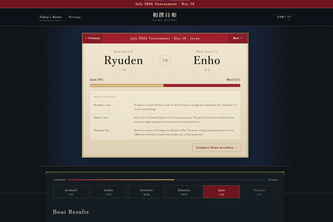
Sumo Biyori is a self-reported live sumo fan platform that uses structured historical data and AI (specifically GPT-5.6) to generate match previews, win-probability predictions, wrestler ratings, and recent-form analysis for sumo bouts, especially those in lower divisions.
What changed
The author states they built this platform from concept to release-ready product in four days using AI-assisted development tools like Codex and GPT-5.6, with no prior web development experience.
Single most important open question
Is there any evidence of actual user engagement or adoption beyond the author's own use of the platform?
What The Product Actually Is
The description states that Sumo Biyori is:
- A live sumo fan platform
- That provides:
- Win-probability predictions
- Wrestler ratings
- Recent-form analysis
- AI-generated match previews
- Featured bouts from the lower divisions
- Prediction validation and calibration data
It covers every Makuuchi bout and selected high-interest bouts from lower divisions.
The platform uses structured historical data (87,000 bouts) to calculate probabilities rather than direct LLM generation. GPT is used to transform verified facts into readable match previews.
Inference: The product appears to be a data-driven web application that combines statistical modeling with AI-generated storytelling for sumo coverage.
Positioning & Claim Evolution
The author claims:
- Sumo Biyori gives "overlooked sports the context, analysis, and stories they deserve"
- It addresses a problem where "top-ranked wrestlers receive plenty of attention, while many other bouts—especially in the lower divisions—are presented with little context or explanation"
- The broader goal is to show how AI can bring high-quality coverage to overlooked sports and lower divisions
Inference: This positioning suggests an intent to democratize sports journalism through AI, but no evidence exists that this has been achieved beyond the author's own platform.
Target Customer & ICP
The description states:
- The platform is aimed at sumo fans
- Specifically those interested in lower-division bouts and wrestlers who are not well-covered by traditional media
Inference: The target customer appears to be niche: dedicated sumo fans, particularly those interested in lesser-known wrestlers or lower divisions. No evidence of broader market segmentation or customer acquisition strategy.
Business Model & Pricing Evidence
The description does not state:
- Whether the platform is monetized
- What pricing model exists (if any)
- Whether there are paid features or subscriptions
Not evidenced: No commercial structure, revenue streams, or pricing information provided.
Technical & Delivery Signals
The author states:
- Built with Codex Sites environment
- Used medium to high reasoning settings for implementation tasks
- Backend processes 87,000 historical sumo bouts
- Prediction system includes calibration and validation data
- Uses GPT API for match preview generation
- Built in four days despite limited web dev experience
Inference: The technical stack includes Next.js, Node.js, React, TypeScript, OpenAI APIs, and GPT-5.6. The delivery timeline suggests rapid prototyping with AI assistance.
Traction & Maturity Signals
The description states:
- Built from concept to release-ready product in four days
- Provides real predictions, real-time updates, wrestler ratings, lower-division discovery, and AI-generated commentary grounded in verified data
- Includes a prediction-validation system
Not evidenced: No evidence of actual users, usage metrics, or customer feedback. The author's own experience is the only signal of product maturity.
Competitive Context
The description does not mention:
- Direct competitors
- Existing platforms covering sumo
- Market share or competitive positioning
Not evidenced: No competitive landscape information provided.
Open Questions & Risks
Key risks and open questions based on self-reported evidence:
- The platform is described as a single-person project with no team, suggesting limited scalability or long-term maintenance capability
- No revenue model or monetization strategy is evident
- The author has no prior web development experience, raising questions about product durability and future evolution
- The platform only covers sumo; there's no indication of expansion plans beyond this niche sport
- No evidence of user engagement or feedback mechanisms
Inference: The project may be a prototype rather than a scalable business. Risk of obsolescence due to lack of team, funding, or traction.
Questions the description leaves open
- What is the actual source and quality of the 87,000 historical sumo bouts used for modeling?
- How does the prediction validation system work in practice? Is it being monitored?
- Are there any plans to monetize or scale beyond sumo into other sports?
- What are the long-term maintenance and update strategies given the single-developer model?
- Has the platform been tested with actual users, and what feedback has been received?
Overall Assessment
Not evidenced: No evidence of revenue, customers, or traction to support an investment or partnership decision.
The author states that Sumo Biyori is a working product built in four days using AI tools. However, the description lacks any indication of commercial viability, user adoption, or sustainable business model.
This appears to be a proof-of-concept or personal project rather than a scalable venture. The lack of team, funding, and measurable outcomes makes it difficult to assess its potential for investment or partnership.
Confidence level: Low — based entirely on self-reported evidence with no external validation or traction data.
User Stories BotA demo video on every pull request
Get a demo video on every new feature
GitHub App that watches your pull requests and records a narrated, captioned demo.
Save time on demo prep and make informed decisions faster with a video walkthrough of every new feature.
Source
Submitted to the OpenAI 2026 hackathon on Devpost. Project home on Devpost. Back to the full gallery on Devpost.
This competitive analysis was produced by top-founders.com (opens in a new tab)
Generated by a language model from this project's public Devpost page — its tagline, the author's own write-up and any built-with tags listed there — as captured in August 2026. Short quotations are the author's words. It is an opinion on the idea as a business, not on the people behind it, and it reflects the description as published then. If the project has moved on, request a correction below. The analysis is not independent research and contains no verified traction, revenue or customer data.
An independent guide by KFG International LLC — not affiliated with, endorsed by, or connected to Devpost or OpenAI.