

Archive position — measured, not model output
0 likes on Devpost
2,263 of the 7,850 archived projects have more likes, and 5,587 share exactly 0 — so this project's #5,056 place in the like-ranked listing is a tie-break inside that group, not a ranking.
Projects (log scale)
Likes on Devpost. ▲ marks this project's group.
Show the figures
| Likes | Projects | Share of archive |
|---|---|---|
| 0 | 5,587 | 71.2% |
| 1 | 1,758 | 22.4% |
| 2 | 284 | 3.6% |
| 3–4 | 132 | 1.7% |
| 5–9 | 75 | 1.0% |
| 10+ | 14 | 0.2% |
 User Stories BotA demo video on every pull request
Get a demo video on every new feature
GitHub App that watches your pull requests and records a narrated, captioned demo.
Save time on demo prep and make informed decisions faster with a video walkthrough of every new feature.
Executive Summary
Log Sentinel is a rule-based threat detection tool for authentication logs, built as a solo project by a cybersecurity beginner. It scans SSH and sudo logs for three attack patterns (brute force, rapid IP change, suspicious sudo bursts) using regex and sliding-window logic, then passes findings to GPT-5.6 for plain-English diagnosis and remediation steps. The system is presented as a Streamlit interface for uploading or pasting log files.
The project is self-reported as a first attempt at building a cybersecurity tool, with no evidence of revenue, customers, or traction beyond the author's own testing. It uses a hybrid approach: deterministic detection logic with AI explanation, but lacks independent validation of its effectiveness or adoption.
Key open question
Is there any evidence that this system has been tested in real-world environments or validated by users outside the author’s own testing?
What The Product Actually Is
The description states that Log Sentinel:
- Scans SSH and sudo authentication logs
- Detects three attack patterns using rule-based logic:
- Brute force: 8+ failed login attempts from one IP within 5 minutes
- Rapid login IP change: same user account logging in from two different IPs within 15 minutes
- Suspicious sudo command burst: 3+ sudo commands in a short window that occur overnight or touch sensitive targets like
/etc/shadowor/etc/passwd
- Sends detected findings to GPT-5.6 for diagnosis, severity rating (Low/Medium/High), and remediation steps
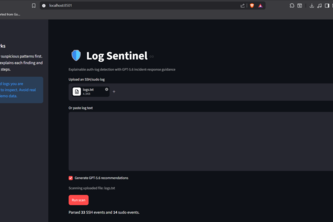
- Is presented through a Streamlit interface where users can upload or paste log files
The system is described as built with Codex, cybersecurity tools, Python, and Streamlit.
Inference The product is a proof-of-concept tool for detecting known attack patterns in authentication logs using a hybrid approach of rule-based detection and AI explanation.
Positioning & Claim Evolution
The author states that the project was inspired by the challenge of noisy authentication logs and the need to surface attack patterns automatically. It is positioned as:
- A beginner’s first cybersecurity project
- A tool that explains threats in plain English, like a human analyst would
- A hybrid approach combining deterministic detection with AI explanation
There is no evidence of prior positioning or evolution beyond this initial self-description.
Inference The product is presented as an educational and exploratory effort, not a commercial offering. It does not claim to be a production-ready solution or part of a larger platform.
Target Customer & ICP
The description states that the author is a beginner in cybersecurity and built this tool while studying networking fundamentals. No explicit customer segment or ideal customer profile (ICP) is described.
Inference The target audience appears to be individuals or teams learning cybersecurity, or those testing tools for educational purposes. There is no evidence of a defined market segment or enterprise use case.
Business Model & Pricing Evidence
There is no evidence of pricing, monetization, or business model in the description. The project is described as a solo effort and not as a commercial product.
Inference No business model or pricing information is provided. It is unclear whether this will be monetized or offered as a service.
Technical & Delivery Signals
The author states:
- Detection logic was manually designed and tested using regex-based parsing
- The system uses sliding-window logic for detection rules
- Codex was used to build the rest of the system, including GPT-5.6 integration with structured JSON schema
- Streamlit interface was built end-to-end
- A temporary swap to a free-tier model was used due to billing limitations
Inference The technical approach is described as hybrid: deterministic detection logic with AI explanation. However, there is no evidence of production deployment or scalability.
Traction & Maturity Signals
The description states:
- This is the author’s first solo cybersecurity project
- It was submitted to an OpenAI hackathon
- Testing was done on synthetic and realistic sample log data
- The system was validated end-to-end using a temporary free-tier model for API testing
There is no evidence of:
- Customers or users
- Revenue or monetization
- Product adoption or usage metrics
- Deployment in real-world environments
Inference No traction or maturity signals are evident. It remains a prototype or proof-of-concept.
Competitive Context
The description does not mention any competitors or existing solutions in the authentication log analysis or threat detection space.
Inference There is no evidence of competitive positioning or awareness of existing tools in this domain.
Open Questions & Risks
- The project is described as a solo effort and first-time cybersecurity project, with no prior experience in building security tools
- The author notes a billing limitation that prevented full API testing before submission
- No evidence of real-world validation or user feedback
- No mention of scalability, performance, or production readiness
- No indication of whether the system is being used or tested beyond the author’s own environment
Inference The project is experimental and lacks commercial viability or traction. It may not be suitable for enterprise use.
Questions the description leaves open
- What was the actual accuracy of the detection logic when tested on real logs?
- Has the system been validated in any real-world environment beyond the author’s own testing?
- Are there plans to expand beyond the three attack patterns currently supported?
- Is there a plan for production deployment or scalability?
- How does the hybrid approach (rule-based + AI) handle false positives or edge cases?
- What is the current status of GPT-5.6 API integration and billing?
Overall Assessment
The project is described as a solo, first-time effort in cybersecurity, submitted to an OpenAI hackathon. It is not evidenced as a commercial product or solution with traction, revenue, or adoption.
Inference There is no evidence of a viable business case or investment opportunity at this stage. It appears to be a learning project or prototype with no demonstrated market readiness or commercial potential.
User Stories BotA demo video on every pull request
Get a demo video on every new feature
GitHub App that watches your pull requests and records a narrated, captioned demo.
Save time on demo prep and make informed decisions faster with a video walkthrough of every new feature.
Source
Submitted to the OpenAI 2026 hackathon on Devpost. Project home on Devpost. Back to the full gallery on Devpost.
This competitive analysis was produced by top-founders.com (opens in a new tab)
Generated by a language model from this project's public Devpost page — its tagline, the author's own write-up and any built-with tags listed there — as captured in August 2026. Short quotations are the author's words. It is an opinion on the idea as a business, not on the people behind it, and it reflects the description as published then. If the project has moved on, request a correction below. The analysis is not independent research and contains no verified traction, revenue or customer data.
An independent guide by KFG International LLC — not affiliated with, endorsed by, or connected to Devpost or OpenAI.