

Archive position — measured, not model output
1 like on Devpost
505 of the 7,850 archived projects have more likes, and 1,758 share exactly 1 — so this project's #1,132 place in the like-ranked listing is a tie-break inside that group, not a ranking.
Projects (log scale)
Likes on Devpost. ▲ marks this project's group.
Show the figures
| Likes | Projects | Share of archive |
|---|---|---|
| 0 | 5,587 | 71.2% |
| 1 | 1,758 | 22.4% |
| 2 | 284 | 3.6% |
| 3–4 | 132 | 1.7% |
| 5–9 | 75 | 1.0% |
| 10+ | 14 | 0.2% |
 User Stories BotA demo video on every pull request
Get a demo video on every new feature
GitHub App that watches your pull requests and records a narrated, captioned demo.
Save time on demo prep and make informed decisions faster with a video walkthrough of every new feature.
Executive Summary
Company: Gitship
Self-reported basis: The description is entirely self-reported and unverified, based on a Devpost submission for the OpenAI 2026 hackathon. No independent evidence of revenue, customers, or traction exists.
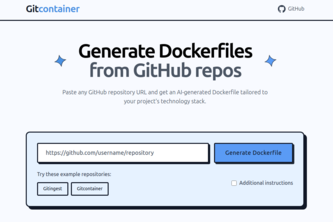
What it appears to be: A web-based tool that generates Dockerfiles from GitHub repositories using AI, with a focus on speed and developer experience.
What changed: The project was built as a hackathon submission; no indication of post-hackathon development or commercialization.
Single most important open question: Is there any evidence of user adoption, revenue, or product-market fit beyond the initial prototype?
What The Product Actually Is
The description states that Gitship is an AI-powered web application that takes a public GitHub repository URL and generates a custom, optimized Dockerfile. It also suggests a docker-compose.yml file for multi-container setups and allows users to pass custom instructions (e.g., "Use Alpine Linux").
- The backend is built with Python and FastAPI.
- It uses WebSockets to stream the generation process in real time.
- It clones the repository locally, analyzes it using
gitingest, and passes this context to Groq’s API (Llama models) for Dockerfile generation. - The frontend uses vanilla HTML/CSS, TailwindCSS, Jinja2 templates, and Monaco Editor for syntax highlighting.
Inference: The tool is a prototype or proof-of-concept built in a short timeframe, not a production-ready product.
Not evidenced: No information on whether the generated Dockerfiles are actually functional or tested in real environments.
Positioning & Claim Evolution
The author claims Gitship eliminates friction in writing Dockerfiles by automating the process using AI. It positions itself as a tool that generates “perfect” Dockerfiles from nothing but a GitHub URL, with support for customization and multi-container setups.
- The tool is described as instantaneous, leveraging Groq’s API.
- It aims to be a developer-first tool with a clean UI and real-time feedback.
- Future plans include integrating with GitHub App and enabling one-click deployments.
Inference: The positioning is focused on developer convenience and speed, but there is no evidence of market testing or user feedback.
Not evidenced: No claims about market traction, customer personas, or competitive differentiation beyond the hackathon context.
Target Customer & ICP
The description implies Gitship targets developers who work with GitHub repositories and need to containerize their applications quickly.
- It is designed for users who want to generate Dockerfiles without deep knowledge of Docker best practices.
- Customization options suggest it may appeal to developers looking for flexibility in base images or deployment configurations.
Inference: The ICP appears to be technical users, especially those working with open-source or personal projects.
Not evidenced: No data on actual customer segments, usage patterns, or feedback from target users.
Business Model & Pricing Evidence
The description does not include any information about pricing, monetization, or business model.
- The tool is presented as a web application, but no indication of subscription tiers, freemium models, or enterprise features.
- No mention of revenue streams or customer acquisition costs.
Inference: There is no evidence of a defined business model beyond the prototype.
Not evidenced: No pricing data, monetization strategy, or commercial roadmap.
Technical & Delivery Signals
The project was built using:
- Backend: Python, FastAPI, WebSockets
- AI: Groq API (Llama models), GPT-5.6 and Codex for planning/debugging
- Frontend: HTML/CSS, TailwindCSS, Jinja2 templates, Monaco Editor
- Tools: gitingest, docker
Inference: The tech stack is consistent with a hackathon prototype focused on rapid development and AI integration.
Not evidenced: No evidence of scalability, performance benchmarks, or production deployment details.
Traction & Maturity Signals
The project was submitted as a hackathon entry, not a commercial product.
- It has no reported users, customers, or adoption metrics.
- The team size is listed as 2 members.
- No mention of funding, partnerships, or product launches beyond the Devpost submission.
Inference: This is an early-stage prototype with no demonstrated traction.
Not evidenced: No data on user engagement, retention, or product usage.
Competitive Context
The description does not provide any information about competitors or market positioning relative to existing tools for Dockerfile generation.
- No mention of similar products (e.g., Docker’s own tooling, GitHub Codespaces, or other AI-assisted containerization tools).
- No indication of how Gitship differentiates from or competes with existing solutions.
Inference: The competitive landscape is unknown.
Not evidenced: No competitor analysis, pricing comparison, or market share data.
Open Questions & Risks
- Prototype only: The tool is a hackathon submission, not a product in development.
- No commercialization evidence: No revenue, customers, or monetization strategy.
- Unverified output quality: The generated Dockerfiles are not tested or validated for production use.
- Limited team size: A 2-person team may struggle to scale beyond prototype stage.
- Dependency on external AI APIs: Reliance on Groq and Llama models introduces risk of API availability or cost.
Inference: High risk of failure if no further development or commercialization occurs.
Not evidenced: No evidence of user feedback, product iteration, or roadmap beyond the hackathon submission.
Questions the description leaves open
- What is the current status of Gitship beyond this hackathon prototype?
- Have you tested the generated Dockerfiles in real-world scenarios?
- Are there any plans to monetize or scale the product?
- How do you plan to handle large repositories or edge cases in codebase analysis?
- What is your roadmap for integrating with GitHub and enabling one-click deployments?
Overall Assessment
Not evidenced: No data on financials, traction, or commercial viability.
Inference: This project is a hackathon prototype with no demonstrated product-market fit or commercial potential. It lacks any evidence of traction, revenue, or user adoption beyond the initial submission.
Confidence level: Very low — based entirely on self-reported author claims and no external validation.
User Stories BotA demo video on every pull request
Get a demo video on every new feature
GitHub App that watches your pull requests and records a narrated, captioned demo.
Save time on demo prep and make informed decisions faster with a video walkthrough of every new feature.
Source
Submitted to the OpenAI 2026 hackathon on Devpost. Project home on Devpost. Back to the full gallery on Devpost.
This competitive analysis was produced by top-founders.com (opens in a new tab)
Generated by a language model from this project's public Devpost page — its tagline, the author's own write-up and any built-with tags listed there — as captured in August 2026. Short quotations are the author's words. It is an opinion on the idea as a business, not on the people behind it, and it reflects the description as published then. If the project has moved on, request a correction below. The analysis is not independent research and contains no verified traction, revenue or customer data.
An independent guide by KFG International LLC — not affiliated with, endorsed by, or connected to Devpost or OpenAI.