

Archive position — measured, not model output
1 like on Devpost
505 of the 7,850 archived projects have more likes, and 1,758 share exactly 1 — so this project's #1,134 place in the like-ranked listing is a tie-break inside that group, not a ranking.
Projects (log scale)
Likes on Devpost. ▲ marks this project's group.
Show the figures
| Likes | Projects | Share of archive |
|---|---|---|
| 0 | 5,587 | 71.2% |
| 1 | 1,758 | 22.4% |
| 2 | 284 | 3.6% |
| 3–4 | 132 | 1.7% |
| 5–9 | 75 | 1.0% |
| 10+ | 14 | 0.2% |
 User Stories BotA demo video on every pull request
Get a demo video on every new feature
GitHub App that watches your pull requests and records a narrated, captioned demo.
Save time on demo prep and make informed decisions faster with a video walkthrough of every new feature.
Executive Summary
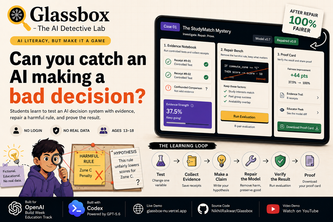
The company appears to be a solo-built AI investigation tool named Glassbox — The AI Detective Lab, designed to help users investigate questions by making the reasoning behind AI-generated answers visible and traceable. It is presented as an AI detective workspace that structures input into investigative signals, connects clues, and separates evidence from hypotheses.
The author states this is a hackathon project built in a short timeframe using OpenAI APIs, React, and TypeScript. There is no evidence of revenue, customers, or product-market fit beyond the self-reported description.
The single most important open question
Is there any evidence that users actually need or will pay for this type of AI transparency tool, or whether the core value proposition resonates with a market beyond the hackathon context?
What The Product Actually Is
The description states:
- Glassbox is an AI detective lab that helps users investigate questions from evidence.
- It allows users to input notes, documents, links, statements, or raw text and ask investigative questions.
- It extracts people, places, dates, claims, and events; identifies relationships and patterns; surfaces contradictions and missing context; builds a clear evidence trail behind each conclusion.
- It separates what is supported by evidence from AI-generated hypotheses.
- The interface uses visual elements like case files, evidence cards, connections, and timelines to make complex information approachable.
Inference The product appears to be an AI-powered investigation assistant that emphasizes traceability and transparency over final answers. It is not a general-purpose AI tool but one tailored for investigative workflows.
Positioning & Claim Evolution
The description states:
- Glassbox aims to make AI investigation feel less like a black box and more like a transparent detective desk.
- The core idea is to give users a place to bring messy information, investigate it with AI, connect clues, and receive conclusions that remain understandable and traceable.
- It positions itself as an AI workspace that feels like a detective lab: clues come in, connections become visible, and every conclusion can be inspected.
Inference The positioning evolved from solving the problem of "AI giving answers in seconds but not explaining why" to offering a structured, transparent investigative process. The evolution is implied through the emphasis on traceability, evidence trails, and user control over AI reasoning.
Target Customer & ICP
The description states:
- Glassbox is intended for researchers, journalists, analysts, students, compliance teams, and curious people who need more than a confident answer.
- It is designed for users who want to inspect the path to an answer rather than just accept it.
Inference The target customer profile includes individuals or teams involved in research, fact-checking, analysis, and investigative work. These are likely professionals or advanced users with specific needs for transparency and accountability in AI outputs.
Business Model & Pricing Evidence
Not evidenced.
The description does not mention any pricing model, monetization strategy, or business model. It is unclear whether the product will be sold as a SaaS offering, freemium, or otherwise.
Technical & Delivery Signals
The description states:
- Built with: codex, gpt-5.6, openai-responses-api, react, tanstack-start, typescript, vercel, zod.
- The product flow begins with an investigation board where users add information and define the question.
- AI layer structures input into useful investigative signals and organizes them into a traceable view of facts, connections, confidence levels, and open questions.
- Interface uses familiar visual language of case files, evidence cards, connections, and timelines.
Inference The technical stack suggests a modern web application using OpenAI's APIs and React-based frontend. The architecture implies an AI-driven data processing pipeline with structured output presentation.
Traction & Maturity Signals
Not evidenced.
There is no mention of users, customers, revenue, usage metrics, or product adoption beyond the hackathon submission. No evidence of traction or market validation exists in the description.
Competitive Context
Not evidenced.
The description does not reference competitors, existing tools, or market positioning relative to others in the AI investigation or transparency space.
Open Questions & Risks
- Solo-built product: The team size is listed as one. This raises questions about scalability and long-term maintenance.
- No revenue or traction evidence: The project has no demonstrated commercial viability or user base.
- Unproven market need: While the concept of AI transparency is appealing, there is no evidence that users actually demand this functionality in a productized form.
- Unclear monetization path: No indication of how Glassbox intends to generate revenue or sustain itself beyond a hackathon prototype.
Questions the description leaves open
- What specific use cases have you identified for Glassbox, and how do they differ from existing tools?
- Have you validated the need for this product with potential users outside of the hackathon context?
- How do you plan to monetize Glassbox, and what pricing model are you considering?
- What is your roadmap for scaling beyond a solo-built prototype?
- Are there any partnerships or integrations planned that could accelerate adoption?
Overall Assessment
Not evidenced.
There is insufficient evidence to assess whether this project represents a viable investment or partnership opportunity. The product is described as a hackathon submission with no demonstrated traction, revenue, or market validation. Any potential value depends on future development and user adoption, which are not evident in the current description.
User Stories BotA demo video on every pull request
Get a demo video on every new feature
GitHub App that watches your pull requests and records a narrated, captioned demo.
Save time on demo prep and make informed decisions faster with a video walkthrough of every new feature.
Source
Submitted to the OpenAI 2026 hackathon on Devpost. Project home on Devpost. Back to the full gallery on Devpost.
This competitive analysis was produced by top-founders.com (opens in a new tab)
Generated by a language model from this project's public Devpost page — its tagline, the author's own write-up and any built-with tags listed there — as captured in August 2026. Short quotations are the author's words. It is an opinion on the idea as a business, not on the people behind it, and it reflects the description as published then. If the project has moved on, request a correction below. The analysis is not independent research and contains no verified traction, revenue or customer data.
An independent guide by KFG International LLC — not affiliated with, endorsed by, or connected to Devpost or OpenAI.