

Archive position — measured, not model output
0 likes on Devpost
2,263 of the 7,850 archived projects have more likes, and 5,587 share exactly 0 — so this project's #5,057 place in the like-ranked listing is a tie-break inside that group, not a ranking.
Projects (log scale)
Likes on Devpost. ▲ marks this project's group.
Show the figures
| Likes | Projects | Share of archive |
|---|---|---|
| 0 | 5,587 | 71.2% |
| 1 | 1,758 | 22.4% |
| 2 | 284 | 3.6% |
| 3–4 | 132 | 1.7% |
| 5–9 | 75 | 1.0% |
| 10+ | 14 | 0.2% |
 User Stories BotA demo video on every pull request
Get a demo video on every new feature
GitHub App that watches your pull requests and records a narrated, captioned demo.
Save time on demo prep and make informed decisions faster with a video walkthrough of every new feature.
Executive Summary
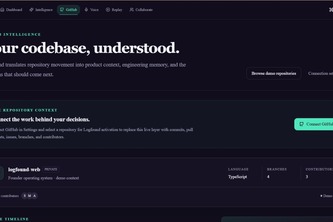
What the company appears to be: Logfound is a self-reported AI-powered workspace for solo founders and small teams, designed to help users log project updates, engineering decisions, release notes, and milestones in one timeline. It includes three AI agents: Founder Coach, CTO Agent, and Learning Agent.
What changed: The author states they built this tool to solve their own problem of forgetting why they made certain decisions while building projects. They describe a personal journey from initial idea to hackathon submission, with no evidence of prior traction or customers.
Single most important open question: Is there any evidence that the described AI agents actually function as claimed, or whether the product has been tested by users beyond the founder?
Analysis basis: This report is based entirely on the self-reported project description provided by the author. No external verification, revenue data, customer information or traction metrics are available.
What The Product Actually Is
The description states that Logfound is:
- An AI-powered workspace for solo founders and small teams
- A tool to log project updates, engineering decisions, release notes, and milestones in one timeline
- Designed to replace "spreading them across different apps"
- Built around a single workspace where AI can understand previous decisions instead of starting from scratch
The author describes three AI agents:
- Founder Coach – helps with planning, prioritization, and focus
- CTO Agent – assists with coding, architecture, debugging, and technical decisions
- Learning Agent – analyzes past work to help users learn from their progress
The product is described as being built using Next.js, React, Tailwind CSS, Supabase, Groq, and Vercel.
Note: The description does not clarify whether these AI agents are functional prototypes or conceptual features. It also does not specify how the AI agents interact with user data or what kind of context they use to provide assistance.
Positioning & Claim Evolution
The author positions Logfound as:
- A solution for solo founders and small teams who struggle with tracking their work
- An alternative to scattered note-taking tools and project management apps
- A tool that helps users "build faster with context" rather than just answering questions
The claim evolution appears to be:
- Initial problem: Forgetting why decisions were made during development
- Solution: Centralized logging of all project-related information
- Enhancement: AI agents that understand the user's history and help improve future work
Inference: The positioning seems to evolve from a personal productivity tool to an AI-enhanced workspace for iterative learning and decision-making.
Target Customer & ICP
The description states:
- Primary users are solo founders and small teams
- The tool is meant to help people "keep track of their work, decisions, and progress"
No further segmentation or targeting details are provided. There is no mention of specific industries, roles (e.g., CTO vs. founder), or use cases beyond general development workflows.
Inference: The ICP appears to be early-stage developers or founders who want to maintain a structured log of their work and benefit from AI-driven insights.
Business Model & Pricing Evidence
There is no evidence in the description regarding:
- Revenue model
- Pricing structure
- Monetization strategy
- Customer acquisition plans
- Any commercial activity beyond the hackathon submission
Note: The author does not describe any business model or pricing approach, nor does the project suggest a path to monetization.
Technical & Delivery Signals
The description states:
- Built with Next.js, React, Tailwind CSS, Supabase, Groq, and Vercel
- Used Codex for code generation, bug fixing, refactoring, and development speedup
- Used GPT-5.6 for feature planning, UX improvement, workflow design, documentation, and problem-solving
Challenges mentioned include:
- Debugging API issues across multiple services (Gemini, OpenAI, Groq)
- GitHub integration problems related to Supabase authentication, UUID errors, workspace sync, and deployment
- Environment variables, API keys, database configuration, and deployment issues
Inference: The technical stack suggests a modern web application with AI integrations. However, the challenges indicate potential instability or incomplete implementation.
Traction & Maturity Signals
The description states:
- This is a hackathon project submitted to the OpenAI 2026 hackathon
- It was built by one person (Thando Lameck Ncube)
- The author mentions ongoing improvements despite technical hurdles
- No mention of users, customers, or adoption beyond personal use
Note: There is no evidence of traction, user feedback, or product-market fit beyond the founder's own experience.
Competitive Context
The description does not provide:
- Information about competitors
- Market positioning relative to existing tools
- Comparison with similar AI-powered workspaces or project tracking platforms
Inference: Without explicit competitive analysis, it is unclear how Logfound differentiates itself from other tools in the space.
Open Questions & Risks
Key risks and open questions based on the description:
- Unverified functionality: No evidence that the AI agents actually function as described
- Single-founder constraint: Only one team member, which may limit scalability or execution
- Incomplete features: GitHub integration is still being completed
- Lack of commercial traction: No customers, revenue, or monetization strategy
- Technical instability: Multiple debugging issues reported during development
- Unproven AI utility: The author claims AI agents help with context, but no demonstration or data on effectiveness
Inference: The project lacks commercial viability indicators and may be in early conceptual or prototyping stages.
Questions the description leaves open
- Can you demonstrate how the AI agents actually function in practice?
- What specific problems have users (if any) encountered while using the tool?
- How do you plan to monetize this product beyond the current hackathon prototype?
- Are there any existing users or beta testers who can validate its utility?
- What are your plans for expanding beyond the current technical limitations?
- How does the AI understand and retain context over time?
Overall Assessment
There is no evidence of:
- Revenue
- Customers
- Traction
- Product-market fit
- Commercial viability
The project is described as a hackathon submission by one person, with no indication of prior adoption or business development.
Assessment: Not evidenced. The description suggests a conceptual idea or early prototype, but lacks any commercial due-diligence signals. Any investment or partnership decision would require further evidence of functionality, traction, and market validation.
User Stories BotA demo video on every pull request
Get a demo video on every new feature
GitHub App that watches your pull requests and records a narrated, captioned demo.
Save time on demo prep and make informed decisions faster with a video walkthrough of every new feature.
Source
Submitted to the OpenAI 2026 hackathon on Devpost. Project home on Devpost. Back to the full gallery on Devpost.
This competitive analysis was produced by top-founders.com (opens in a new tab)
Generated by a language model from this project's public Devpost page — its tagline, the author's own write-up and any built-with tags listed there — as captured in August 2026. Short quotations are the author's words. It is an opinion on the idea as a business, not on the people behind it, and it reflects the description as published then. If the project has moved on, request a correction below. The analysis is not independent research and contains no verified traction, revenue or customer data.
An independent guide by KFG International LLC — not affiliated with, endorsed by, or connected to Devpost or OpenAI.