

Archive position — measured, not model output
0 likes on Devpost
2,263 of the 7,850 archived projects have more likes, and 5,587 share exactly 0 — so this project's #5,059 place in the like-ranked listing is a tie-break inside that group, not a ranking.
Projects (log scale)
Likes on Devpost. ▲ marks this project's group.
Show the figures
| Likes | Projects | Share of archive |
|---|---|---|
| 0 | 5,587 | 71.2% |
| 1 | 1,758 | 22.4% |
| 2 | 284 | 3.6% |
| 3–4 | 132 | 1.7% |
| 5–9 | 75 | 1.0% |
| 10+ | 14 | 0.2% |
 User Stories BotA demo video on every pull request
Get a demo video on every new feature
GitHub App that watches your pull requests and records a narrated, captioned demo.
Save time on demo prep and make informed decisions faster with a video walkthrough of every new feature.
Executive Summary
What the company appears to be
LOGOS Continuity is a self-reported AI work continuity tool designed for long-running projects that span days or weeks. The author states it adds an "explicit continuity layer" to manage authority, provenance, and state in AI-assisted workflows. It uses GPT-5.6 for structured project recognition and statement classification, but deterministic rules govern canonical changes.
What changed
The description indicates a shift from general AI assistance to a system focused on managing the continuity of AI work — particularly around authority, truth, and provenance. The tool is positioned as solving problems like "remembering something with the wrong authority" or treating unverified claims as completed work.
Single most important open question
Is there any evidence of real-world usage or adoption beyond a hackathon prototype? The description makes no mention of customers, revenue, or traction — only a public demo and automated tests.
What The Product Actually Is
The description states that LOGOS Continuity:
- Adds an "explicit continuity layer" for long-running AI work.
- Identifies projects from natural language.
- Assembles a "Continuity Brief" with authority-ordered information.
- Separates Project Truth, Current State, Next Actions, Exploration, and Active Checkpoint.
- Uses GPT-5.6 for structured classification of statements.
- Enforces approval gates via deterministic local rules.
- Tracks provenance drift and supports context promotion.
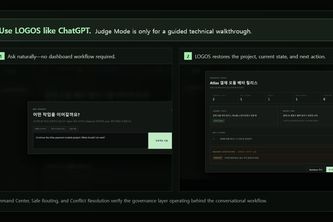
- Includes a "Judge Mode" for workflow demonstration.
It is built with React, TypeScript, Vite, Node.js, Docker, SQLite, and the OpenAI Responses API. The system is described as portable and deployable without npm or API keys.
Inference The product appears to be a structured, state-aware interface for managing AI-assisted workflows where canonical truth must be preserved through explicit approval.
Positioning & Claim Evolution
The author states:
- AI assistants are increasingly used for long-running projects.
- The main failure is not forgetting details but "remembering something with the wrong authority."
- LOGOS Continuity addresses this by making authority, verification, and provenance explicit.
- It is positioned as solving problems like treating an old state as current or unverified claims as completed.
Inference The positioning evolved from a general AI tool to one focused on continuity — not just retrieval or generation, but managing the state of AI work over time with clear authority and provenance.
Target Customer & ICP
The description does not state who the target customer is. It only describes the problem: "AI assistants are increasingly used for projects that span days, weeks, and many separate conversations."
Inference Based on the problem statement, the likely ICP includes users working on long-running AI-assisted projects — possibly developers, researchers, or knowledge workers who rely heavily on AI tools over time.
Business Model & Pricing Evidence
The description states:
- No account, payment, or API key is required to use LOGOS.
- The app is deployed on Render and can be accessed via a public instance.
- It is described as a "public product experience" rather than a commercial offering.
Inference There is no evidence of a pricing model or business model beyond the public demo. No revenue, subscriptions, or monetization strategy are mentioned.
Technical & Delivery Signals
The description states:
- Built with React, TypeScript, Vite, Node.js 24, SQLite.
- Uses GPT-5.6 via OpenAI Responses API.
- Deterministic rules enforce approval gates and prevent model output from changing canonical state.
- The system is packaged with Docker and deployed on Render.
- A portable judge build runs without npm, pnpm, or a build step.
- Codex was used for schema design, implementation, testing, and UI fixes.
Inference The technical stack suggests a lightweight, portable, and modular architecture. Use of deterministic rules and approval gates implies a strong focus on safety and control.
Traction & Maturity Signals
The description states:
- Built as a public demo for the OpenAI 2026 hackathon.
- Passed 54 automated tests.
- Underwent a full public browser rehearsal.
- Includes Judge Mode, which demonstrates workflow in under three minutes.
- No mention of users, customers, or revenue.
Inference There is no evidence of traction beyond a hackathon submission. The product is described as a prototype with no commercial deployment or user base.
Competitive Context
The description does not mention any competitors. It focuses on the problem and solution without reference to existing tools or platforms in this space.
Inference No competitive landscape is evident from the description. The author does not claim to be solving a known market gap, nor does it name any similar tools.
Open Questions & Risks
- No evidence of traction or adoption: The product is described as a hackathon demo with no users or revenue.
- Unverified claims: The author states GPT-5.6 is used for structured classification but does not provide data on its performance or reliability.
- Unclear commercial viability: No pricing, monetization strategy, or business model is evident.
- No user feedback or studies: The description mentions “user studies” as a future goal but does not report any conducted.
- Unproven scalability: The system is described as portable and lightweight but lacks evidence of performance under load or in production.
Questions the description leaves open
- What specific use cases are you targeting, and how do they differ from existing tools?
- How does the system handle conflicts between user input and model output in practice?
- Is there any data on how often users need to approve or reject canonical changes?
- What is your plan for scaling beyond a single-user, public demo?
- Are you planning to integrate with existing AI workspaces or tools (e.g., GitHub, Notion)?
- How do you intend to monetize this product, if at all?
Overall Assessment
Not evidenced.
The description is self-reported and unverified. There is no evidence of revenue, customers, traction, or a clear path to commercialization. The project is described as a hackathon demo with no indication of real-world usage or adoption.
Confidence level Low This analysis is based entirely on the author's own account. No third-party validation, user data, or financials are available.
User Stories BotA demo video on every pull request
Get a demo video on every new feature
GitHub App that watches your pull requests and records a narrated, captioned demo.
Save time on demo prep and make informed decisions faster with a video walkthrough of every new feature.
Source
Submitted to the OpenAI 2026 hackathon on Devpost. Project home on Devpost. Back to the full gallery on Devpost.
This competitive analysis was produced by top-founders.com (opens in a new tab)
Generated by a language model from this project's public Devpost page — its tagline, the author's own write-up and any built-with tags listed there — as captured in August 2026. Short quotations are the author's words. It is an opinion on the idea as a business, not on the people behind it, and it reflects the description as published then. If the project has moved on, request a correction below. The analysis is not independent research and contains no verified traction, revenue or customer data.
An independent guide by KFG International LLC — not affiliated with, endorsed by, or connected to Devpost or OpenAI.