

Archive position — measured, not model output
0 likes on Devpost
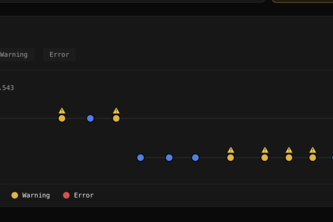
2,263 of the 7,850 archived projects have more likes, and 5,587 share exactly 0 — so this project's #5,061 place in the like-ranked listing is a tie-break inside that group, not a ranking.
Projects (log scale)
Likes on Devpost. ▲ marks this project's group.
Show the figures
| Likes | Projects | Share of archive |
|---|---|---|
| 0 | 5,587 | 71.2% |
| 1 | 1,758 | 22.4% |
| 2 | 284 | 3.6% |
| 3–4 | 132 | 1.7% |
| 5–9 | 75 | 1.0% |
| 10+ | 14 | 0.2% |
 User Stories BotA demo video on every pull request
Get a demo video on every new feature
GitHub App that watches your pull requests and records a narrated, captioned demo.
Save time on demo prep and make informed decisions faster with a video walkthrough of every new feature.
Executive Summary
What the company appears to be: LogWeave is a terminal-first incident investigation tool for developers and SREs, built as a hackathon project. It allows engineers to enter an event ID, trace ID, or request ID and retrieve correlated logs from a log provider (currently Better Stack), print raw evidence in the terminal, and use GPT-5.6 to generate a root-cause investigation report. The tool also supports local history and cross-investigation chat.
What changed: The project was built over a short timeframe as part of the OpenAI 2026 hackathon. It is described as a proof-of-concept with no revenue, customers or traction beyond its own author's claims.
Single most important open question: Is there any evidence that this tool has been adopted by developers or SREs in real-world environments, and if so, what is the nature of that adoption?
What The Product Actually Is
The description states that LogWeave is a terminal-first incident investigation tool for developers and SREs. It retrieves correlated logs from a log provider (initially Better Stack), prints raw evidence in the terminal, and uses GPT-5.6 to build an AI-assisted root-cause investigation.
It also includes:
- A local web report showing comprehensive investigation reports.
- History functionality that lets engineers compare selected investigations.
- Cross-investigation chat that allows AI to answer questions about shared causes, services, and recurring patterns across incidents.
Inferred: The tool is designed for use in distributed systems where engineers need to trace events across multiple services and regions. It aims to reduce the time spent correlating logs manually by automating parts of the root-cause analysis process through AI.
Positioning & Claim Evolution
The description states that LogWeave was inspired by the idea that an engineer should be able to start with one event ID and immediately follow evidence across services first in the terminal, then in an AI-assisted root-cause investigation. The goal is not to replace engineers' judgment but to remove tedious correlation work so they can focus on fixing failures.
The author claims:
- LogWeave removes the need for engineers to manually correlate scattered logs.
- It turns individual investigations into operational memory over time.
- It supports both local and future hosted team experiences.
- It aims to build a shared reliability memory that surfaces similar past incidents and fixes.
Inferred: The positioning has evolved from a simple CLI-based log tracer to a tool that could eventually support collaborative incident response and long-term reliability insights. However, the current version is described as a prototype with no production deployment or user feedback.
Target Customer & ICP
The description states that LogWeave targets developers and SREs who work in distributed systems where incidents occur across multiple services and regions.
Inferred: The primary users are likely engineers working on complex software infrastructures, such as those found in large tech companies or cloud-native environments. These users would benefit from tools that reduce the time spent correlating logs and identifying root causes.
Not evidenced: No specific customer segments, personas, or use cases beyond general developer/SRE roles were provided.
Business Model & Pricing Evidence
The description does not provide any information about pricing, monetization strategy, or business model. It is unclear whether LogWeave intends to be a freemium product, sold as part of a larger platform, or offered through enterprise licensing.
Not evidenced: No evidence of revenue streams, pricing tiers, or commercial arrangements.
Technical & Delivery Signals
The description states that LogWeave was built using:
- Codex with GPT-5.6 Terra and medium reasoning
- Better Stack as the initial log provider
- JavaScript, Next.js, Node.js, Tailwind, TypeScript for frontend/backend components
It uses OpenAI's API with gpt-5.6-terra and medium reasoning effort for two tasks:
- Root-cause investigation: structured output reconstructs a timeline, identifies anomalies, distinguishes observed evidence from inference, and explains the probable root cause.
- Cross-investigation chat: GPT-5.6 receives only selected investigations and answers questions about shared causes, services, and repeated incident patterns.
Inferred: The tool is built with modern web technologies and leverages AI for structured outputs. It supports local execution and has a CLI-first interface, which suggests ease of adoption for developers.
Not evidenced: No details on scalability, performance metrics, or integration capabilities beyond Better Stack.
Traction & Maturity Signals
The description indicates that LogWeave is a hackathon project submitted to the OpenAI 2026 hackathon. It was built in a short timeframe and has no evidence of:
- Revenue
- Customers
- Adoption
- Product-market fit
- Iteration beyond initial prototype
Not evidenced: No traction data, user feedback, or market validation.
Competitive Context
The description does not mention any competitors or existing tools in the space. It is unclear whether similar solutions already exist in the market for distributed log tracing and AI-assisted root-cause analysis.
Inferred: The tool likely competes with existing logging platforms like Datadog, Splunk, or internal observability tools used by SREs and developers. However, no direct comparison or competitive positioning was provided.
Not evidenced: No mention of competitors, market size, or differentiation strategies.
Open Questions & Risks
- Unverified AI outputs: The description notes that producing dependable AI output is hard due to the probabilistic nature of GPT models. This raises concerns about reliability and trustworthiness in critical incident scenarios.
- Limited scope: The tool currently runs locally and saves investigations on one developer's machine, limiting its utility for team-based collaboration or enterprise use cases.
- No commercial viability: As a hackathon project with no evidence of revenue or customer traction, there is uncertainty about whether it will evolve into a viable product or service.
- Dependency on AI model: The tool relies heavily on GPT-5.6, which may not be available long-term or could change in ways that break compatibility.
- Lack of production experience: There is no indication that the tool has been tested in real-world environments or used by actual teams.
Questions the description leaves open
- What specific problems are you solving for developers and SREs, and how do you know these problems exist?
- How does LogWeave handle false positives or misleading AI conclusions?
- Are there any plans to integrate with other logging providers beyond Better Stack?
- What is the expected timeline for moving from prototype to a production-ready product?
- Have you tested this tool with real users or teams in actual incident response workflows?
- How do you plan to address data privacy and access control concerns when sharing logs and investigations within teams?
- What are your thoughts on building a hosted version of the platform, and what features would be required for that transition?
Overall Assessment
The description states that LogWeave is a hackathon project submitted to the OpenAI 2026 hackathon. There is no evidence of revenue, customers, traction, or any commercial activity beyond its own self-description.
Not evidenced: No financials, user base, partnerships, or investment history are available.
Inferred: While the concept shows promise in addressing a common pain point for developers and SREs, the lack of real-world usage, validation, or business model makes it difficult to assess whether this project is ready for investment or partnership. The tool remains at a very early stage of development with no clear path to monetization or scalability.
The author states that the tool supports local-only execution and needs further development to support hosted team experiences and shared reliability memory. This suggests significant work remains before any commercial viability can be assessed.
User Stories BotA demo video on every pull request
Get a demo video on every new feature
GitHub App that watches your pull requests and records a narrated, captioned demo.
Save time on demo prep and make informed decisions faster with a video walkthrough of every new feature.
Source
Submitted to the OpenAI 2026 hackathon on Devpost. Project home on Devpost. Back to the full gallery on Devpost.
This competitive analysis was produced by top-founders.com (opens in a new tab)
Generated by a language model from this project's public Devpost page — its tagline, the author's own write-up and any built-with tags listed there — as captured in August 2026. Short quotations are the author's words. It is an opinion on the idea as a business, not on the people behind it, and it reflects the description as published then. If the project has moved on, request a correction below. The analysis is not independent research and contains no verified traction, revenue or customer data.
An independent guide by KFG International LLC — not affiliated with, endorsed by, or connected to Devpost or OpenAI.