

Archive position — measured, not model output
0 likes on Devpost
2,263 of the 7,850 archived projects have more likes, and 5,587 share exactly 0 — so this project's #5,063 place in the like-ranked listing is a tie-break inside that group, not a ranking.
Projects (log scale)
Likes on Devpost. ▲ marks this project's group.
Show the figures
| Likes | Projects | Share of archive |
|---|---|---|
| 0 | 5,587 | 71.2% |
| 1 | 1,758 | 22.4% |
| 2 | 284 | 3.6% |
| 3–4 | 132 | 1.7% |
| 5–9 | 75 | 1.0% |
| 10+ | 14 | 0.2% |
 User Stories BotA demo video on every pull request
Get a demo video on every new feature
GitHub App that watches your pull requests and records a narrated, captioned demo.
Save time on demo prep and make informed decisions faster with a video walkthrough of every new feature.
Executive Summary
What the company appears to be
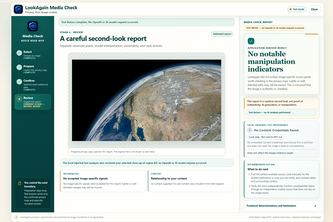
LookAgain Media Check is a browser-based tool designed to help users inspect suspicious images using privacy-first methods. It allows users to analyze JPEG, PNG, or static WebP images locally in their browser before optionally sending a privacy-stripped copy for GPT-5.6 review.
What changed
The project evolved from an existing browser-safety extension (LookAgain) into a standalone application focused on image inspection during Build Week. It introduces new functionality around local image analysis and optional cloud-based review using GPT-5.6.
Single most important open question — the commercial due-diligence read
Is there any evidence of user adoption, market demand, or traction beyond the author's own development efforts?
What The Product Actually Is
The description states that LookAgain Media Check is a browser-based tool for inspecting suspicious images. It performs local image analysis and can optionally send a privacy-stripped copy to GPT-5.6 for further review.
Key technical elements include:
- Browser-local inspection of original-file signals, metadata categories, file-format mismatches, and Content Credentials.
- Automatic detection of repeated or copied regions without requiring manual input.
- A privacy-stripped copy is created and shown to the user before any data leaves the device.
- Optional GPT-5.6 review that examines visible-pixel details such as edges, lighting, shadows, texture consistency, and plausible non-deceptive alternatives.
- The tool separates local evidence from GPT evidence, with application code validating responses and producing one of three cautious summaries: "No notable manipulation indicators", "Weak manipulation indicators", or "Moderate manipulation indicators".
The product is built using technologies like JavaScript, Node.js, Playwright, OpenAI GPT-5.6, AJV, C2PA, JSFeat, and others.
Evidence Self-reported by author; no independent verification provided.
Positioning & Claim Evolution
The author positions the tool as a privacy-first solution that slows down decision-making rather than acting like a truth machine. The goal is to help users inspect available evidence and decide what to verify next.
Key claims:
- The tool does not label images as “real” or “fake”.
- It avoids creating new dangers when wrong by providing cautious summaries.
- It helps ordinary people deal with online deception.
- It emphasizes transparency, user control, and privacy boundaries.
- GPT-5.6 is an optional second opinion, not the sole source of evidence.
The positioning has evolved from a general browser-safety project to a focused image inspection tool during Build Week.
Evidence Self-reported; no external validation or market positioning data.
Target Customer & ICP
The description indicates that the target customer is "ordinary people" who are dealing with online deception and need tools to inspect suspicious images.
There is no explicit segmentation beyond this general audience. The tool appears aimed at individuals rather than enterprises or specific professional groups.
Evidence Self-reported; no indication of specific customer segments, personas, or use cases beyond the author’s stated intent.
Business Model & Pricing Evidence
No business model or pricing information is provided in the description.
The tool is described as a standalone application built during a hackathon and not yet commercialized. There is no mention of monetization strategies, subscriptions, or paid features.
Evidence Not evidenced.
Technical & Delivery Signals
The project combines:
- Browser-local image preparation and hashing;
- Bounded original-file inspection;
- Offline Content Credentials validation;
- Deterministic browser-local duplicate-region detector;
- Loopback-only local analysis server;
- OpenAI Responses API with GPT-5.6;
- Strict JSON-schema and semantic validation;
- Explicit consent and sent/not-sent controls;
- Accessible, responsive report presentation;
- Unit, security, browser, formatting, syntax, secret-scan, and deterministic-build checks.
It includes:
- A test mode without provider access.
- Recorded controlled GPT-5.6 examples for judges.
- Extensive automated testing (152 unit tests, 50 security tests, etc.).
The author notes that Codex was used to accelerate development but that all major decisions were retained and approved by the author.
Evidence Self-reported; no third-party validation or delivery performance data.
Traction & Maturity Signals
There is no evidence of user adoption, revenue, customer base, or market traction beyond the author’s own development efforts.
The project was submitted to a hackathon and described as a working prototype, not a product in production. It includes no mention of users, usage metrics, or product maturity indicators.
Evidence Not evidenced.
Competitive Context
No competitive landscape or comparison with existing tools is provided in the description.
The author does not reference competitors or similar products in the market for image inspection or media verification.
Evidence Not evidenced.
Open Questions & Risks
- Lack of traction: No evidence of users, customers, or adoption beyond the author’s own development.
- Unproven commercial viability: The tool is presented as a hackathon submission and not yet monetized.
- Dependency on GPT-5.6: While optional, the inclusion of GPT-5.6 raises questions about scalability and cost if it becomes a core feature.
- Unclear long-term strategy: The author mentions future steps but does not provide clarity on execution plans or roadmap.
- No data on accuracy or reliability: No false-positive/negative measurements or performance benchmarks are shared.
Evidence Inferred from lack of stated traction, business model, or competitive context.
Questions the description leaves open
- What is the intended user base beyond "ordinary people"? Are there specific demographics or use cases?
- Has there been any user testing or feedback on the interface and workflow?
- How does the team plan to scale beyond a single developer?
- Is there any intention to monetize this tool, and if so, how?
- What are the plans for integrating with existing browser extensions or platforms?
- Are there any partnerships or collaborations in development or distribution?
- How will the tool handle edge cases or ambiguous results from GPT-5.6?
- What is the timeline for moving beyond the prototype phase?
Evidence Inferred from lack of stated information.
Overall Assessment
There is no evidence of revenue, customers, traction, or commercial viability beyond the author’s own development efforts. The project is described as a hackathon submission and not yet in production or market-ready form.
The tool shows technical sophistication and clear attention to privacy and user control, but lacks any indication of real-world demand or business momentum.
Confidence Level Low — based entirely on self-reported description with no external validation or traction data.
Assessment Not ready for investment or partnership consideration without further evidence of market fit, adoption, or commercialization strategy.
User Stories BotA demo video on every pull request
Get a demo video on every new feature
GitHub App that watches your pull requests and records a narrated, captioned demo.
Save time on demo prep and make informed decisions faster with a video walkthrough of every new feature.
Source
Submitted to the OpenAI 2026 hackathon on Devpost. Project home on Devpost. Back to the full gallery on Devpost.
This competitive analysis was produced by top-founders.com (opens in a new tab)
Generated by a language model from this project's public Devpost page — its tagline, the author's own write-up and any built-with tags listed there — as captured in August 2026. Short quotations are the author's words. It is an opinion on the idea as a business, not on the people behind it, and it reflects the description as published then. If the project has moved on, request a correction below. The analysis is not independent research and contains no verified traction, revenue or customer data.
An independent guide by KFG International LLC — not affiliated with, endorsed by, or connected to Devpost or OpenAI.