

Archive position — measured, not model output
0 likes on Devpost
2,263 of the 7,850 archived projects have more likes, and 5,587 share exactly 0 — so this project's #5,055 place in the like-ranked listing is a tie-break inside that group, not a ranking.
Projects (log scale)
Likes on Devpost. ▲ marks this project's group.
Show the figures
| Likes | Projects | Share of archive |
|---|---|---|
| 0 | 5,587 | 71.2% |
| 1 | 1,758 | 22.4% |
| 2 | 284 | 3.6% |
| 3–4 | 132 | 1.7% |
| 5–9 | 75 | 1.0% |
| 10+ | 14 | 0.2% |
 User Stories BotA demo video on every pull request
Get a demo video on every new feature
GitHub App that watches your pull requests and records a narrated, captioned demo.
Save time on demo prep and make informed decisions faster with a video walkthrough of every new feature.
Executive Summary
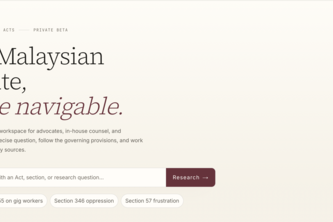
What the company appears to be: Locus is a self-reported AI legal research assistant for Malaysian legislation, built as a hackathon project. The author states it helps users research AGC Acts through English, Bahasa Malaysia, or mixed-language queries and provides citations with direct links to PDF sources.
What changed: This is a single-person project submitted to the OpenAI 2026 hackathon. No evidence of prior development, funding, traction or commercial activity exists beyond the author’s own description.
Single most important open question: Is there any evidence that Locus has been adopted by legal practitioners or has begun generating revenue, or is it purely a proof-of-concept?
What The Product Actually Is
The description states that Locus is a Malaysian legal research assistant built for the Attorney General’s Chambers (AGC) portal. It allows users to ask questions in English, Bahasa Malaysia, or a mix of both and receive answers with citations to relevant Acts, sections, and PDF pages.
It includes:
- A Citation Receipt viewer, which shows the exact PDF source used as a reference.
- The ability to highlight supporting text within that PDF when it can be uniquely matched.
- A system to validate citations before delivery.
- A focus on legislation research, not legal advice.
The product is built using:
- Scraping of Malaysian Acts from AGC portal
- Text extraction and section splitting
- pgvector database for retrieval
- LangGraph and FastAPI for response generation
- Next.js frontend
Inference: The author describes a tool that functions as an AI-powered legal research assistant with citation verification features. However, no evidence exists of actual deployment or usage beyond the project’s submission.
Positioning & Claim Evolution
The description states:
- Locus is built for legal research, not legal advice.
- It is focused on Malaysian legislation and cited to AGC Acts.
- It supports English, Bahasa Malaysia, and mixed-language queries.
- It emphasizes trustworthiness through citation validation and source verification.
The author claims:
- The tool was inspired by Harvey (a legal AI assistant).
- It aims to provide answers grounded in real sources rather than sounding convincing.
- It avoids giving legal advice and routes client-specific questions to human lawyers.
Inference: The positioning is that of a trustworthy, localized legal research tool, focused on Malaysian law. There is no evidence of broader market positioning or branding beyond the author’s own claims.
Target Customer & ICP
The description states:
- Locus is built for legal researchers, particularly those working with Malaysian legislation.
- It supports English, Bahasa Malaysia, and mixed-language users.
- The tool is intended to help verify AI-generated answers against original sources.
Inference: The target customer appears to be legal professionals or students in Malaysia, who need access to accurate, traceable legal information. No evidence of specific personas, usage patterns, or segmentation beyond the author’s own description.
Business Model & Pricing Evidence
The description does not state:
- Any pricing model
- Revenue streams
- Monetization strategy
- Subscription plans or paywalls
Inference: There is no evidence of a business model or pricing structure. The project is described as a hackathon submission, with no indication of commercial viability or monetization.
Technical & Delivery Signals
The description states:
- Built using LangGraph, FastAPI, and Next.js
- Scrapes Malaysian Acts from AGC portal
- Stores text in pgvector for retrieval
- Uses PDF extraction metadata and text coordinates to support the Citation Receipt viewer
- Implements citations validation before answers are shown
Inference: The technical stack suggests a proof-of-concept with some backend sophistication, including vector search and PDF handling. However, no evidence of production deployment or scalability.
Traction & Maturity Signals
The description states:
- It is a hackathon project
- Built by one person (aishahsofea Muhamad Hanifa)
- No mention of users, customers, or adoption
- No evidence of revenue, funding, or growth metrics
Inference: There is no evidence of traction, customers, or maturity beyond the author’s own account. The project has not been commercialized or scaled.
Competitive Context
The description does not mention:
- Competitors
- Market size
- Existing solutions in the legal AI space
Inference: No competitive context is provided. It is unclear whether Locus competes with other legal research tools, and no evidence of market analysis or differentiation exists.
Open Questions & Risks
- Single-person project: No team, no funding, no traction.
- No commercialization: Not monetized, not deployed for real use.
- Unverified claims: All features and functionality are self-reported.
- No evidence of adoption: No users or feedback from legal practitioners.
- Limited scope: Focused only on AGC Acts, with no indication of expansion plans.
Inference: The project is a proof-of-concept, not a product in development. It lacks commercial viability and real-world application.
Questions the description leaves open
- What is the source of the AGC legislation used? Is it current, and how often is it updated?
- Has the tool been tested or validated by legal practitioners?
- Are there any plans to expand beyond AGC Acts or to other legal domains (e.g., case law)?
- How does Locus handle discrepancies in PDF versions or translations?
- What are the long-term goals for this project — is it intended to be commercialized?
- Has the author considered scalability, data privacy, and compliance with Malaysian legal regulations?
Overall Assessment
Not evidenced.
The description states that Locus is a hackathon submission, built by one person, with no evidence of traction, revenue, or adoption. It is not clear whether this project has moved beyond the prototype stage or has any commercial potential.
Confidence level: Low — based on self-reported, unverified information only.
Assessment: This is a conceptual tool with no demonstrated commercial viability or market traction. It does not meet criteria for investment or partnership at this time.
User Stories BotA demo video on every pull request
Get a demo video on every new feature
GitHub App that watches your pull requests and records a narrated, captioned demo.
Save time on demo prep and make informed decisions faster with a video walkthrough of every new feature.
Source
Submitted to the OpenAI 2026 hackathon on Devpost. Project home on Devpost. Back to the full gallery on Devpost.
This competitive analysis was produced by top-founders.com (opens in a new tab)
Generated by a language model from this project's public Devpost page — its tagline, the author's own write-up and any built-with tags listed there — as captured in August 2026. Short quotations are the author's words. It is an opinion on the idea as a business, not on the people behind it, and it reflects the description as published then. If the project has moved on, request a correction below. The analysis is not independent research and contains no verified traction, revenue or customer data.
An independent guide by KFG International LLC — not affiliated with, endorsed by, or connected to Devpost or OpenAI.