

Archive position — measured, not model output
0 likes on Devpost
2,263 of the 7,850 archived projects have more likes, and 5,587 share exactly 0 — so this project's #7,018 place in the like-ranked listing is a tie-break inside that group, not a ranking.
Projects (log scale)
Likes on Devpost. ▲ marks this project's group.
Show the figures
| Likes | Projects | Share of archive |
|---|---|---|
| 0 | 5,587 | 71.2% |
| 1 | 1,758 | 22.4% |
| 2 | 284 | 3.6% |
| 3–4 | 132 | 1.7% |
| 5–9 | 75 | 1.0% |
| 10+ | 14 | 0.2% |
 User Stories BotA demo video on every pull request
Get a demo video on every new feature
GitHub App that watches your pull requests and records a narrated, captioned demo.
Save time on demo prep and make informed decisions faster with a video walkthrough of every new feature.
Executive Summary
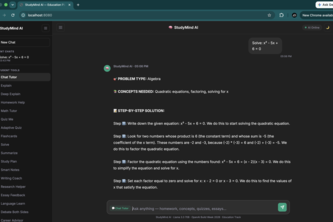
StudyMind AI is a self-reported 33-feature AI education platform built by one developer (Abhishek Deshmukh) in under 48 hours using Flask, Groq API, Llama 3.3-70B, and GitHub Copilot. The platform claims to offer free, real-time AI tutoring tools for students and teachers across subjects like math, writing, research, and career guidance.
The author states that the goal is to provide "a brilliant, patient, always-available tutor - completely free" to students who cannot afford private tutoring, with a focus on accessibility and educational equity. The platform includes features such as Chat Tutor, Homework Help, Math Tutor, Writing Coach, and Teacher Tools like Lesson Plan and Grade Rubric.
Key commercial due-diligence questions include:
- Is there any evidence of user adoption or feedback?
- What is the actual business model beyond "free"?
- How does the team plan to scale beyond a single developer?
- Are there any competitors already offering similar tools?
The most important open question: What traction, revenue, or customer data supports the claim that this platform will be adopted at scale?
What The Product Actually Is
The description states that StudyMind AI is a 33-feature AI education platform built with:
- Frontend: HTML5, CSS3, Vanilla JavaScript (ES6+)
- Backend: Python 3.13, Flask 3.0
- AI Engine: Groq API → Llama 3.3-70B-Versatile
- Streaming: Server-Sent Events (SSE) for real-time word-by-word output
- Storage: localStorage for chat history and saved notes
- Speech: Web Speech API for Read Aloud functionality
Features are organized into three categories:
- Student Tools (19 features): Chat Tutor, Homework Help, Math Tutor, Adaptive Quiz, Writing Coach, Research Helper, Career Advisor, Language Learn, Debate, Flashcards, Smart Notes, Essay Feedback, Study Plan
- Teacher Tools (2 features): Lesson Plan, Grade Rubric
- Power Tools (7 features): Mind Map, Test Prep, Coding Help, Timeline, Science Lab, Reading Guide, Vocabulary
The platform is described as having real-time streaming capabilities with first token under 500ms, and uses a structured prompt engineering approach across all features.
Positioning & Claim Evolution
The author positions StudyMind AI as:
- A free, world-class AI tutor for every student
- An alternative to expensive private tutoring ($50–$150/hour)
- A solution to the global problem of 300 million+ students with no access to quality tutoring
- A tool that addresses ineffective study strategies (70% of students use passive re-reading)
- A platform built to tear down barriers in education by making AI accessible
The claim evolution shows:
- Initial inspiration from personal experience watching classmates struggle due to cost
- A shift toward a scalable, open-source solution using AI and web technologies
- Expansion from basic tutoring to include teacher tools and gamification plans
- Long-term vision of becoming the default free tutoring tool for public schools
The positioning emphasizes accessibility, equity, and education-first design.
Target Customer & ICP
The description states that StudyMind AI targets:
- Students who cannot afford private tutoring
- Public school students, especially in underfunded districts
- Teachers spending time on administrative tasks instead of teaching
- Users seeking structured learning tools rather than general chatbots
The author claims the platform works for both a 7th grader and a PhD student because it adapts responses based on grade level.
No specific ICP segmentation beyond these broad categories is provided. The focus appears to be on mass accessibility rather than niche targeting.
Business Model & Pricing Evidence
The description states that StudyMind AI is:
- Completely free for users
- Built using Groq's free tier (Llama 3.3-70B)
- Designed to run at zero cost to end-users
There is no evidence of any monetization strategy, subscription model, or paid features mentioned in the description.
The author mentions that the platform is built with the goal of making AI tutoring universally accessible, implying a non-commercial, open-source ethos.
Technical & Delivery Signals
Key technical signals from the description:
- Real-time streaming via Server-Sent Events (SSE) for word-by-word output
- First token under 500ms perceived latency
- Prompt engineering with 3-layer system: System Prompt, Task Prompt, Parameters
- GitHub Copilot used extensively for development (70% of codebase)
- Built in 48 hours by one developer
- Uses Flask + Python backend, HTML/CSS/JS frontend
- No external dependencies beyond Groq API and Llama 3.3-70B
Delivery signals:
- All 33 features tested and connected to UI
- Chat history saved in localStorage
- Responsive UI with dark/light mode, Read Aloud, mobile support
- Full architecture documentation including ASCII diagrams and API reference
Traction & Maturity Signals
Not evidenced.
The description contains no data on:
- User adoption or engagement metrics
- Customer feedback or testimonials
- Revenue or monetization attempts
- Deployment or usage statistics
- Product iteration history or user testing results
The only maturity signal is that the platform was built in 48 hours with GitHub Copilot and includes full documentation.
Competitive Context
Not evidenced.
The description does not mention:
- Competitors in the AI education space
- Existing platforms offering similar tools
- Market positioning relative to other edtech solutions
- Differentiation strategies or competitive advantages
No information is provided about how StudyMind AI compares to existing AI tutoring platforms or educational tools.
Open Questions & Risks
- Single Developer Dependency: The platform was built by one person (Abhishek Deshmukh), raising concerns about scalability, maintenance, and long-term support.
- No Revenue Model: The platform is described as completely free with no monetization strategy, which raises questions about sustainability and future development.
- Unverified Claims: All claims about impact, effectiveness, and user experience are self-reported without independent verification or data.
- Limited Traction: No evidence of actual users, usage metrics, or customer feedback.
- Technical Limitations: Reliance on Groq's free tier may limit performance or availability in production environments.
- Scalability Concerns: The use of localStorage for storage and a single-person development team suggest limited scalability.
Questions the description leaves open
- What is the actual user base or adoption rate, if any?
- How do you plan to monetize or sustain the platform beyond free access?
- What are your plans for scaling beyond one developer?
- Have you tested the platform with real students or teachers? What feedback have you received?
- How will you handle technical limitations of Groq’s free tier in production?
- What is your roadmap for user authentication, progress tracking, and gamification features?
- Are there any legal or compliance issues related to AI-generated content in education?
- How do you plan to ensure consistent quality across all 33 features?
Overall Assessment
Not evidenced.
There is no evidence of:
- Revenue streams
- Customer acquisition or retention metrics
- Market validation or user traction
- Financial projections or funding history
- Strategic partnerships or integrations
The description presents a self-reported vision and technical implementation but lacks any commercial due-diligence signals that would support an investment or partnership decision.
This is a highly speculative project based on a single developer's effort, with no demonstrated market traction or business viability. The platform is presented as a proof-of-concept or prototype rather than a scalable product.
User Stories BotA demo video on every pull request
Get a demo video on every new feature
GitHub App that watches your pull requests and records a narrated, captioned demo.
Save time on demo prep and make informed decisions faster with a video walkthrough of every new feature.
Source
Submitted to the OpenAI 2026 hackathon on Devpost. Project home on Devpost. Back to the full gallery on Devpost.
This competitive analysis was produced by top-founders.com (opens in a new tab)
Generated by a language model from this project's public Devpost page — its tagline, the author's own write-up and any built-with tags listed there — as captured in August 2026. Short quotations are the author's words. It is an opinion on the idea as a business, not on the people behind it, and it reflects the description as published then. If the project has moved on, request a correction below. The analysis is not independent research and contains no verified traction, revenue or customer data.
An independent guide by KFG International LLC — not affiliated with, endorsed by, or connected to Devpost or OpenAI.