

Archive position — measured, not model output
1 like on Devpost
505 of the 7,850 archived projects have more likes, and 1,758 share exactly 1 — so this project's #1,371 place in the like-ranked listing is a tie-break inside that group, not a ranking.
Projects (log scale)
Likes on Devpost. ▲ marks this project's group.
Show the figures
| Likes | Projects | Share of archive |
|---|---|---|
| 0 | 5,587 | 71.2% |
| 1 | 1,758 | 22.4% |
| 2 | 284 | 3.6% |
| 3–4 | 132 | 1.7% |
| 5–9 | 75 | 1.0% |
| 10+ | 14 | 0.2% |
 User Stories BotA demo video on every pull request
Get a demo video on every new feature
GitHub App that watches your pull requests and records a narrated, captioned demo.
Save time on demo prep and make informed decisions faster with a video walkthrough of every new feature.
Executive Summary
What the company appears to be
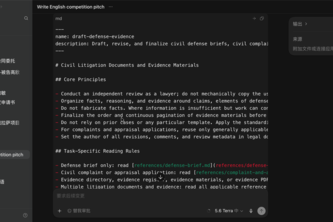
Litigraft AI is a self-reported AI-powered workflow tool designed for civil litigation drafting in the PRC (People’s Republic of China). It claims to transform case materials into evidence-grounded legal documents such as defense briefs, evidence directories, and court-ready evidence bundles. The system is described as a reusable process that enforces constraints to improve accuracy, traceability, and professional judgment.
What changed
The author states they built this tool after identifying inefficiencies in their own practice — specifically, the difficulty of turning scattered materials into coherent, consistent legal arguments without overstatement or inconsistency. The project was submitted to the OpenAI 2026 hackathon.
Single most important open question
Is there any evidence of real-world use or adoption by legal practitioners beyond the author’s personal experience?
What The Product Actually Is
The description states that Litigraft AI is a reusable AI workflow for PRC civil litigation drafting, intended to help lawyers convert case materials into structured, evidence-grounded documents. It includes:
- A process that reviews cases from a lawyer's perspective.
- Flagging unsupported facts as “To Be Confirmed.”
- Organizing evidence by legal issue and purpose of proof.
- Merging evidence into one ordered PDF with continuous page numbers.
- Backfilling exact page references only after final PDF completion.
- Performing a consistency check across names, dates, amounts, page ranges, signatures, and seals.
This is described as an AI-assisted drafting system, not a general-purpose AI chatbot or document generator. It emphasizes structured output boundaries, validation steps, and constraints to reduce error.
Confidence Low — this is entirely self-reported, with no demonstration of actual functionality or outputs.
Positioning & Claim Evolution
The author positions Litigraft AI as an AI-powered system that improves legal drafting by enforcing discipline, rather than simply generating text. It is framed as a solution to the problem of “plausible but wrong” output in AI-assisted legal work.
Key claims:
- The tool helps lawyers avoid overstating facts or creating inconsistencies.
- It preserves professional judgment and evidence discipline.
- It turns repeated personal workflow corrections into an explicit, reusable skill.
- It makes AI-assisted drafting faster without sacrificing caution, traceability, and professionalism.
These are claims about intent and positioning, not proof of traction or adoption. The author does not describe any prior users or market testing beyond their own use case.
Confidence Very low — all claims are self-reported and unverified.
Target Customer & ICP
The description states that Litigraft AI is intended for practicing lawyers working in PRC civil litigation. It is described as a tool for transforming case materials into court-ready documents, including defense briefs and evidence directories.
There is no indication of:
- Whether the tool targets solo practitioners or firms.
- If it’s designed for specific types of cases (e.g., commercial disputes, family law).
- Any segmentation beyond the general legal profession in China.
Confidence Low — only a broad professional category is mentioned; no clear ICP defined.
Business Model & Pricing Evidence
There is no evidence in the description of:
- A pricing model.
- Revenue streams.
- Monetization strategy.
- Customer acquisition or sales process.
The project is described as a hackathon submission, not a commercial product. The author does not state whether they plan to sell it, license it, or offer it as a service.
Confidence Not evidenced — no business model or pricing data provided.
Technical & Delivery Signals
The description provides some technical details:
- It uses AI to process case materials.
- It enforces a specific sequence: finalize evidence bundle → backfill page references → run consistency checks.
- It outputs structured documents in PDF format with continuous pagination.
- It flags unsupported facts and merges evidence by legal issue.
It is described as a structured workflow, not a general-purpose tool. The author notes that synchronization of multiple deliverables was a major challenge, suggesting the system enforces order and validation.
However, there is no evidence of:
- Technical architecture or platform used.
- API access or integrations.
- Scalability or performance metrics.
- Any demonstration or live functionality.
Confidence Low — technical details are limited to process description, not implementation.
Traction & Maturity Signals
The project is described as a hackathon submission, and the author states that it was built for personal use. There is no evidence of:
- Customers or users.
- Revenue or monetization.
- Product-market fit or adoption.
- Iteration beyond the initial version.
- Any form of product release, testing, or feedback loop.
The team size is listed as 1, and the only member is identified as Yifan Zhang. No external validation or traction data is provided.
Confidence Not evidenced — no signs of traction or maturity beyond a single-person project.
Competitive Context
There is no evidence in the description of:
- Competitors.
- Market dynamics.
- Existing tools for legal drafting or case management.
- How Litigraft AI compares to other solutions.
The author does not reference any existing platforms, tools, or workflows used by lawyers in China. The project appears to be self-contained and unanchored in a competitive landscape.
Confidence Not evidenced — no competitive context provided.
Open Questions & Risks
- Single-person team: No evidence of scaling or support beyond one individual.
- No commercial traction: Submitted as a hackathon project, not a product with users or revenue.
- Unverified claims: All benefits and features are self-reported without independent validation.
- Limited scope: Only described for PRC civil litigation — no indication of broader applicability.
- Unclear monetization path: No evidence of how the tool would be sold or used commercially.
- No demonstration: The project is not shown to function, only described in theory.
Confidence Medium — risks are inferred from lack of evidence and self-reporting.
Questions the description leaves open
- What specific legal cases or materials have you tested this system on?
- How do you ensure that unsupported facts are flagged correctly in real-world use?
- Have you validated the output with practicing lawyers or legal professionals?
- Is there a plan to scale beyond a single user or personal workflow?
- What is your intended business model for monetizing this tool?
- How does the system handle edge cases or unusual legal arguments?
- Are there any plans to integrate with existing legal software or platforms?
Overall Assessment
The project is described as a self-reported hackathon submission by one individual, with no evidence of traction, revenue, or commercial viability. It is positioned as a tool for improving legal drafting in the PRC, but there is no indication that it has been adopted or tested beyond the author’s own use.
Assessment Not ready for investment or partnership at this stage. The project lacks evidence of product-market fit, scalability, or commercialization strategy. Any potential value lies in its conceptual framework, but no real-world validation exists.
Confidence Very low — no evidence of traction, customers, or business model beyond the author’s own account.
User Stories BotA demo video on every pull request
Get a demo video on every new feature
GitHub App that watches your pull requests and records a narrated, captioned demo.
Save time on demo prep and make informed decisions faster with a video walkthrough of every new feature.
Source
Submitted to the OpenAI 2026 hackathon on Devpost. Project home on Devpost. Back to the full gallery on Devpost.
This competitive analysis was produced by top-founders.com (opens in a new tab)
Generated by a language model from this project's public Devpost page — its tagline, the author's own write-up and any built-with tags listed there — as captured in August 2026. Short quotations are the author's words. It is an opinion on the idea as a business, not on the people behind it, and it reflects the description as published then. If the project has moved on, request a correction below. The analysis is not independent research and contains no verified traction, revenue or customer data.
An independent guide by KFG International LLC — not affiliated with, endorsed by, or connected to Devpost or OpenAI.