

Archive position — measured, not model output
1 like on Devpost
505 of the 7,850 archived projects have more likes, and 1,758 share exactly 1 — so this project's #1,373 place in the like-ranked listing is a tie-break inside that group, not a ranking.
Projects (log scale)
Likes on Devpost. ▲ marks this project's group.
Show the figures
| Likes | Projects | Share of archive |
|---|---|---|
| 0 | 5,587 | 71.2% |
| 1 | 1,758 | 22.4% |
| 2 | 284 | 3.6% |
| 3–4 | 132 | 1.7% |
| 5–9 | 75 | 1.0% |
| 10+ | 14 | 0.2% |
 User Stories BotA demo video on every pull request
Get a demo video on every new feature
GitHub App that watches your pull requests and records a narrated, captioned demo.
Save time on demo prep and make informed decisions faster with a video walkthrough of every new feature.
Executive Summary
What the company appears to be
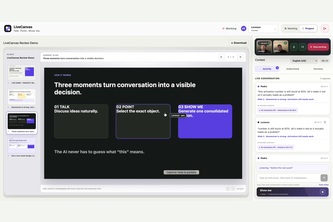
LiveCanvas is a self-reported collaborative visual workspace that integrates live meeting context with AI-powered generation to produce structured UI updates from verbal discussion. It allows participants in a video call to point at components on screen, and when someone presses "Show me", an AI synthesizes decisions into safe, deterministic UI changes.
What changed
The project description is a self-reported submission for the OpenAI 2026 hackathon. No evidence of prior traction, revenue, or customer adoption is provided. The author describes a functional MVP built in under a few months, using a range of technologies including Next.js, React, TypeScript, GPT-5.6, and WebRTC.
Single most important open question
Is there any evidence that LiveCanvas has been used beyond the hackathon demo? If not, what is the path to product-market fit or commercial adoption?
What The Product Actually Is
The description states that LiveCanvas is a collaborative visual workspace with:
- A Meet-style video call interface
- A shared canvas that supports synchronized context
- An action called “Show me” that triggers AI generation
- Real-time synchronization of speech, clicks, screen state, and component metadata
- A deterministic mutation engine that applies only safe UI changes
It is described as a canvas-agnostic protocol, meaning it can work with interfaces, dashboards, reports, prototypes, whiteboards, and author-approved code-backed previews.
The product uses:
- GPT-5.6 for semantic compilation of human discussion into structured UI operations
- Zod for validation of AI outputs
- A component registry that tracks stable IDs, editable properties, and rendering references
- WebRTC and WebSocket protocols for real-time collaboration
- PowerPoint as a demo boundary, but not the product’s final scope
Inference The system is built to support deictic language in meetings — where “this” refers to a specific component — by anchoring conversation to exact UI elements at precise moments.
Positioning & Claim Evolution
The author claims that LiveCanvas turns the meeting itself into the next version of your visual product. It aims to eliminate the "handoff tax" — where teams reconstruct decisions from notes after meetings — and instead ends meetings with a new, updated version of the product.
It positions itself as:
- A visual collaboration tool for creative teams
- A meeting-to-version protocol
- An AI-powered UI editing assistant
The claim evolution shows:
- The problem: "Notes don’t preserve context"
- The solution: “Show me” action that turns conversation into structured UI changes
- The innovation: AI grounded in real-time UI state, not just text
Inference This is a product design and collaboration tool, not a general-purpose AI assistant or meeting recorder.
Target Customer & ICP
The description does not name specific customers or personas. However, it implies:
- Creative teams (designers, developers, founders) who meet to discuss UI/UX
- Product teams working on visual products that can be represented in a canvas
- Meeting-heavy workflows where context is lost in transcription-only tools
The product is described as being built for interfaces, dashboards, reports, prototypes, whiteboards, and author-approved code-backed previews.
Inference The ICP likely includes product managers, UI/UX designers, developers, and creative leads working in visual design or prototyping environments.
Business Model & Pricing Evidence
No evidence of pricing, monetization, or business model is provided. The description only states that the product is a hackathon submission and does not mention any revenue streams, subscriptions, or paid features.
Inference There is no commercial business model evident in the self-reported description.
Technical & Delivery Signals
The project is built with:
- Frontend: React, Next.js, TypeScript, Tailwind CSS
- Backend: Google Cloud Run, WebRTC, WebSocket relay
- AI Integration: GPT-5.6 via OpenAI API, Structured Outputs
- Validation: Zod for schema validation
- Testing: Vitest, Playwright, 117 unit tests, 22 end-to-end journeys
- Deployment: GCP with TURN fallback for restrictive networks
It includes:
- A PowerPoint parser (OOXML)
- Component registry with stable IDs and editable properties
- Shared context clock for synchronized events
- Deterministic mutation engine
- Demo mode that works without permissions or credentials
Inference The architecture is designed to be scalable, secure, and testable, but the MVP is limited to PowerPoint and declarative canvases.
Traction & Maturity Signals
The description states:
- It is an MVP built for a hackathon
- It includes a demo mode that works without permissions or credentials
- It has 117 unit tests and 22 end-to-end journeys
- It was submitted to the OpenAI 2026 hackathon
There is no evidence of:
- Customers, users, or adoption
- Revenue or funding rounds
- Product-market fit or retention metrics
Inference The product is in a pre-commercial stage, likely at MVP or prototype level.
Competitive Context
The description does not mention competitors. However, based on the features described — real-time collaboration, AI-powered UI editing, and visual meeting context — it may compete with:
- Figma + collaborative tools
- Notion + meeting recording tools
- Slack + visual design platforms
It is positioned as a tool that turns meetings into product iterations, which is distinct from existing tools that focus on documentation or asynchronous collaboration.
Inference The competitive landscape is unclear, but the positioning suggests a novel approach to visual collaboration and AI-assisted UI editing.
Open Questions & Risks
- No commercial traction: No evidence of users, customers, or revenue
- Limited scope: MVP only supports PowerPoint and declarative canvases; no code or arbitrary repository support
- AI dependency: Relies heavily on GPT-5.6 for decision synthesis — risks if model quality degrades
- Technical complexity: Real-time synchronization, component registry, and deterministic mutation engine are high-risk engineering challenges
- Unproven adoption: No evidence that teams actually use this in practice beyond a demo
Inference The product is technically ambitious, but lacks commercial validation or user feedback.
Questions the description leaves open
- What is the actual user feedback from the hackathon or any early adopters?
- How does LiveCanvas handle edge cases like multiple participants pointing at different components simultaneously?
- Is there a plan to support more than PowerPoint, such as Figma or code-backed previews?
- What are the limitations of the AI model in terms of accuracy and consistency?
- Are there any plans for monetization or commercial deployment beyond the MVP?
- How does the system handle version control when multiple "Show me" actions are triggered rapidly?
Overall Assessment
Not evidenced.
The description is a self-reported hackathon submission with no evidence of traction, revenue, or customer adoption. The product is technically sophisticated and addresses a real problem in creative collaboration, but it remains at the pre-commercial prototype stage.
Confidence Level Low
Next Steps
If this were a commercial opportunity, due diligence would require:
- Evidence of early user feedback
- Proof of concept with actual teams
- A clear path to monetization or product-market fit
Until such evidence is provided, LiveCanvas remains an unproven idea, not a product ready for investment or partnership.
User Stories BotA demo video on every pull request
Get a demo video on every new feature
GitHub App that watches your pull requests and records a narrated, captioned demo.
Save time on demo prep and make informed decisions faster with a video walkthrough of every new feature.
Source
Submitted to the OpenAI 2026 hackathon on Devpost. Project home on Devpost. Back to the full gallery on Devpost.
This competitive analysis was produced by top-founders.com (opens in a new tab)
Generated by a language model from this project's public Devpost page — its tagline, the author's own write-up and any built-with tags listed there — as captured in August 2026. Short quotations are the author's words. It is an opinion on the idea as a business, not on the people behind it, and it reflects the description as published then. If the project has moved on, request a correction below. The analysis is not independent research and contains no verified traction, revenue or customer data.
An independent guide by KFG International LLC — not affiliated with, endorsed by, or connected to Devpost or OpenAI.