

Archive position — measured, not model output
1 like on Devpost
505 of the 7,850 archived projects have more likes, and 1,758 share exactly 1 — so this project's #1,372 place in the like-ranked listing is a tie-break inside that group, not a ranking.
Projects (log scale)
Likes on Devpost. ▲ marks this project's group.
Show the figures
| Likes | Projects | Share of archive |
|---|---|---|
| 0 | 5,587 | 71.2% |
| 1 | 1,758 | 22.4% |
| 2 | 284 | 3.6% |
| 3–4 | 132 | 1.7% |
| 5–9 | 75 | 1.0% |
| 10+ | 14 | 0.2% |
 User Stories BotA demo video on every pull request
Get a demo video on every new feature
GitHub App that watches your pull requests and records a narrated, captioned demo.
Save time on demo prep and make informed decisions faster with a video walkthrough of every new feature.
Executive Summary
What the company appears to be
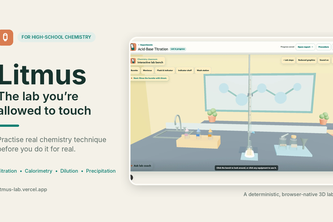
Litmus is an AI-native browser-based chemistry lab simulation platform designed for high school students and teachers. The description states it provides immersive 3D lab experiences with deterministic chemical simulations, live AI coaching, and teacher-authored lab workflows. It uses GPT-5.6 for pedagogy, authoring, and advisory critique, while a deterministic engine handles the core chemistry.
What changed
The project is presented as a self-contained prototype built by one developer (Mingjia Zhang) over a hackathon period. The author describes a significant technical evolution from a hard-coded titration engine to a generalizable chemistry engine that supports multiple experiments and allows AI-based lab composition.
Single most important open question
Is there any evidence of real-world usage, user feedback, or traction with students or teachers? The description is entirely self-reported and lacks any demonstration of adoption, revenue, or customer validation beyond the author’s own claims.
What The Product Actually Is
The description states that Litmus is a browser-based 3D chemistry lab simulation platform. It includes:
- Interactive 3D equipment for students to manipulate.
- Deterministic chemical simulations (based on real chemistry calculations).
- A GPT-5.6 Student Coach offering contextual guidance and safety alerts.
- A Lab Composer tool for teachers to describe learning goals and receive AI-generated lesson plans.
- Support for lab types including acid/base titrations, quantitative precipitation, solution preparation, and mass-based dissolution calorimetry.
The system is built using Next.js, React, TypeScript, React Three Fiber, Zustand, Zod, Supabase, and OpenAI API. The architecture separates deterministic chemistry logic from AI components to ensure scientific accuracy.
Evidence
- Author states: “Litmus provides two connected experiences for students and teachers.”
- Author states: “Students can perform browser-based chemistry labs with interactive 3D equipment.”
- Author states: “A GPT-5.6 Student Coach—reminiscent of a helpful TA—is available to help guide the student through confusing patches.”
Inference The product is described as an educational tool for high school chemistry, but no evidence of actual deployment or usage exists.
Positioning & Claim Evolution
The author positions Litmus as a solution to gaps in U.S. public high school chemistry education:
- Lack of physical lab space.
- Nonimmersive 2D simulations that limit inquiry.
- Students entering labs without understanding procedures.
- Need for rehearsal environments before real-life execution.
The platform is described as an AI-native browser lab where GPT-5.6 adapts pedagogy, but deterministic software remains the authority on chemistry.
Evidence
- Author states: “Over half of U.S. public high schools lack physical lab space...”
- Author states: “I wanted something more active: a rehearsal space where students manipulate equipment, make meaningful mistakes, ask contextual questions, and build confidence before touching the real apparatus.”
- Author states: “At the same time, teachers should not need to become simulation developers.”
Inference The positioning suggests a shift from traditional lab simulations toward an AI-enhanced, student-driven learning environment. However, no evidence of market testing or user validation is provided.
Target Customer & ICP
The author identifies two main customer segments:
- Students – High school students who need to practice chemistry labs before using real equipment.
- Teachers – Who use Lab Composer to create custom lab assignments based on curriculum goals.
The platform is intended for schools with limited physical lab access, particularly in U.S. public high schools.
Evidence
- Author states: “Students can perform browser-based chemistry labs...”
- Author states: “Teachers use Lab Composer to describe a desired lesson.”
Inference While the target market is defined, there is no evidence of actual users or customer engagement beyond the author’s own description.
Business Model & Pricing Evidence
The description does not contain any information about pricing, monetization, or business model. There is no mention of subscription tiers, licensing, or revenue streams.
Evidence
- No statement on how the platform will be monetized.
- No indication of whether it’s free, paid, or B2B.
Inference The business model remains undefined in the self-reported description.
Technical & Delivery Signals
The system is built using a modular architecture that separates AI from deterministic chemistry logic:
- Frontend: React, Next.js, React Three Fiber for 3D rendering.
- State Management: Zustand.
- Validation: TypeScript + Zod.
- Engine: Plain TypeScript for deterministic chemistry and lab mechanics.
- AI Layer: GPT-5.6 via OpenAI API for coaching, authoring, and critique.
- Backend: Supabase for persistence; Vercel serverless functions for API handling.
- Testing: Vitest + Playwright.
The architecture is designed to ensure replayability and scientific accuracy by isolating AI from chemistry logic.
Evidence
- Author states: “Responsibilities are split so that no model output can become scientific truth.”
- Author states: “Deterministic chemistry models own pH, equilibrium, precipitation, conservation, temperature, and enthalpy.”
Inference The technical stack suggests a strong focus on correctness and reproducibility. However, no evidence of production deployment or scalability is provided.
Traction & Maturity Signals
There is no evidence of traction, adoption, or user feedback beyond the author’s own account. The project was submitted to a hackathon and appears to be a prototype built by one person.
Evidence
- Author states: “This project was submitted to the OpenAI 2026 hackathon on Devpost.”
- Author states: “Team size: 1.”
Inference No data on user engagement, retention, or performance metrics is available. The platform has not been demonstrated in a real-world setting.
Competitive Context
The description does not mention competitors or market positioning relative to existing lab simulation tools. It implies that current solutions are limited to 2D and nonimmersive formats.
Evidence
- Author states: “Most virtual labs solve this with fixed animations or step-by-step worksheets.”
- Author states: “Existing lab simulations are 2D and nonimmersive, restricting free student inquiry and exploration.”
Inference While the author positions Litmus as an improvement over current offerings, no competitive analysis or market data is provided.
Open Questions & Risks
- Single Developer: The platform was built by one person (Mingjia Zhang), raising questions about scalability and long-term maintenance.
- No Traction: No evidence of real-world usage, user feedback, or adoption.
- Unverified Claims: All claims are self-reported; no independent validation or third-party data.
- AI Dependency: Heavy reliance on GPT-5.6 for pedagogy and authoring raises risks related to model availability, cost, and consistency.
- Technical Complexity: The described architecture is complex, but there is no evidence of successful deployment or performance testing at scale.
Evidence
- Author states: “Team size: 1.”
- Author states: “This project was submitted to the OpenAI 2026 hackathon on Devpost.”
Questions the description leaves open
- What is the current status of the platform? Is it being used in any classrooms or schools?
- How do you plan to scale beyond a single developer?
- Have you tested the AI components with real students or teachers?
- What are your plans for monetization and distribution?
- How do you ensure consistency and accuracy of GPT-5.6 outputs across different use cases?
Overall Assessment
Not evidenced.
The description is entirely self-reported, unverified, and lacks any data on traction, revenue, customers, or market validation. The platform appears to be a prototype built by one person for a hackathon, with no evidence of real-world usage or commercial viability.
Confidence Level Low
Reasoning
No third-party verification, no user data, no financials, no customer feedback — only the author’s own claims and technical architecture.
User Stories BotA demo video on every pull request
Get a demo video on every new feature
GitHub App that watches your pull requests and records a narrated, captioned demo.
Save time on demo prep and make informed decisions faster with a video walkthrough of every new feature.
Source
Submitted to the OpenAI 2026 hackathon on Devpost. Project home on Devpost. Back to the full gallery on Devpost.
This competitive analysis was produced by top-founders.com (opens in a new tab)
Generated by a language model from this project's public Devpost page — its tagline, the author's own write-up and any built-with tags listed there — as captured in August 2026. Short quotations are the author's words. It is an opinion on the idea as a business, not on the people behind it, and it reflects the description as published then. If the project has moved on, request a correction below. The analysis is not independent research and contains no verified traction, revenue or customer data.
An independent guide by KFG International LLC — not affiliated with, endorsed by, or connected to Devpost or OpenAI.