

Archive position — measured, not model output
0 likes on Devpost
2,263 of the 7,850 archived projects have more likes, and 5,587 share exactly 0 — so this project's #5,298 place in the like-ranked listing is a tie-break inside that group, not a ranking.
Projects (log scale)
Likes on Devpost. ▲ marks this project's group.
Show the figures
| Likes | Projects | Share of archive |
|---|---|---|
| 0 | 5,587 | 71.2% |
| 1 | 1,758 | 22.4% |
| 2 | 284 | 3.6% |
| 3–4 | 132 | 1.7% |
| 5–9 | 75 | 1.0% |
| 10+ | 14 | 0.2% |
 User Stories BotA demo video on every pull request
Get a demo video on every new feature
GitHub App that watches your pull requests and records a narrated, captioned demo.
Save time on demo prep and make informed decisions faster with a video walkthrough of every new feature.
Executive Summary
What the company appears to be
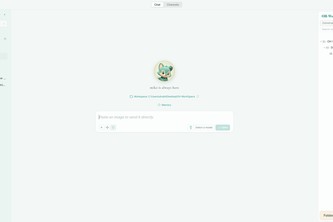
Miko is a self-reported desktop AI companion built as a personal assistant with memory, personality, and computer control capabilities. The author describes it as an autonomous agent that can operate a computer, manage tasks, browse the web, and collaborate with other agents.
What changed
The project was submitted to the OpenAI 2026 hackathon, indicating it is in early development or prototype stage. It is not evidenced to have launched commercially or gained users.
Single most important open question
Is there any evidence of product-market fit, user adoption, or revenue generation beyond the author’s own description?
What The Product Actually Is
The description states that Miko is a desktop AI companion built with Electron and React. It combines:
- Memory (long-term context retention)
- Personality (customizable character templates)
- Computer control (file management, code execution, browsing)
- Multi-agent collaboration
- Plugin ecosystem
- Cross-platform support (desktop, mobile, messaging)
It is described as a full-stack desktop application using Hono for backend, Pi SDK as agent runtime, and better-sqlite3 for local storage.
The author claims it supports:
- Web browsing
- File management
- Code execution
- Task scheduling
- Autonomous workflows
- Plugin architecture
Inferred: Miko is not a SaaS product but a desktop application with an AI agent runtime. It is not evidenced to be cloud-hosted or subscription-based.
Positioning & Claim Evolution
The author positions Miko as:
“A personal AI agent that feels more like a persistent teammate than a chatbot—something that remembers previous interactions, develops a personality, works autonomously, and can actually operate your computer instead of simply suggesting what to do.”
This is a self-reported claim about the product's emotional and functional role. The author describes Miko as:
- Not transactional
- Persistent
- Companion-like
- Autonomous
- Capable of operating a computer
The positioning evolves from a conceptual idea (to build an AI teammate) to a technical implementation (a desktop app with agent runtime, memory, and plugin system).
Inferred: The author is trying to position Miko as a personal AI assistant that goes beyond chatbots, but there is no evidence of actual user feedback or market validation.
Target Customer & ICP
The description does not state who the target customer is. It is self-reported that:
- Miko is for users who want an AI agent that remembers context and works autonomously.
- It targets individuals who work with computers and want AI to act as a persistent teammate.
Inferred: The ICP appears to be technical or power users who are interested in AI automation, personal productivity, and desktop tools. However, no evidence of actual customer segments or personas is provided.
Business Model & Pricing Evidence
There is no evidence of pricing, monetization, or business model in the description.
The author states that Miko is a desktop application, but does not indicate whether it will be:
- Free
- Paid
- Freemium
- Subscription-based
- One-time purchase
Inferred: The product is likely not yet commercialized. It is described as a hackathon submission, suggesting no revenue or pricing model has been implemented.
Technical & Delivery Signals
The author states that Miko was built with:
- Electron (desktop app)
- React 19 (frontend)
- Hono (backend server)
- Pi SDK (agent runtime)
- better-sqlite3 (local storage)
- Vitest (testing)
- Modular plugin architecture
It supports:
- Multi-agent collaboration
- Cross-platform compatibility (macOS, Windows, Linux, mobile)
- Plugin system for tools, skills, providers, routes, widgets, and extensions
- Local model support (for privacy)
Inferred: The technical stack is modular, suggesting scalability. However, there is no evidence of:
- Production deployment
- Performance metrics
- Reliability or stability data
Traction & Maturity Signals
The description does not provide any evidence of traction or maturity.
It is self-reported that:
- It was built as a hackathon project (OpenAI 2026)
- The author worked alone (team size: 1)
- It includes features like persistent memory, multi-agent collaboration, and plugin architecture
- It supports multiple platforms
Not evidenced: No user data, adoption metrics, or usage statistics are provided.
Inferred: Miko is in early-stage development, likely a prototype or proof-of-concept. There is no evidence of product-market fit or commercial traction.
Competitive Context
The description does not mention any competitors. It is self-reported that:
- Traditional AI assistants are transactional
- Miko aims to be more persistent and autonomous
Inferred: Miko appears to compete with:
- Chatbots (e.g., ChatGPT, Claude)
- Personal productivity tools (e.g., Notion, Obsidian, Zapier)
- Desktop automation tools (e.g., AutoHotkey, Keyboard Maestro)
However, no evidence of competitive analysis or market positioning is provided.
Open Questions & Risks
Key risks and open questions based on the description:
- No traction or revenue: The product is described as a hackathon submission with no commercialization.
- Single-person team: A team size of 1 raises concerns about scalability, maintenance, and feature delivery.
- Unproven market fit: No evidence of user feedback, adoption, or demand.
- Technical complexity without validation: Features like multi-agent collaboration and autonomous workflows are ambitious but untested in real-world use.
- No pricing or monetization model: Unclear how the product will be monetized.
- Self-reported only: All claims are unverified.
Questions the description leaves open
- What is your definition of "memory" and "personality" in Miko, and how do you plan to validate these features with users?
- How does Miko handle privacy and security, especially when operating on a user’s computer?
- Are there any early adopters or users who have tested the product? What feedback did they give?
- What is your roadmap for monetization or commercialization?
- How do you plan to scale beyond a single developer?
- What are the technical limitations of the current architecture, and how are you planning to address them?
Overall Assessment
Not evidenced: There is no evidence of revenue, customers, or traction.
The description states that Miko is:
- A hackathon project
- Built by one person
- Not yet commercialized
- Without a pricing model or business plan
Inferred: This is an early-stage idea or prototype, not a product ready for investment or partnership. It lacks the commercial signals needed to assess viability.
Confidence level: Low — based on self-reported, unverified evidence only.
User Stories BotA demo video on every pull request
Get a demo video on every new feature
GitHub App that watches your pull requests and records a narrated, captioned demo.
Save time on demo prep and make informed decisions faster with a video walkthrough of every new feature.
Source
Submitted to the OpenAI 2026 hackathon on Devpost. Project home on Devpost. Back to the full gallery on Devpost.
This competitive analysis was produced by top-founders.com (opens in a new tab)
Generated by a language model from this project's public Devpost page — its tagline, the author's own write-up and any built-with tags listed there — as captured in August 2026. Short quotations are the author's words. It is an opinion on the idea as a business, not on the people behind it, and it reflects the description as published then. If the project has moved on, request a correction below. The analysis is not independent research and contains no verified traction, revenue or customer data.
An independent guide by KFG International LLC — not affiliated with, endorsed by, or connected to Devpost or OpenAI.