

Archive position — measured, not model output
0 likes on Devpost
2,263 of the 7,850 archived projects have more likes, and 5,587 share exactly 0 — so this project's #5,297 place in the like-ranked listing is a tie-break inside that group, not a ranking.
Projects (log scale)
Likes on Devpost. ▲ marks this project's group.
Show the figures
| Likes | Projects | Share of archive |
|---|---|---|
| 0 | 5,587 | 71.2% |
| 1 | 1,758 | 22.4% |
| 2 | 284 | 3.6% |
| 3–4 | 132 | 1.7% |
| 5–9 | 75 | 1.0% |
| 10+ | 14 | 0.2% |
 User Stories BotA demo video on every pull request
Get a demo video on every new feature
GitHub App that watches your pull requests and records a narrated, captioned demo.
Save time on demo prep and make informed decisions faster with a video walkthrough of every new feature.
Executive Summary
What the company appears to be
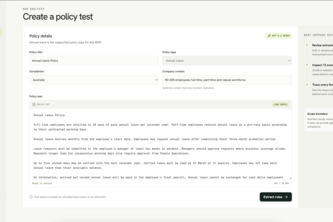
Mikel AI Rule Test is a self-reported tool that uses GPT-5.6 to convert workplace policies into structured business rules, then generates employee scenarios to test those rules for clarity and consistency. The author states it applies software engineering practices like unit testing to policy design.
What changed
The project description indicates this is a hackathon submission (Devpost entry for OpenAI 2026 hackathon). It was built as an end-to-end workflow using AI, React, Firebase, and Codex. The author describes it as a structured AI product with schema validation, traceability, and human review steps.
Single most important open question
Is there any evidence of real-world usage or traction beyond the hackathon prototype? The description contains no data on customers, revenue, adoption, or operational deployment.
What The Product Actually Is
The description states that Mikel AI Rule Test:
- Converts workplace policies into structured business rules using GPT-5.6.
- Generates realistic employee edge-case scenarios based on policy content.
- Evaluates each scenario against the approved rules and classifies results as:
- Pass
- Ambiguous
- Missing rule
- Conflict
- Risk
- Provides a Policy Readiness Score and suggested wording changes to resolve issues.
- Does not provide legal advice or regulatory certification.
- Is built using React, TypeScript, Firebase, OpenAI API, GPT-5.6, Codex, and Zod for validation.
This is described as an AI-powered workflow that applies software testing principles to HR policy design.
Evidence Author's own write-up
Inference The product appears to be a prototype or proof-of-concept built in a hackathon context.
Positioning & Claim Evolution
The author claims:
- Workplace policies are business logic.
- Employee situations are test cases.
- RuleTest brings software engineering discipline into policy design.
- It tests whether policies can consistently answer realistic employee scenarios.
- It helps identify ambiguity before operational problems arise.
These claims suggest a positioning around policy clarity and operational readiness, using AI to automate testing of HR logic.
Evidence Author's own write-up
Inference The positioning is based on the author’s interpretation of how software engineering practices can be applied to HR processes, but no external validation or market feedback is provided.
Target Customer & ICP
The description states that RuleTest targets:
- Engineering leaders working closely with HR and payroll.
- HR and operations teams needing to evaluate policy clarity.
- Organizations seeking to reduce ambiguity in workplace policies.
It implies a B2B SaaS or internal tooling use case, likely within large enterprises or organizations with complex HR systems.
Evidence Author's own write-up
Inference The target customer is inferred from the stated inspiration and use case, but no explicit segmentation or customer interviews are included.
Business Model & Pricing Evidence
Not evidenced. The description does not mention any pricing model, monetization strategy, or business model.
Evidence None provided
Inference No indication of how this would be sold or whether it is intended for commercial use beyond the hackathon.
Technical & Delivery Signals
The project was built using:
- Frontend: React, TypeScript, Vite, Tailwind CSS, shadcn/ui
- Backend: Firebase Authentication, Firestore, Cloud Functions, OpenAI API (GPT-5.6)
- Development tools: Codex, Zod for schema validation
- AI workflow: Multi-step process including rule extraction, scenario generation, test execution, and amendment generation
All AI responses are validated using Zod schemas before storage or display.
Evidence Author's own write-up
Inference The technical stack suggests a modern web application with backend cloud infrastructure and structured AI processing. However, no deployment details or scalability assumptions are mentioned.
Traction & Maturity Signals
Not evidenced. There is no mention of:
- Customers
- Revenue
- Usage metrics
- Product adoption
- Market traction
- Post-hackathon development or iteration
Evidence None provided
Inference The project appears to be a hackathon prototype with no evidence of real-world deployment or user engagement.
Competitive Context
Not evidenced. No information is given about:
- Competitors in the HR policy testing space
- Existing tools for policy clarity or compliance
- Market size or competitive landscape
Evidence None provided
Inference The competitive environment is unknown, and no differentiation from existing solutions is described.
Open Questions & Risks
- Unverified claims: All statements are self-reported and unverified.
- No traction evidence: No customers, revenue, or usage data.
- Limited scope: Built for a hackathon; unclear if it has been iterated beyond prototype stage.
- AI reliability risk: Reliance on GPT-5.6 without independent validation of outputs.
- Human-in-the-loop dependency: The system depends heavily on human review and approval, which may not scale.
- No commercialization plan: No indication of how the product would be monetized or deployed in enterprise settings.
Evidence Self-reported description
Inference These are risks inferred from the lack of real-world data and the prototype nature of the project.
Questions the description leaves open
- What is the actual business problem you're solving, and how does this tool address it?
- Have you tested this with real HR or policy teams? If so, what feedback did you get?
- How do you plan to validate AI outputs in production environments?
- Is there a roadmap for post-hackathon development or commercialization?
- What are the key assumptions about user behavior and adoption that underpin your approach?
- Are there any legal or compliance risks associated with using this tool in real HR workflows?
Overall Assessment
Not evidenced. No information is provided on:
- Valuation
- Funding status
- Strategic fit for investors or partners
- Commercial viability beyond the hackathon
Evidence None provided
Inference Based solely on the self-reported description, there is insufficient evidence to assess whether this project has investment or partnership potential. It appears to be a prototype with no demonstrated traction or commercial readiness.
User Stories BotA demo video on every pull request
Get a demo video on every new feature
GitHub App that watches your pull requests and records a narrated, captioned demo.
Save time on demo prep and make informed decisions faster with a video walkthrough of every new feature.
Source
Submitted to the OpenAI 2026 hackathon on Devpost. Project home on Devpost. Back to the full gallery on Devpost.
This competitive analysis was produced by top-founders.com (opens in a new tab)
Generated by a language model from this project's public Devpost page — its tagline, the author's own write-up and any built-with tags listed there — as captured in August 2026. Short quotations are the author's words. It is an opinion on the idea as a business, not on the people behind it, and it reflects the description as published then. If the project has moved on, request a correction below. The analysis is not independent research and contains no verified traction, revenue or customer data.
An independent guide by KFG International LLC — not affiliated with, endorsed by, or connected to Devpost or OpenAI.