

Archive position — measured, not model output
0 likes on Devpost
2,263 of the 7,850 archived projects have more likes, and 5,587 share exactly 0 — so this project's #4,991 place in the like-ranked listing is a tie-break inside that group, not a ranking.
Projects (log scale)
Likes on Devpost. ▲ marks this project's group.
Show the figures
| Likes | Projects | Share of archive |
|---|---|---|
| 0 | 5,587 | 71.2% |
| 1 | 1,758 | 22.4% |
| 2 | 284 | 3.6% |
| 3–4 | 132 | 1.7% |
| 5–9 | 75 | 1.0% |
| 10+ | 14 | 0.2% |
 User Stories BotA demo video on every pull request
Get a demo video on every new feature
GitHub App that watches your pull requests and records a narrated, captioned demo.
Save time on demo prep and make informed decisions faster with a video walkthrough of every new feature.
Executive Summary
What the company appears to be
The project described by the author is a physics education tool named Light Years from Home: Spacetime Lab. It combines interactive simulations with AI-powered tutoring to teach concepts in relativity, orbital mechanics, and gravity through hands-on experimentation. The system uses deterministic physics engines for core computations but integrates GPT-5.6 as a teaching layer that contextualizes results without overriding them.
What changed
The author states they built this tool to reverse the traditional approach of teaching physics — moving from equations-first to curiosity-first learning. They describe how the project evolved through iterative development using Codex and GPT-5.6, with an emphasis on transparency in engineering and scientific accuracy.
Single most important open question
Is there any evidence of traction or adoption beyond the author’s own use-case? The description contains no data about users, customers, revenue, or impact beyond self-reported claims.
Note: This analysis is based entirely on the self-reported, unverified project description provided by the caller. No external verification or historical data is available.
What The Product Actually Is
- The description states that Light Years from Home: Spacetime Lab is a physics education tool.
- It includes:
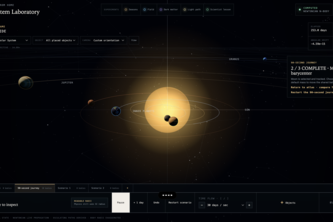
- An animated nearby-star atlas with real distance records and relativistic travel-time comparisons.
- A deterministic orbital laboratory for building, changing, and replaying multi-body systems.
- Guided experiments covering barycentres, resonances, collisions, light paths, fields, and relativity of simultaneity.
- The application supports:
- Relativity experiments (e.g., Sun-Earth-Mars setup with frame comparisons).
- Dark-matter comparison scenarios.
- Compact-binary demonstrator (with explicit disclaimer that it does not solve general relativity).
- It is described as an interactive simulation-based learning environment, not a research or engineering tool.
Inference: The product appears to be a web-based educational platform combining physics simulations with AI tutoring. However, no evidence of actual deployment or usage beyond the author's own development and testing exists.
Positioning & Claim Evolution
- The description claims the project aims to "bring back" the way Einstein learned — through thought experiments and intuition before equations.
- It positions itself as a pedagogical alternative to traditional physics instruction that focuses on memorization over understanding.
- The author emphasizes:
- Curiosity-driven exploration.
- Separation of computational truth from illustrative effects.
- Use of AI for contextual explanation, not decision-making.
Claim vs Fact: These are stated intentions and design philosophies. There is no evidence of market positioning or user feedback to validate these claims.
Target Customer & ICP
- The description implies the primary audience is students learning physics.
- It targets learners who struggle with abstract concepts and want to build intuition through experimentation.
- No specific demographic, grade level, or institutional context is mentioned.
Not evidenced: There is no indication of whether this tool is aimed at K–12, college-level, or university audiences. No evidence of institutional partnerships or pilot programs exists.
Business Model & Pricing Evidence
- The description does not mention any pricing model, monetization strategy, or business structure.
- It explicitly states that the software is educational and not intended for scientific research, engineering, navigation, or safety-critical applications.
- No indication of B2B, B2C, freemium, subscription, or licensing models.
Not evidenced: No evidence of revenue streams, pricing tiers, or commercialization plans.
Technical & Delivery Signals
- Built with:
- JavaScript, Node.js, WebGL, Three.js
- OpenAI Realtime API, Codex, GPT-5.6
- Uses deterministic physics engines for core computations (gravity integration, trajectories, collisions, etc.)
- GPT-5.6 operates above the simulation as a teaching layer; it does not modify or override numerical results.
- Includes:
- 131 passing tests covering replay, conservation checks, relativity ordering, and dark-matter behavior
- Server-side API credentials for AI interactions (not exposed to browser)
- Persistent trajectory trails and scenario workspaces
- Live deployment exists at https://light-years-from-home.vercel.app
Inference: The technical stack suggests a modern web-based simulation platform with AI integration. However, no evidence of scalability, performance metrics, or production infrastructure is provided.
Traction & Maturity Signals
- The project is described as fully operational.
- It includes:
- Atlas
- Orbital laboratory
- Relativity wizard
- Dark-matter comparison
- Compact-binary scenario
- The author mentions a primary Codex build session (019f64f3-2a7b-79f3-b2e3-199704c8843c) and verification suite of 131 tests.
- No evidence of user adoption, retention, or usage statistics.
Not evidenced: There is no data on users, customer engagement, or product maturity beyond the author’s own development efforts.
Competitive Context
- The description does not reference competitors or similar tools in the educational physics space.
- It does not compare its features to existing platforms like PhET, Khan Academy, or other simulation-based learning tools.
- No mention of market size, competitive landscape, or differentiation strategy.
Not evidenced: No evidence of competitive positioning or awareness of existing solutions.
Open Questions & Risks
- The project is described as a single-person effort (team size: 1).
- It is built for educational purposes and explicitly not intended for scientific or engineering use.
- AI integration relies on server-side configuration, which may be fragile or unavailable.
- No evidence of scalability, long-term maintenance plans, or institutional adoption.
- The author’s own write-up suggests this is a hackathon submission — raising questions about product longevity.
Inference: A single-developer project with no commercial traction raises concerns about sustainability and scalability. The reliance on AI for tutoring also introduces dependency risks.
Questions the description leaves open
- What is the intended user base, and how are you planning to reach them?
- Are there any pilot programs or institutional partnerships in place?
- How do you plan to monetize this tool if at all?
- Is there a roadmap for expanding beyond the current scope (e.g., additional physics domains)?
- What happens when GPT-5.6 is unavailable or misconfigured?
- Are there any plans for open-sourcing or community contributions?
Overall Assessment
- The project is described as an educational tool with a strong pedagogical vision.
- It demonstrates technical capability in combining physics simulations with AI tutoring.
- However, the lack of traction, revenue, or user data makes it difficult to assess commercial viability.
- Given that this appears to be a personal or hackathon project, there is no clear indication of a scalable business model or market demand.
Assessment: Not ready for investment or partnership without further evidence of traction, adoption, or monetization strategy. The concept shows promise but lacks commercial validation.
User Stories BotA demo video on every pull request
Get a demo video on every new feature
GitHub App that watches your pull requests and records a narrated, captioned demo.
Save time on demo prep and make informed decisions faster with a video walkthrough of every new feature.
Source
Submitted to the OpenAI 2026 hackathon on Devpost. Project home on Devpost. Back to the full gallery on Devpost.
This competitive analysis was produced by top-founders.com (opens in a new tab)
Generated by a language model from this project's public Devpost page — its tagline, the author's own write-up and any built-with tags listed there — as captured in August 2026. Short quotations are the author's words. It is an opinion on the idea as a business, not on the people behind it, and it reflects the description as published then. If the project has moved on, request a correction below. The analysis is not independent research and contains no verified traction, revenue or customer data.
An independent guide by KFG International LLC — not affiliated with, endorsed by, or connected to Devpost or OpenAI.