

Archive position — measured, not model output
1 like on Devpost
505 of the 7,850 archived projects have more likes, and 1,758 share exactly 1 — so this project's #1,067 place in the like-ranked listing is a tie-break inside that group, not a ranking.
Projects (log scale)
Likes on Devpost. ▲ marks this project's group.
Show the figures
| Likes | Projects | Share of archive |
|---|---|---|
| 0 | 5,587 | 71.2% |
| 1 | 1,758 | 22.4% |
| 2 | 284 | 3.6% |
| 3–4 | 132 | 1.7% |
| 5–9 | 75 | 1.0% |
| 10+ | 14 | 0.2% |
 User Stories BotA demo video on every pull request
Get a demo video on every new feature
GitHub App that watches your pull requests and records a narrated, captioned demo.
Save time on demo prep and make informed decisions faster with a video walkthrough of every new feature.
Executive Summary
FinPilot AI is a self-reported educational tool for finance students that presents learning content as short, practical missions. The product aims to bridge the gap between theoretical knowledge and demonstrated skill by allowing users to complete tasks and receive rubric-based feedback. It includes an AI coach (Ask FinPilot) that answers questions within a fixed curriculum.
The project is described as a minimal viable product (MVP), built with vanilla JavaScript, HTML, CSS, and serverless functions using Vercel and OpenAI APIs. It currently supports three beginner missions and uses a deterministic rubric checker for assessment rather than AI grading.
Key commercial due-diligence read
There is no evidence of revenue, customers, or traction beyond the authors' own description. The product appears to be an early-stage prototype with no apparent monetization strategy or market validation.
What The Product Actually Is
The description states that FinPilot AI:
- Turns finance and accounting fundamentals into short, practical missions.
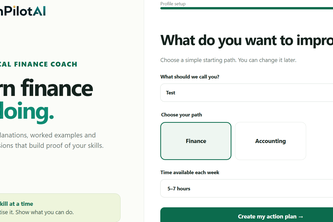
- Has a two-step loop: "Learn" (concept, worked example in rupees, common mistake) and "Assess" (user does the task and submits work).
- Scores submissions against a rubric with four explicit criteria.
- Includes an AI coach called "Ask FinPilot" that answers questions within the syllabus using plain language and worked examples.
- Ships three beginner missions: building a monthly budget in Excel, explaining profit versus cash flow, and rewriting a resume bullet with evidence.
The product is described as being built with vanilla JavaScript, HTML, CSS, and serverless functions. It uses localStorage for state management and does not require accounts or server-side persistence at this stage.
Inference The system is designed to produce a portfolio of "evidence" that users can accumulate through completing missions.
Positioning & Claim Evolution
The authors claim FinPilot AI addresses the gap between academic finance education and real-world application. They state:
- Finance students graduate with theory but not proof.
- Certificates don’t demonstrate ability to perform tasks like building a budget or explaining cash flow.
- The product was built around the question: "what if learning finance produced a record of demonstrated skills instead of a completion percentage?"
The positioning is that FinPilot AI helps learners build a portfolio of verified evidence, which could be useful for recruiters.
Inference This implies a shift from traditional education models toward competency-based learning with verifiable outcomes.
Target Customer & ICP
The description states:
- The target audience is finance students.
- It focuses on helping students transition from theory to practical application in finance and accounting.
There is no further segmentation or definition of specific subgroups within the student population (e.g., undergrads vs. grads, finance majors vs. business students).
Inference The ICP likely includes undergraduate or graduate-level finance students who are seeking to improve their practical skills and build a portfolio of evidence for job applications.
Business Model & Pricing Evidence
There is no mention of pricing, monetization strategy, or business model in the description.
The authors state that:
- The MVP uses localStorage and does not require accounts.
- Accounts and server-side persistence are listed as future features.
- Exportable skill evidence is also a planned feature.
Inference No commercial structure has been implemented yet. Future plans include account-based functionality and possibly exporting evidence, but no revenue streams or pricing models are described.
Technical & Delivery Signals
The authors report:
- The front end is a single index.html file with no framework or build step.
- Markup, styles, and logic all live in one file.
- The AI coach runs as a Vercel serverless function (
api/coach.js). - State management uses localStorage.
- Hosting is on Vercel with security headers.
- The prompt engineering for the AI coach includes constraints to avoid giving investment advice or drifting off-topic.
- Challenges included handling LaTeX and rendering markdown from scratch.
Inference The technical approach is minimalistic, focused on rapid iteration and simplicity. It avoids frameworks and build tools, which may reflect early-stage development or a deliberate choice for agility.
Traction & Maturity Signals
The description states:
- Three beginner missions ship today.
- The product is an MVP built during a hackathon.
- No mention of users, customers, or usage metrics.
- The team size is four members.
- It was submitted to the OpenAI 2026 hackathon.
Inference There is no evidence of traction, adoption, or user engagement beyond the authors' own development efforts. The product is clearly in an early stage and lacks any commercial validation.
Competitive Context
The description does not include any information about competitors or market positioning relative to existing platforms.
Inference No competitive landscape is described. It's unclear whether FinPilot AI competes with other finance education tools, gamified learning platforms, or AI tutoring systems.
Open Questions & Risks
- No revenue or monetization strategy: The product has no evidence of a business model or path to profitability.
- MVP nature: The system is described as an MVP and lacks features like AI grading, accounts, and exportable records.
- Deterministic rubric checker: The current assessment method relies on pattern matching rather than AI comprehension, which may be easily gamed or insufficiently accurate.
- No user data or feedback: No evidence of real users, usage patterns, or performance metrics.
- Limited scope: Only three beginner missions are available; no indication of how the platform scales beyond this.
Questions the description leaves open
- What is the intended monetization model for FinPilot AI?
- How do you plan to scale beyond the current three beginner missions?
- Are there any users or pilot groups currently testing the product?
- What are the key assumptions about user behavior and learning outcomes that underpin this product?
- How will the rubric-based assessment evolve from deterministic pattern matching to AI grading?
- What is your roadmap for account creation, persistence, and exportable evidence?
- Have you considered how to validate the effectiveness of the learning outcomes?
Overall Assessment
The description indicates that FinPilot AI is an early-stage prototype built during a hackathon. There is no evidence of revenue, customers, or traction.
Assessment Not evidenced as a viable investment or partnership opportunity at this time. The product shows potential in addressing a gap in finance education but lacks commercial viability, user validation, and a clear path to monetization.
User Stories BotA demo video on every pull request
Get a demo video on every new feature
GitHub App that watches your pull requests and records a narrated, captioned demo.
Save time on demo prep and make informed decisions faster with a video walkthrough of every new feature.
Source
Submitted to the OpenAI 2026 hackathon on Devpost. Project home on Devpost. Back to the full gallery on Devpost.
This competitive analysis was produced by top-founders.com (opens in a new tab)
Generated by a language model from this project's public Devpost page — its tagline, the author's own write-up and any built-with tags listed there — as captured in August 2026. Short quotations are the author's words. It is an opinion on the idea as a business, not on the people behind it, and it reflects the description as published then. If the project has moved on, request a correction below. The analysis is not independent research and contains no verified traction, revenue or customer data.
An independent guide by KFG International LLC — not affiliated with, endorsed by, or connected to Devpost or OpenAI.