

Archive position — measured, not model output
0 likes on Devpost
2,263 of the 7,850 archived projects have more likes, and 5,587 share exactly 0 — so this project's #4,981 place in the like-ranked listing is a tie-break inside that group, not a ranking.
Projects (log scale)
Likes on Devpost. ▲ marks this project's group.
Show the figures
| Likes | Projects | Share of archive |
|---|---|---|
| 0 | 5,587 | 71.2% |
| 1 | 1,758 | 22.4% |
| 2 | 284 | 3.6% |
| 3–4 | 132 | 1.7% |
| 5–9 | 75 | 1.0% |
| 10+ | 14 | 0.2% |
 User Stories BotA demo video on every pull request
Get a demo video on every new feature
GitHub App that watches your pull requests and records a narrated, captioned demo.
Save time on demo prep and make informed decisions faster with a video walkthrough of every new feature.
Executive Summary
What the company appears to be
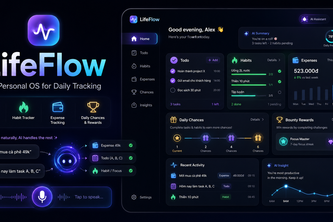
LifeFlow is a self-reported personal operating system for daily task, habit, expense, and opportunity tracking. The author describes it as a tool that allows users to input updates via text or voice, which are then classified by an AI pipeline into structured actions (e.g., todo, habit, expense). It includes features like offline storage, cross-platform delivery, and integration with online opportunities such as hackathons or bounties.
What changed
The project was submitted to the OpenAI 2026 hackathon. The author describes it as a personal OS that unifies daily tracking and discovery of opportunities. No evidence of prior development, traction, or commercial activity is provided beyond this submission.
Single most important open question
Is there any evidence of user adoption, revenue, or product-market fit beyond the self-reported description?
What The Product Actually Is
The description states that LifeFlow is a personal operating system for daily tasks, habits, expenses, and online opportunities. It allows users to input updates via text or voice, which are then classified by an AI pipeline powered by DeepSeek into structured actions (e.g., todo, habit, expense). The resulting action is validated before being saved.
It includes:
- Todo management
- Habit tracking
- Expense tracking
- Voice and text Quick Capture
- Daily Chances (discovery of online opportunities)
- Offline-friendly storage
- Cross-platform delivery (web, Tauri desktop app, Chrome extension)
The author also states that the project was built with gpt-5.6 and tauri.
Evidence
- The description states LifeFlow is a personal OS for daily tracking.
- It uses an AI classification pipeline powered by DeepSeek.
- It supports voice/text input and structured output.
- Features include todo, habit, expense tracking, offline storage, cross-platform delivery.
- Built with gpt-5.6 and tauri.
Inference The product is described as a personal productivity tool that integrates AI for classification and offers multi-channel access.
Positioning & Claim Evolution
The author positions LifeFlow as:
- A "daily opportunity OS"
- A calm workspace for managing tasks, habits, expenses, and online opportunities
- A system that allows users to speak or type updates without navigating forms
- A tool for discovering coding rewards, bounties, hackathons, open-source tasks, and competitions
It is described as a personal operating system that unifies daily activity and opportunity discovery.
Evidence
- Tagline: “Speak your day. Track your life. Discover your next opportunity.”
- Description states it brings tasks, habits, expenses, and opportunities into one calm workspace.
- It supports voice/text input for quick capture.
- It includes a feature called "Daily Chances" to discover online opportunities.
Inference The positioning is centered on personal productivity and opportunity discovery through AI and natural language input. The product is positioned as a unified OS for personal tracking and exploration of external opportunities.
Target Customer & ICP
The description does not state the target customer or ideal customer profile (ICP). It only describes the features and functionality of the product.
Evidence
- No mention of specific user personas, demographics, or use cases.
- The author describes it as a personal OS for daily tracking, but does not specify who uses it.
Inference The target customer is likely individuals seeking personal productivity tools that integrate AI, voice input, and opportunity discovery. However, no evidence supports a defined ICP.
Business Model & Pricing Evidence
There is no evidence of a business model or pricing structure in the description. The author does not mention monetization, subscriptions, or any commercial offering.
Evidence
- No mention of pricing, subscriptions, or revenue streams.
- No indication of whether it’s free, paid, or ad-supported.
Inference The product is described as a personal OS with no evidence of a monetization strategy. It may be a prototype or hackathon submission without commercial intent.
Technical & Delivery Signals
The author states that LifeFlow was built using:
- gpt-5.6
- tauri
It supports:
- Web application
- Tauri desktop app
- Chrome new-tab extension
It includes offline-friendly storage and cross-platform delivery.
Evidence
- Built with gpt-5.6 and tauri.
- Cross-platform delivery (web, desktop, Chrome extension).
- Offline-friendly storage.
Inference The technical stack suggests a modern, multi-platform approach using AI for classification and Tauri for desktop delivery. However, no evidence of scalability or performance data is provided.
Traction & Maturity Signals
There is no evidence of traction, revenue, customers, or adoption beyond the author’s own description. The project was submitted to a hackathon, and no further development or usage data is provided.
Evidence
- Submitted to OpenAI 2026 hackathon.
- No mention of users, customers, or revenue.
- No evidence of product-market fit or commercial traction.
Inference The product appears to be in early-stage development or prototype form. There is no indication of user engagement or adoption beyond the submission.
Competitive Context
There is no evidence of a competitive analysis or market positioning in the description. The author does not mention competitors or how LifeFlow differentiates from existing tools.
Evidence
- No mention of competitors.
- No differentiation strategy described.
Inference The product’s competitive context is unknown. It may compete with personal productivity tools (e.g., Notion, Todoist) or opportunity discovery platforms (e.g., HackerOne, Gitcoin), but no evidence supports this.
Open Questions & Risks
- No commercial traction or revenue: The project was submitted to a hackathon and lacks any evidence of adoption or monetization.
- Unverified AI pipeline: The use of “DeepSeek” is not verified; the author does not describe how it’s implemented or validated.
- Lack of clarity on user base: No evidence of target users, personas, or market fit.
- No pricing or business model: No indication of monetization strategy.
- Single-founder project: The team size is listed as one member, which may limit development capacity.
Evidence
- Submitted to a hackathon.
- No revenue, customers, or adoption data.
- No pricing or monetization strategy.
- Single founder (chung phuoc).
- AI pipeline not described in detail.
Questions the description leaves open
- What is the source of the AI classification pipeline? Is it based on DeepSeek or another model?
- How does the product differentiate from existing personal productivity tools like Todoist, Notion, or Obsidian?
- Are there any users or early adopters who have tested the product beyond the hackathon submission?
- What is the monetization strategy for LifeFlow? Is it free, subscription-based, or ad-supported?
- How does the offline storage work, and what are the limitations of this feature?
- What is the roadmap for development beyond the current prototype?
Overall Assessment
The description presents a self-reported personal OS with AI-powered input classification and cross-platform delivery. It was submitted to a hackathon and lacks evidence of traction, revenue, or commercial viability.
Evidence
- No revenue, customers, or adoption data.
- No business model or pricing structure.
- Submitted as a hackathon project.
- Single founder.
Inference This is likely an early-stage prototype or proof-of-concept. There is no evidence to support investment or partnership interest at this time. The product may evolve into something viable, but current evidence does not support commercial due diligence beyond the initial idea.
User Stories BotA demo video on every pull request
Get a demo video on every new feature
GitHub App that watches your pull requests and records a narrated, captioned demo.
Save time on demo prep and make informed decisions faster with a video walkthrough of every new feature.
Source
Submitted to the OpenAI 2026 hackathon on Devpost. Project home on Devpost. Back to the full gallery on Devpost.
This competitive analysis was produced by top-founders.com (opens in a new tab)
Generated by a language model from this project's public Devpost page — its tagline, the author's own write-up and any built-with tags listed there — as captured in August 2026. Short quotations are the author's words. It is an opinion on the idea as a business, not on the people behind it, and it reflects the description as published then. If the project has moved on, request a correction below. The analysis is not independent research and contains no verified traction, revenue or customer data.
An independent guide by KFG International LLC — not affiliated with, endorsed by, or connected to Devpost or OpenAI.