

Archive position — measured, not model output
1 like on Devpost
505 of the 7,850 archived projects have more likes, and 1,758 share exactly 1 — so this project's #1,346 place in the like-ranked listing is a tie-break inside that group, not a ranking.
Projects (log scale)
Likes on Devpost. ▲ marks this project's group.
Show the figures
| Likes | Projects | Share of archive |
|---|---|---|
| 0 | 5,587 | 71.2% |
| 1 | 1,758 | 22.4% |
| 2 | 284 | 3.6% |
| 3–4 | 132 | 1.7% |
| 5–9 | 75 | 1.0% |
| 10+ | 14 | 0.2% |
 User Stories BotA demo video on every pull request
Get a demo video on every new feature
GitHub App that watches your pull requests and records a narrated, captioned demo.
Save time on demo prep and make informed decisions faster with a video walkthrough of every new feature.
Executive Summary
What the company appears to be
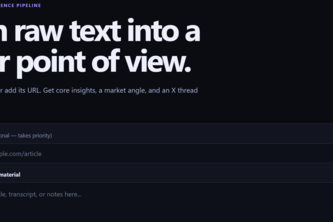
Lens is a self-reported AI-powered tool that processes articles or URLs through a three-step pipeline using GPT-5.6, aiming to extract core insights, market angle, and generate ready-to-post X threads. It was built as a hackathon submission by one developer (Lynn Hu) with no evidence of revenue, customers, or traction.
What changed
The author states that Lens emerged from personal frustration with manually analyzing content and seeking automation in the analysis phase — not just summarization — to make insights actionable for marketing purposes. The tool is described as an MVP built using Codex and a 3-node pipeline architecture.
Single most important open question
Is there any evidence of actual usage or adoption beyond the author’s own development and submission? The description does not indicate whether Lens has been used by others, tested in real-world conditions, or validated with users.
What The Product Actually Is
The description states that Lens is a tool that:
- Takes an article (via URL or pasted text)
- Processes it through three chained GPT-5.6 nodes:
- Context Parsing: pulls out topic, source type, key claims, background
- Core Insights + Market Angle: analyzes from a marketing/audience lens to surface what matters and to whom
- X Thread Generation: turns that analysis into a ready-to-post thread
- Outputs results as three cards (Core Insights, Market Angle, X Thread), each with one-click copy functionality
The tool is described as built using:
- Express.js, React, Vite
- Mozilla Readability for URL extraction
- OpenAI Codex and GPT-5.6
- Server-side handling of OpenAI API keys
Inference: The product appears to be a prototype or MVP, not a commercial offering.
Positioning & Claim Evolution
The author claims:
- Lens was built to solve their own problem: turning content into actionable insights quickly.
- It is positioned as an alternative to generic summarization tools that skip the analysis step.
- The tool differentiates itself by focusing on “what actually matters” and “who cares,” rather than just writing.
Inference: The positioning suggests a niche for marketers or content creators who want to analyze and repurpose content more strategically. However, no evidence of market validation or user feedback is provided.
Target Customer & ICP
The description states:
- The author comes from a marketing analytics background.
- The tool aims to help users “turn what I read into a clear point of view I could actually use or post.”
Inference: The implied target customer is someone who reads a lot and needs to distill content for personal or professional use, particularly in marketing or social media contexts.
Not evidenced: No explicit identification of personas, buyer personas, or customer segments beyond the author’s own experience.
Business Model & Pricing Evidence
The description does not state:
- Whether Lens is sold as a SaaS product
- What pricing model (if any) exists
- If there are subscription tiers, freemium options, or usage-based billing
Inference: The tool appears to be a prototype with no commercialization strategy described.
Technical & Delivery Signals
The author states:
- Built entirely with Codex
- Uses a 3-node pipeline architecture (not multi-agent framework)
- Each node outputs structured JSON to ensure reliability
- URL extraction via Mozilla Readability, with fallback to paste text
- Server-side OpenAI API key handling
- Vite + React frontend with live progress states and copy-to-clipboard cards
Inference: The technical approach is minimalistic and focused on reliability over ambition. It was built quickly under time constraints.
Traction & Maturity Signals
The description does not provide:
- Any evidence of revenue or monetization
- Customer base or user adoption data
- Product usage metrics or retention rates
- Evidence of product-market fit or feedback loops
Inference: The tool is described as a hackathon submission, with no indication of ongoing development or traction beyond the author’s own use.
Competitive Context
The description does not mention:
- Direct competitors
- Indirect substitutes
- Market size or competitive landscape
Inference: While the author positions Lens as different from generic summarization tools, there is no evidence of awareness of existing tools in this space.
Open Questions & Risks
- No traction or validation: The tool is described only as a hackathon submission with no evidence of adoption.
- Unverified claims: The use of GPT-5.6 is self-reported; no confirmation that such a model exists or is used.
- Single-person team: Only one developer (Lynn Hu) is mentioned, raising questions about scalability and long-term maintenance.
- No commercialization plan: No indication of monetization strategy, pricing, or go-to-market approach.
- Prototype nature: The MVP was built under tight time constraints; no evidence of iteration or product maturity.
Questions the description leaves open
- What is the actual model version used (e.g., GPT-5.6)? Is this a real model or a self-reported label?
- Has Lens been tested with users beyond the author? If so, what feedback was received?
- Are there any plans to monetize or scale the product beyond the current MVP?
- What are the technical limitations of the 3-node pipeline in real-world usage?
- How is data handled and stored (e.g., is it ephemeral or persistent)?
- Is there a plan for expanding into other output formats or input types?
Overall Assessment
Not evidenced: There is no evidence of revenue, customers, traction, or commercial viability beyond the author’s own description.
Inference: Given that this is a hackathon submission with no evidence of product-market fit or monetization, it is premature to consider Lens for investment or partnership. The tool may be a useful prototype, but lacks the commercial signals required for due-diligence evaluation.
User Stories BotA demo video on every pull request
Get a demo video on every new feature
GitHub App that watches your pull requests and records a narrated, captioned demo.
Save time on demo prep and make informed decisions faster with a video walkthrough of every new feature.
Source
Submitted to the OpenAI 2026 hackathon on Devpost. Project home on Devpost. Back to the full gallery on Devpost.
This competitive analysis was produced by top-founders.com (opens in a new tab)
Generated by a language model from this project's public Devpost page — its tagline, the author's own write-up and any built-with tags listed there — as captured in August 2026. Short quotations are the author's words. It is an opinion on the idea as a business, not on the people behind it, and it reflects the description as published then. If the project has moved on, request a correction below. The analysis is not independent research and contains no verified traction, revenue or customer data.
An independent guide by KFG International LLC — not affiliated with, endorsed by, or connected to Devpost or OpenAI.