

Archive position — measured, not model output
0 likes on Devpost
2,263 of the 7,850 archived projects have more likes, and 5,587 share exactly 0 — so this project's #4,916 place in the like-ranked listing is a tie-break inside that group, not a ranking.
Projects (log scale)
Likes on Devpost. ▲ marks this project's group.
Show the figures
| Likes | Projects | Share of archive |
|---|---|---|
| 0 | 5,587 | 71.2% |
| 1 | 1,758 | 22.4% |
| 2 | 284 | 3.6% |
| 3–4 | 132 | 1.7% |
| 5–9 | 75 | 1.0% |
| 10+ | 14 | 0.2% |
 User Stories BotA demo video on every pull request
Get a demo video on every new feature
GitHub App that watches your pull requests and records a narrated, captioned demo.
Save time on demo prep and make informed decisions faster with a video walkthrough of every new feature.
Executive Summary
What the company appears to be
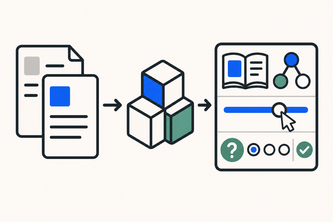
Learning Companions is a self-reported Codex skill that transforms repository or knowledge base content into short, interactive HTML lessons. The author states it uses GPT-5.6 and is built with Python, JavaScript, Node.js, and other technologies. It generates offline-capable lessons with quizzes and feedback.
What changed
The project was developed during a hackathon (OpenAI 2026) as an extension of prior work in creating interactive educational materials. The author describes splitting the system into reusable components: a general skill, optional repository adapter, and lesson payloads.
Single most important open question
Is there any evidence of real-world usage or adoption beyond the author's personal teaching context?
What The Product Actually Is
The description states that Learning Companions is a Codex skill. It turns selected material from repositories or knowledge bases into short, interactive lessons.
- The system generates one self-contained
index.htmlfile. - It includes:
- A short explanation
- Topic-specific interaction
- Quizzes
- Corrective feedback
- Lessons run offline and do not require:
- Server access
- Account or API key
- Network connection
- AI model at runtime
The author describes building three layers:
- General skill (content contract, Python generator/validator, shared JS runtime)
- Repository adapter (defines source rules, privacy, output, publishing)
- Lesson payloads (JSON-based content and references)
It uses Codex with GPT-5.6, Pytest, Node.js, GitHub Actions, and other tools.
Confidence Low — this is a self-reported technical description without evidence of deployment or usage.
Positioning & Claim Evolution
The author states that the project was inspired by their need to provide students with quick review material between lectures. They previously recorded full lectures, published Markdown notes, and an interactive textbook, but students rarely used them for review.
Instead, students used AI agents to find material and request summaries.
Positioning claim
Learning Companions is positioned as a tool that turns course sources into short, interactive lessons with feedback — aiming to improve student engagement and learning outcomes.
Evolution of claims
- Initial inspiration: Need for better review tools.
- Product evolution: From static notes to AI-generated interactive lessons.
- Future vision: Adaptation to learner’s level, goals, and previous conversations; possible tracking and scheduling features.
Confidence Low — all claims are self-reported and lack external validation or traction data.
Target Customer & ICP
The author states that the tool was built for university students reviewing machine learning concepts. The first implementation targets a machine learning course, but the system is described as general-purpose.
- Primary user: Students in university-level courses.
- Secondary use case: Educators creating interactive content from repositories or knowledge bases.
- Use case: Quick review, reinforcement of concepts, and feedback-driven learning.
Confidence Low — no evidence of actual customers or usage beyond the author’s teaching context.
Business Model & Pricing Evidence
Not evidenced.
The description does not mention:
- Revenue model
- Pricing structure
- Monetization strategy
- Customer acquisition plan
Confidence None — no business model or pricing data provided.
Technical & Delivery Signals
The system is described as:
- Built using Codex with GPT-5.6
- Uses a layered architecture:
- General skill (core logic)
- Repository adapter (customizable rules)
- Lesson payloads (content and references)
- Generates offline-capable HTML lessons
- Uses Python, JavaScript, Node.js, Pytest, GitHub Actions
The author notes:
- Splitting the system into reusable components to avoid duplication.
- Reusing core and adapter to reduce token usage.
- Separation of content from rendering logic.
Confidence Low — technical details are self-reported, with no evidence of production deployment or performance data.
Traction & Maturity Signals
Not evidenced.
The description does not include:
- Customer base
- Revenue
- Usage metrics
- Adoption rate
- Product maturity indicators (e.g., versioning, roadmap, user feedback)
The author mentions:
- The ML course was the first implementation.
- The system predates the hackathon event but was extended during it.
Confidence None — no traction or maturity data provided.
Competitive Context
Not evidenced.
The description does not mention:
- Competitors
- Market size
- Competitive advantages
- Differentiation from existing tools
Confidence None — no competitive analysis or market positioning data.
Open Questions & Risks
- No external validation or adoption: The system is described only in the context of one author’s teaching.
- Unproven scalability: No evidence that it works across different domains or with large datasets.
- Limited product maturity: Built during a hackathon, no indication of long-term development or production use.
- Self-reported tooling: Uses Codex and GPT-5.6 — not verified as a scalable or stable solution.
- No business model: No evidence of monetization or customer acquisition strategy.
Confidence Medium to high — these are inferences based on the lack of evidence, not direct claims.
Questions the description leaves open
- What is the actual use case beyond your personal teaching?
- Have you tested this with other educators or students outside your course?
- How do you plan to scale beyond one repository type or domain?
- What are the limitations of the current Codex/GPT-5.6 implementation?
- Are there any plans for monetization or customer acquisition?
- What is the long-term roadmap for this product?
Overall Assessment
Not evidenced.
The description does not provide:
- Financials
- Traction
- Market opportunity
- Team strength
- Strategic fit
Confidence None — no basis to assess investment or partnership potential.
User Stories BotA demo video on every pull request
Get a demo video on every new feature
GitHub App that watches your pull requests and records a narrated, captioned demo.
Save time on demo prep and make informed decisions faster with a video walkthrough of every new feature.
Source
Submitted to the OpenAI 2026 hackathon on Devpost. Project home on Devpost. Back to the full gallery on Devpost.
This competitive analysis was produced by top-founders.com (opens in a new tab)
Generated by a language model from this project's public Devpost page — its tagline, the author's own write-up and any built-with tags listed there — as captured in August 2026. Short quotations are the author's words. It is an opinion on the idea as a business, not on the people behind it, and it reflects the description as published then. If the project has moved on, request a correction below. The analysis is not independent research and contains no verified traction, revenue or customer data.
An independent guide by KFG International LLC — not affiliated with, endorsed by, or connected to Devpost or OpenAI.