

Archive position — measured, not model output
0 likes on Devpost
2,263 of the 7,850 archived projects have more likes, and 5,587 share exactly 0 — so this project's #4,797 place in the like-ranked listing is a tie-break inside that group, not a ranking.
Projects (log scale)
Likes on Devpost. ▲ marks this project's group.
Show the figures
| Likes | Projects | Share of archive |
|---|---|---|
| 0 | 5,587 | 71.2% |
| 1 | 1,758 | 22.4% |
| 2 | 284 | 3.6% |
| 3–4 | 132 | 1.7% |
| 5–9 | 75 | 1.0% |
| 10+ | 14 | 0.2% |
 User Stories BotA demo video on every pull request
Get a demo video on every new feature
GitHub App that watches your pull requests and records a narrated, captioned demo.
Save time on demo prep and make informed decisions faster with a video walkthrough of every new feature.
Executive Summary
What the company appears to be
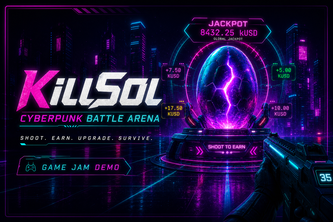
KillSol is a self-reported cyberpunk arena shooter game that blends Web3 and AI elements, designed for mobile and desktop play. The author states it aims to create a fun, accessible experience where every kill raises value and extraction decisions determine outcomes. It uses Solana Devnet for optional wallet integration and includes multilingual support and AI-driven gameplay.
What changed
This is a hackathon prototype submitted to the OpenAI 2026 hackathon. The author describes it as a playable 3D web prototype built in a short timeframe, with no evidence of prior development or commercial traction.
The single most important open question
Is there any evidence that KillSol has achieved product-market fit, user engagement, or monetization beyond the initial prototype?
What The Product Actually Is
The description states that KillSol is a cyberpunk arena shooter game built as a 3D web prototype, designed for both mobile and desktop platforms. It includes:
- A tactical HUD
- Bots
- An internal economy
- Session telemetry
- A central value sink represented by an "egg and jackpot"
The author describes it as a game where players enter, fight, accumulate value, and decide when to extract — with every action inside the arena having visible and measurable consequences.
It is built using technologies including:
- 3D graphics (Three.js, WebGL)
- Web3 (Solana Devnet)
- AI (OpenAI integration)
- Frontend frameworks (React, Framer Motion, Tailwind CSS)
- Backend tools (Node.js, Express.js, Supabase)
Inference The product is described as a prototype, not a finished product or commercial offering.
Positioning & Claim Evolution
The author positions KillSol as:
- A Web3 game that feels like a real game, not a financial interface.
- An experience where "everything they do inside the arena has value."
- Designed to be fun and accessible without requiring prior Web3 knowledge.
- A global experience supporting multiple languages.
- A competitive game with tension built into gameplay, not just economics.
The author claims that KillSol was developed to address two major issues:
- Most Web3 experiences feel more like financial forms than fun products.
- Many games fail because they don’t create real tension or meaningful economies.
They describe it as a way to merge shooters and value-based competition, creating an experience where players can choose whether to play with or without a wallet, on mobile or desktop, in their preferred language.
Inference The positioning is focused on accessibility, fun, and Web3 integration, but there is no evidence of market testing or user feedback beyond the author's own claims.
Target Customer & ICP
The description states that KillSol targets:
- Players who enjoy action games
- People unfamiliar with Web3 technology
- Users who want to compete and take risks in a game setting
- A global audience, supporting multiple languages
It also mentions that the experience is designed for both guest access and wallet-based access, allowing users to engage without needing to understand Web3.
Inference The ICP appears to be casual gamers interested in competitive gameplay, with a focus on Web3 newcomers or non-technical players. However, no customer segmentation data or user personas are provided.
Business Model & Pricing Evidence
The description states that KillSol uses a fixed-value reward system pegged at 1 USD = 1,000 KUSD. Every kill raises the value, and every extraction decides fate.
It also mentions that players can choose whether to connect a wallet or not — implying an optional Web3 layer.
There is no mention of:
- Revenue streams
- Pricing models
- Monetization strategies beyond gameplay
- In-game purchases or subscriptions
Inference The business model seems to be based on value accumulation and extraction mechanics, but there is no evidence of a monetized structure or pricing data.
Technical & Delivery Signals
The project was built as a 3D web prototype during a hackathon, using:
- Technologies: 3D (Three.js), Web3 (Solana Devnet), AI (OpenAI), frontend (React, Tailwind, Framer Motion), backend (Node.js, Express.js, Supabase)
- Frameworks: Vite, Fiber, Drei
- Deployment: Vercel
The author notes that the experience adapts to desktop and mobile, supports guest access or wallet-based access, and includes multilingual support.
Inference The technical stack suggests a modern web-based game with Web3 integration, but there is no evidence of scalability, performance metrics, or production deployment beyond the prototype stage.
Traction & Maturity Signals
The description states that KillSol was built as a hackathon submission, and the author describes it as a playable 3D web prototype.
There is no mention of:
- Users or player base
- Revenue or monetization
- Customer acquisition or retention metrics
- Product usage data
- Any form of traction beyond the initial prototype
Inference There is no evidence of traction or maturity, and the product remains in a pre-commercial prototype phase.
Competitive Context
The author states that KillSol was developed to address problems in:
- Web3 experiences (which feel like financial forms rather than products)
- Game design (lack of tension, economy, and meaningful decision-making)
They describe it as a new kind of experience, combining shooters, value-based competition, AI, and Web3.
There is no mention of:
- Direct competitors
- Market size or competitive landscape
- Prior art in similar games or Web3 gaming
Inference The competitive context is not clearly defined. KillSol appears to be positioned as a novel approach, but there is no evidence of market analysis or competitive positioning.
Open Questions & Risks
Key risks and open questions based on the description:
- Prototype only: No evidence of commercial viability, user engagement, or monetization.
- Unproven Web3 integration: The optional wallet layer may not be compelling enough to drive adoption.
- No revenue model: No indication of how the game would generate income.
- Unclear market fit: The author’s claims about accessibility and fun are self-reported without external validation.
- Limited team size: Only one developer, which raises concerns about scalability and execution.
- Hackathon origin: The project was built in a short timeframe, suggesting limited iteration or testing.
Inference The main risk is that KillSol remains a conceptual prototype, not a viable product with traction or monetization.
Questions the description leaves open
- What are the key assumptions about user behavior and engagement that underpin this game?
- How does the value accumulation and extraction system work in practice, and what are the mechanics behind it?
- Has there been any testing with real users beyond the prototype stage?
- What is the plan for monetization or revenue generation?
- How do you intend to scale beyond a single developer?
- What are the technical challenges of moving from a prototype to a full product, especially around Web3 integration and performance?
- Are there any plans to expand beyond the current scope (e.g., multiplayer, more game modes)?
- How does this project differ from existing Web3 games or shooters in the market?
Overall Assessment
Not evidenced
The description provides no evidence of:
- Revenue
- Customers
- Traction
- Product-market fit
- Monetization strategy
- Team scalability
- Market validation
This is a self-reported hackathon prototype, not a commercial product. The author’s claims about the game's design, accessibility, and Web3 integration are unverified.
Confidence level Low — based on limited evidence of a playable prototype only.
Assessment Not ready for investment or partnership consideration at this stage. Further development, traction, and validation are required before any commercial due diligence can proceed.
User Stories BotA demo video on every pull request
Get a demo video on every new feature
GitHub App that watches your pull requests and records a narrated, captioned demo.
Save time on demo prep and make informed decisions faster with a video walkthrough of every new feature.
Source
Submitted to the OpenAI 2026 hackathon on Devpost. Project home on Devpost. Back to the full gallery on Devpost.
This competitive analysis was produced by top-founders.com (opens in a new tab)
Generated by a language model from this project's public Devpost page — its tagline, the author's own write-up and any built-with tags listed there — as captured in August 2026. Short quotations are the author's words. It is an opinion on the idea as a business, not on the people behind it, and it reflects the description as published then. If the project has moved on, request a correction below. The analysis is not independent research and contains no verified traction, revenue or customer data.
An independent guide by KFG International LLC — not affiliated with, endorsed by, or connected to Devpost or OpenAI.