

Archive position — measured, not model output
0 likes on Devpost
2,263 of the 7,850 archived projects have more likes, and 5,587 share exactly 0 — so this project's #6,760 place in the like-ranked listing is a tie-break inside that group, not a ranking.
Projects (log scale)
Likes on Devpost. ▲ marks this project's group.
Show the figures
| Likes | Projects | Share of archive |
|---|---|---|
| 0 | 5,587 | 71.2% |
| 1 | 1,758 | 22.4% |
| 2 | 284 | 3.6% |
| 3–4 | 132 | 1.7% |
| 5–9 | 75 | 1.0% |
| 10+ | 14 | 0.2% |
 User Stories BotA demo video on every pull request
Get a demo video on every new feature
GitHub App that watches your pull requests and records a narrated, captioned demo.
Save time on demo prep and make informed decisions faster with a video walkthrough of every new feature.
Executive Summary
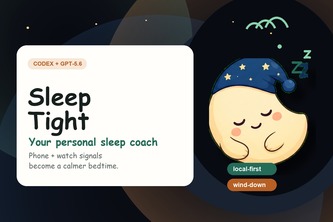
Sleep Tight is a self-reported personalization tool for bedtime routines, built as a hackathon submission. The product uses phone and watch sensor data to generate light-and-sound wind-down plans, with the system claiming to adapt to individual sleep patterns over time. It leverages Codex and GPT-5.6 in its development and conceptualization.
The project is described as a proof-of-concept for a hyper-personalized bedtime experience, but there is no evidence of revenue, customers, or adoption beyond the authors' own account. The team size is stated as two individuals.
Key open question
What is the actual utility of this system in real-world sleep behavior change? The description does not substantiate whether personalization improves outcomes or if users would engage with such a tool long-term.
What The Product Actually Is
The description states that Sleep Tight is a bedtime personalization tool. It collects 24-hour Health Connect vitals from an Android phone and 10-minute pre-sleep heart-rate data from a Galaxy Watch. At 10:05 p.m., Codex Scheduled analyzes this data to choose a safe background sound and lamp-fade plan.
It includes:
- Phone app
- Watch app
- Receiver
- Dashboards
- Lamp simulation
- Sleep report
- Tests
- README
- Slides
- GitHub Pages walkthrough
The system is described as generating monthly learning logs summarizing what worked and how the next routine should be personalized.
Inference The product appears to be a prototype or hackathon project, not a commercial offering. It uses sensor data and AI for personalization but lacks evidence of real-world deployment or user engagement.
Positioning & Claim Evolution
The authors state that Sleep Tight moves away from unreliable real-time sleep-stage intervention toward pre-sleep signals that are safer and more actionable. This suggests an evolution in product thinking, shifting from active sleep monitoring to passive, data-driven wind-down planning.
It also claims to personalize bedtime routines based on daily vitals, moving beyond generic advice to a hyper-personalized experience.
Inference The positioning is framed around safety and personalization, but there is no evidence of how this differs from existing tools or whether it addresses a significant user need. The claim of "hyper-personalization" is self-reported and unverified.
Target Customer & ICP
The description states that Sleep Tight is for people who want a calmer, more targeted wind-down routine that adapts to their lifestyle. It targets individuals interested in sleep optimization through technology.
Not evidenced No specific customer segments, personas, or user research are provided. The target audience is described only in broad terms.
Business Model & Pricing Evidence
The description does not state any business model or pricing information. It is presented as a hackathon submission with no indication of monetization strategy or revenue streams.
Not evidenced No evidence of a commercial model, pricing tiers, or customer acquisition plans.
Technical & Delivery Signals
The project was built using:
- Android
- Codex
- CSS3
- GPT-5.6
- HTML5
- JavaScript
- Python
- Samsung Galaxy Watch sensors
- Wear OS
It includes a phone app, watch app, receiver, dashboards, lamp simulation, sleep report, tests, README, slides, and GitHub Pages walkthrough.
Inference The technical stack suggests a prototype or proof-of-concept built in a short timeframe. The use of Codex and GPT-5.6 indicates AI integration, but no details on scalability or production readiness are provided.
Traction & Maturity Signals
The project was submitted to the OpenAI 2026 hackathon. It is described as a self-contained prototype with no evidence of traction, revenue, or user adoption beyond its authors' own account.
Not evidenced No data on customer usage, retention, or product maturity. The system is not reported to be in production or used by any users.
Competitive Context
The description does not mention competitors or the broader sleep optimization market. It is unclear how Sleep Tight compares to existing tools or platforms that offer bedtime routines or sleep tracking.
Not evidenced No competitive analysis, market positioning, or differentiation from other sleep-related technologies.
Open Questions & Risks
- Unverified claims: The product’s effectiveness and utility are self-reported without evidence.
- Prototype nature: Built as a hackathon project with no indication of scalability or production readiness.
- No commercial viability: No business model, pricing, or revenue data provided.
- Limited scope: The system is described as bounded in time and data inputs, potentially limiting its real-world impact.
Questions the description leaves open
- What specific sleep outcomes or behaviors are you trying to improve with this tool?
- How do you plan to validate that personalization actually improves sleep quality?
- Are there any privacy or ethical concerns around collecting and using health data for bedtime routines?
- What is the long-term vision for this product beyond a hackathon submission?
- Have you tested this system with real users, and what feedback did you receive?
Overall Assessment
The description presents Sleep Tight as a hackathon project with no evidence of traction, revenue, or commercial viability. It is not evident whether the product has moved beyond prototype stage or if there is any market demand for its proposed solution.
Confidence: Low
There is insufficient evidence to assess the commercial potential, scalability, or user engagement of Sleep Tight. The project appears to be a concept or proof-of-concept with no demonstrated path to monetization or adoption.
User Stories BotA demo video on every pull request
Get a demo video on every new feature
GitHub App that watches your pull requests and records a narrated, captioned demo.
Save time on demo prep and make informed decisions faster with a video walkthrough of every new feature.
Source
Submitted to the OpenAI 2026 hackathon on Devpost. Project home on Devpost. Back to the full gallery on Devpost.
This competitive analysis was produced by top-founders.com (opens in a new tab)
Generated by a language model from this project's public Devpost page — its tagline, the author's own write-up and any built-with tags listed there — as captured in August 2026. Short quotations are the author's words. It is an opinion on the idea as a business, not on the people behind it, and it reflects the description as published then. If the project has moved on, request a correction below. The analysis is not independent research and contains no verified traction, revenue or customer data.
An independent guide by KFG International LLC — not affiliated with, endorsed by, or connected to Devpost or OpenAI.