

Archive position — measured, not model output
0 likes on Devpost
2,263 of the 7,850 archived projects have more likes, and 5,587 share exactly 0 — so this project's #2,836 place in the like-ranked listing is a tie-break inside that group, not a ranking.
Projects (log scale)
Likes on Devpost. ▲ marks this project's group.
Show the figures
| Likes | Projects | Share of archive |
|---|---|---|
| 0 | 5,587 | 71.2% |
| 1 | 1,758 | 22.4% |
| 2 | 284 | 3.6% |
| 3–4 | 132 | 1.7% |
| 5–9 | 75 | 1.0% |
| 10+ | 14 | 0.2% |
 User Stories BotA demo video on every pull request
Get a demo video on every new feature
GitHub App that watches your pull requests and records a narrated, captioned demo.
Save time on demo prep and make informed decisions faster with a video walkthrough of every new feature.
Executive Summary
What the company appears to be
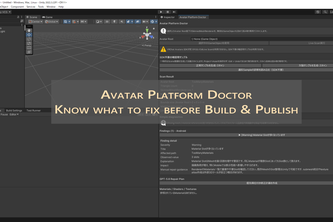
Avatar Platform Doctor is a Unity Editor extension that scans avatar data locally and converts technical observations into structured Findings. These Findings include severity, title, affected path, observed value, explanation, likely impact, and manual repair guidance. The tool can optionally send a reduced payload to OpenAI’s Responses API for GPT-5.6 to return a prioritized repair plan. It does not automatically modify avatars; all scanning and diagnostics are local.
What changed
The project was submitted as part of the OpenAI 2026 hackathon, indicating it is an MVP or proof-of-concept built in a short timeframe. The author states that features like automatic fixes, full Performance Rank reproduction, and broader diagnostic coverage were deferred to post-MVP development.
Single most important open question
Is there any evidence of adoption, usage, or traction beyond the hackathon submission? The description does not indicate whether this tool has been used by developers outside of the author’s own testing environment.
What The Product Actually Is
The description states that Avatar Platform Doctor is a Unity Editor extension. It scans avatar data locally and generates structured Findings based on diagnostic rules. These Findings include:
- Severity
- Title
- Affected path
- Observed value
- Explanation
- Likely impact
- Manual repair guidance
It uses a RuleEngine, a VRChat SDK adapter, and an OpenAI Responses API client to deliver both deterministic diagnostics and generative assistance via GPT-5.6.
The tool is implemented as a Unity Editor package, with layers including:
- An SDK-independent Core scanner
- A conditional VRChat SDK adapter
- A RuleEngine
- A Unity EditorWindow for results
- An OpenAI Responses API client
It does not modify avatars automatically; it remains read-only. The tool supports an SDK-free evaluator sample that allows testing without a VRChat account or commercial avatar.
Inference The product is a diagnostic and guidance tool for developers working with VRChat avatars, focused on helping beginners understand what is wrong with their avatars and how to fix it.
Positioning & Claim Evolution
The description states the inspiration behind Avatar Platform Doctor was to bridge the gap between technical avatar data and actionable repair guidance. It claims that existing tools like VRChat’s own statistics do not answer beginner questions such as:
- What is wrong?
- Why does it matter?
- What should I fix first?
This suggests a positioning shift from raw data to user-friendly diagnostics.
The author also notes that the tool was built with a focus on privacy, ensuring no avatar assets or identifying project data are sent to the API.
Inference The product positions itself as a developer tool for VRChat avatars, emphasizing clarity, usability, and privacy. It is not positioned as a full avatar creation platform but rather as a diagnostic assistant.
Target Customer & ICP
The description states that Avatar Platform Doctor is intended for Unity developers working with VRChat avatars, particularly beginners who struggle to interpret technical data.
It supports both:
- Users with access to the VRChat SDK
- Users without it (via an SDK-free evaluator)
This implies a broad target audience within the VRChat developer community, including those who may not yet be familiar with avatar optimization or debugging.
Inference The ICP is likely Unity developers working in VRChat, especially those new to avatar creation and seeking structured feedback on performance and compatibility issues.
Business Model & Pricing Evidence
There is no evidence of pricing, monetization, or business model in the description. The tool is presented as a developer utility with no indication of commercial use, subscription fees, or paid features.
The author mentions that the tool does not automatically modify avatars and that local scanning remains available even when the API key is missing or the API request fails.
Inference No business model is evident. The tool appears to be a free developer utility, possibly distributed via Unity Package Manager (VPM) in its future form.
Technical & Delivery Signals
The project is built as a Unity Editor package using:
- C#
- Codex
- GPT-5.6
- OpenAI Responses API
- Unity Editor integration
- VRChat SDK (conditional)
- JSON Schema parsing for structured output
It includes:
- EditMode tests (97/97 in SDK-free repo, 115/115 in VCC Avatar Project)
- A deterministic RuleEngine
- An SDK-independent Core scanner
- A Unity EditorWindow for displaying results
- Strict API request filtering to exclude sensitive data
The author notes that the tool does not mark scenes as dirty during Live Scan and excludes API keys from public demos.
Inference The technical implementation is robust, with strong test coverage and a clear separation between deterministic diagnostics and generative AI. It is designed for developer use, not end-user consumption.
Traction & Maturity Signals
The description states that this was a hackathon submission, implying it is an MVP or prototype.
It includes:
- A working Scan → Findings → Repair Plan workflow
- SDK-free evaluator sample
- 97/97 and 115/115 EditMode tests passed
- Public demo with privacy controls
However, there is no evidence of adoption, revenue, or user base beyond the author’s own testing.
Inference The tool is in a pre-MVP phase. It has been tested internally but lacks external traction or usage data.
Competitive Context
The description mentions that VRChat already provides avatar statistics and conversion tools, but these do not provide clear, actionable guidance for beginners.
Avatar Platform Doctor aims to improve upon this by offering:
- Structured Findings
- Manual repair guidance
- Generative AI support for prioritization
It does not appear to directly compete with other Unity-based avatar creation or optimization tools, but rather fills a gap in beginner-friendly diagnostics within the VRChat ecosystem.
Inference The competitive context is limited to existing VRChat tools and developer utilities. It is positioned as a complementary diagnostic tool, not a replacement for full avatar creation platforms.
Open Questions & Risks
- No traction or adoption data: The project is only described as a hackathon submission, with no evidence of real-world usage.
- MVP-only scope: Features like automatic fixes and full Performance Rank estimation were deferred, suggesting the current version is incomplete.
- Dependency on GPT-5.6: The tool relies on an external API for generative assistance, which may not be reliable or scalable.
- Developer-focused only: No indication of end-user or commercial adoption beyond internal testing.
- No monetization strategy: No evidence of a business model or pricing structure.
Inference The project is not yet mature and lacks real-world validation. It is a developer utility in early stages, with no clear path to commercial traction.
Questions the description leaves open
- What is the current status of the tool beyond the hackathon submission?
- Have any developers outside of the team used or tested the tool?
- Is there a plan for monetization or distribution beyond Unity Package Manager?
- How does the tool handle edge cases in avatar data that are not currently covered by its rules?
- What is the expected timeline to reach full functionality, including automatic fixes and broader diagnostics?
- Are there any plans to support other platforms or tools beyond VRChat?
Overall Assessment
Not evidenced.
The description does not provide sufficient evidence of traction, revenue, customer adoption, or a clear business model to assess investment or partnership potential.
The tool is described as an MVP built for a hackathon and lacks any indication of real-world usage or commercial viability.
Inference This project is in early development, with no demonstrated commercial or user traction. It may be a promising idea, but it is not yet ready for investment or partnership consideration based on the provided information.
User Stories BotA demo video on every pull request
Get a demo video on every new feature
GitHub App that watches your pull requests and records a narrated, captioned demo.
Save time on demo prep and make informed decisions faster with a video walkthrough of every new feature.
Source
Submitted to the OpenAI 2026 hackathon on Devpost. Project home on Devpost. Back to the full gallery on Devpost.
This competitive analysis was produced by top-founders.com (opens in a new tab)
Generated by a language model from this project's public Devpost page — its tagline, the author's own write-up and any built-with tags listed there — as captured in August 2026. Short quotations are the author's words. It is an opinion on the idea as a business, not on the people behind it, and it reflects the description as published then. If the project has moved on, request a correction below. The analysis is not independent research and contains no verified traction, revenue or customer data.
An independent guide by KFG International LLC — not affiliated with, endorsed by, or connected to Devpost or OpenAI.