

Archive position — measured, not model output
0 likes on Devpost
2,263 of the 7,850 archived projects have more likes, and 5,587 share exactly 0 — so this project's #4,799 place in the like-ranked listing is a tie-break inside that group, not a ranking.
Projects (log scale)
Likes on Devpost. ▲ marks this project's group.
Show the figures
| Likes | Projects | Share of archive |
|---|---|---|
| 0 | 5,587 | 71.2% |
| 1 | 1,758 | 22.4% |
| 2 | 284 | 3.6% |
| 3–4 | 132 | 1.7% |
| 5–9 | 75 | 1.0% |
| 10+ | 14 | 0.2% |
 User Stories BotA demo video on every pull request
Get a demo video on every new feature
GitHub App that watches your pull requests and records a narrated, captioned demo.
Save time on demo prep and make informed decisions faster with a video walkthrough of every new feature.
Executive Summary
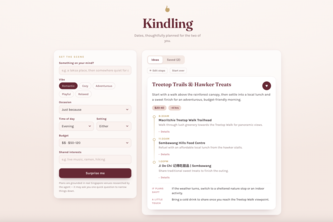
What the company appears to be: Kindling is a self-reported consumer SaaS product that uses agentic AI to help users plan personalized dates in Singapore. It allows users to input vague ideas (e.g., “hiking but not too intense”) and generates an itinerary from real venues, with the ability to refine or replace individual stops during the planning process.
What changed: The author reports building a multi-agent system using LangGraph, FastAPI, React, and GPT-5.6 that enables conversational date planning with structured state management for confirmed choices. It was built iteratively over a hackathon period.
Single most important open question: Is there any evidence of user adoption or product-market fit beyond the author’s own development experience?
Note: This analysis is based entirely on the self-reported project description provided by the author. No external verification, revenue data, customer feedback, or traction metrics are available.
What The Product Actually Is
The description states that Kindling is an “agentic Singapore date planner.” It builds upon a user’s loose idea (e.g., “chicken rice at Golden Mile, then an activity after”) and turns it into a personalized date plan using real venue data from tools like Google Maps and Tavily.
It uses a multi-agent workflow:
- A Planner agent determines what kind of stop should come next.
- An Executor agent selects and calls research tools (e.g., Maps, search).
- A Synthesis agent curates raw search results into useful venue options.
- The Planner remains the only client-facing agent.
The backend is built with FastAPI, LangChain, LangGraph, SQLite checkpointing, and structured state for confirmed venue selections. The frontend uses React and Vite.
Inference: Based on the author’s description, Kindling appears to be a prototype or proof-of-concept tool rather than a commercial product in production use.
Positioning & Claim Evolution
The author claims that Kindling helps users “turn a loose idea into a plan you can shape,” removing the research overhead so couples can focus on choosing what feels right. It is positioned as a personal assistant for date planning, not an automated decision-maker.
It emphasizes flexibility: if a user doesn’t like a suggestion, they can ask for something else and explain preferences in natural language — without restarting the entire plan.
Claim: The goal is to reduce repetitive research while maintaining personalization.
Inference: This positioning suggests a niche consumer-facing use case focused on lifestyle or relationship services.
Target Customer & ICP
The description states that Kindling targets users who want to plan dates in Singapore, particularly those who find the process of researching venues time-consuming and repetitive. It is aimed at couples looking for help with planning personal, flexible date experiences.
Claim: The target audience includes individuals or couples seeking personalized but not overly structured date ideas.
Inference: There is no explicit mention of demographic segmentation beyond “couples” or “users who plan dates.” No evidence of specific personas or user research.
Business Model & Pricing Evidence
There is no evidence in the description of a business model, pricing strategy, monetization approach, or any indication that Kindling has begun generating revenue or has customers.
Not evidenced
Technical & Delivery Signals
The system uses:
- Multi-agent LangGraph workflow
- FastAPI for backend
- React + Vite for frontend
- GPT-5.6 (Sol and Terra variants) for architecture and implementation
- Codex for iterative development
- SQLite checkpointing for state persistence
- Tools like Google Maps, Tavily search, and others
It also includes:
- Structured application state to preserve confirmed choices
- Two-pass research approach (broad → refined)
- Deterministic mock scenarios for reliable demos
Inference: The technical stack indicates a prototype built with modern AI and web frameworks. It is not clear whether this has been scaled or deployed beyond the hackathon context.
Traction & Maturity Signals
There is no evidence of user adoption, customer base, revenue, ARR, or any traction metrics. The project is described as a hackathon submission.
Not evidenced
Competitive Context
No mention of competitors or competitive landscape in the description. The author does not reference existing date-planning apps, travel planners, or AI assistants for personal planning.
Not evidenced
Open Questions & Risks
- Unverified claims: All descriptions are self-reported and unverified.
- No traction evidence: No users, customers, or revenue data.
- Prototype nature: Built as a hackathon project; unclear if it has moved beyond prototype stage.
- Limited scope: Only supports Singapore-based venues and date planning.
- Unclear scalability: No indication of how the system would scale to more complex or diverse use cases.
Inference: The lack of traction, revenue, or customer data raises questions about commercial viability or product-market fit.
Questions the description leaves open
- What is your current user base or any early adopter feedback?
- How do you plan to monetize this service beyond the prototype?
- Have you tested the system with real users outside of the development team?
- Are there plans to expand beyond Singapore or support other types of experiences (e.g., family outings, business events)?
- What are the key assumptions behind your product design and how have they been validated?
Overall Assessment
The description indicates that Kindling is a hackathon project built by one person using AI agents and modern web technologies. It shows technical capability but lacks evidence of traction, revenue, or commercial viability.
Assessment: Not ready for investment or partnership at this stage. The product is in early prototype form with no demonstrated market demand or business model. Further validation through user testing, early customers, or traction would be required before considering deeper due diligence.
User Stories BotA demo video on every pull request
Get a demo video on every new feature
GitHub App that watches your pull requests and records a narrated, captioned demo.
Save time on demo prep and make informed decisions faster with a video walkthrough of every new feature.
Source
Submitted to the OpenAI 2026 hackathon on Devpost. Project home on Devpost. Back to the full gallery on Devpost.
This competitive analysis was produced by top-founders.com (opens in a new tab)
Generated by a language model from this project's public Devpost page — its tagline, the author's own write-up and any built-with tags listed there — as captured in August 2026. Short quotations are the author's words. It is an opinion on the idea as a business, not on the people behind it, and it reflects the description as published then. If the project has moved on, request a correction below. The analysis is not independent research and contains no verified traction, revenue or customer data.
An independent guide by KFG International LLC — not affiliated with, endorsed by, or connected to Devpost or OpenAI.