

Archive position — measured, not model output
0 likes on Devpost
2,263 of the 7,850 archived projects have more likes, and 5,587 share exactly 0 — so this project's #2,838 place in the like-ranked listing is a tie-break inside that group, not a ranking.
Projects (log scale)
Likes on Devpost. ▲ marks this project's group.
Show the figures
| Likes | Projects | Share of archive |
|---|---|---|
| 0 | 5,587 | 71.2% |
| 1 | 1,758 | 22.4% |
| 2 | 284 | 3.6% |
| 3–4 | 132 | 1.7% |
| 5–9 | 75 | 1.0% |
| 10+ | 14 | 0.2% |
 User Stories BotA demo video on every pull request
Get a demo video on every new feature
GitHub App that watches your pull requests and records a narrated, captioned demo.
Save time on demo prep and make informed decisions faster with a video walkthrough of every new feature.
Executive Summary
What the company appears to be
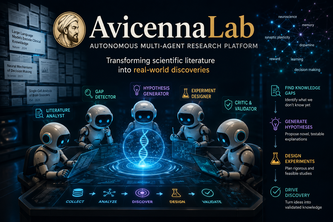
AvicennaLab is described as an autonomous multi-agent research platform that transforms scientific literature into discoveries by identifying knowledge gaps, generating hypotheses, and designing experiments. It is built around a modular architecture of specialized AI agents working in collaboration.
What changed
The project was submitted to the OpenAI 2026 hackathon, indicating it emerged from a short-term development effort focused on demonstrating a proof-of-concept for an AI-powered scientific discovery laboratory.
Single most important open question — the commercial due-diligence read
Is there evidence of early traction or product-market fit beyond the hackathon submission? The description does not indicate any revenue, customers, or adoption beyond the author’s own claims.
What The Product Actually Is
The description states that AvicennaLab is an autonomous multi-agent research platform. It functions as a virtual research team, composed of specialized AI agents that collaborate to perform tasks such as:
- Literature analysis
- Knowledge graph construction
- Research gap detection
- Hypothesis generation and ranking
- Experiment design
- Peer review simulation
It is described as using a modular multi-agent architecture where each agent has a defined role in the scientific discovery process.
The platform is built with technologies including:
- LLMs (large language models)
- Docker
- FastAPI
- Pydantic
- Python
- Codex
- API
Inference The product is conceptual and not yet deployed for public use or commercial application, based on the self-reported nature of the description.
Positioning & Claim Evolution
The author positions AvicennaLab as a next-generation scientific discovery tool, moving beyond traditional AI assistants that retrieve or summarize information to one that participates in full scientific ideation.
Key claims include:
- It enables scientific debate between specialized AI agents
- It supports continuous self-critique and peer review
- It aims to transform AI from an information retrieval tool into a genuine collaborator in scientific discovery
The project is named after Avicenna (Ibn Sina), a historical figure known for synthesizing knowledge across disciplines, which reinforces its positioning around interdisciplinary synthesis.
Inference The positioning reflects an ambitious vision of AI in science, but no evidence exists that this has been validated or tested outside the hackathon context.
Target Customer & ICP
The description implies that AvicennaLab is intended for researchers and scientific institutions, particularly those engaged in interdisciplinary research or seeking to automate parts of their discovery workflow.
It also mentions:
- Support for human-in-the-loop collaboration
- Personalized research assistants for individual laboratories
- Integration with databases like arXiv, PubMed, Semantic Scholar, and Crossref
However, there is no explicit mention of specific customer segments, use cases, or personas beyond general scientific users.
Inference The ICP appears to be researchers and labs, but the description lacks clarity on who exactly will pay for or adopt this platform.
Business Model & Pricing Evidence
There is no evidence in the provided description of:
- Revenue streams
- Pricing models
- Monetization strategy
- Customer acquisition plans
The project is described as a hackathon submission, suggesting it has not yet reached a commercial stage.
Inference No business model or pricing information is evidenced; this remains speculative.
Technical & Delivery Signals
The platform is built using:
- LLMs for reasoning
- Docker containers
- FastAPI for APIs
- Pydantic for data validation
- Python as the core language
- Codex for code generation
- API-based communication between agents
It uses a modular multi-agent architecture with clearly defined roles for each agent, such as:
- Literature Analysis Agent
- Knowledge Graph Agent
- Hypothesis Generation Agent
- Experiment Design Agent
- Reviewer Agent
The system is said to support:
- Structured outputs
- Shared scientific memory
- Iterative reasoning
- Cross-agent collaboration
Inference The technical approach shows a strong understanding of AI systems and agent-based design, but no evidence exists that the platform has been deployed or tested in real-world conditions.
Traction & Maturity Signals
The only signal of traction is:
- Submission to the OpenAI 2026 hackathon
There is no evidence of:
- Revenue
- Customers
- Product adoption
- User feedback
- Market validation
- Product iteration or release history
The project is described as a proof-of-concept, not a product in production.
Inference No traction or maturity indicators are evidenced beyond the hackathon submission.
Competitive Context
The description does not mention:
- Direct competitors
- Indirect substitutes
- Market size or growth trends
- Competitive advantages
It does state that current AI research assistants are limited to linear workflows (search → summarize → answer), and AvicennaLab aims to go beyond this by enabling iterative reasoning, debate, and hypothesis generation.
Inference The competitive landscape is not described, so it's unclear whether AvicennaLab addresses a well-defined market gap or overlaps with existing tools in ways that are substantiated.
Open Questions & Risks
- Unproven concept: The platform is presented as a hackathon prototype, not a tested product.
- Lack of commercial viability evidence: No revenue, customers, or monetization strategy.
- High technical complexity without demonstrated execution: Building multi-agent systems with shared memory and reasoning is complex; no evidence of successful implementation.
- Ambitious scope without clear path to market: The vision includes multimodal data support, autonomous experiment execution, and integration with major scientific databases—none of which are shown to be implemented.
- Single founder team: Only one member listed (Abdelrahman Alkahwaji), raising questions about scalability and execution capacity.
Inference The project is at a very early stage, and the risk of failure is high due to lack of traction, validation, or commercialization plans.
Questions the description leaves open
- What specific scientific domains or disciplines does AvicennaLab target?
- Has there been any testing or feedback from actual researchers using the system?
- How are the specialized agents coordinated and how do they avoid conflicts or redundancy?
- Are there plans to integrate with real-time scientific databases (e.g., arXiv, PubMed)?
- What is the roadmap for monetization or product development beyond the hackathon?
- How does AvicennaLab handle uncertainty or ambiguity in scientific reasoning?
- Can you provide examples of hypotheses generated or experiments designed by the system?
- What are the limitations of the current architecture that would prevent scaling?
Overall Assessment
Not evidenced.
The description provides no information on:
- Financials
- Traction
- Market opportunity
- Team track record
- Product-market fit
This is a pre-product, pre-revenue, pre-traction concept submitted as part of a hackathon.
Confidence Level: Low
The project is described as a conceptual prototype, not a product or service. It lacks any evidence of commercial viability, adoption, or measurable impact.
Inference At this stage, it is not suitable for investment or partnership consideration unless further development and validation occur outside the hackathon framework.
User Stories BotA demo video on every pull request
Get a demo video on every new feature
GitHub App that watches your pull requests and records a narrated, captioned demo.
Save time on demo prep and make informed decisions faster with a video walkthrough of every new feature.
Source
Submitted to the OpenAI 2026 hackathon on Devpost. Project home on Devpost. Back to the full gallery on Devpost.
This competitive analysis was produced by top-founders.com (opens in a new tab)
Generated by a language model from this project's public Devpost page — its tagline, the author's own write-up and any built-with tags listed there — as captured in August 2026. Short quotations are the author's words. It is an opinion on the idea as a business, not on the people behind it, and it reflects the description as published then. If the project has moved on, request a correction below. The analysis is not independent research and contains no verified traction, revenue or customer data.
An independent guide by KFG International LLC — not affiliated with, endorsed by, or connected to Devpost or OpenAI.