

Archive position — measured, not model output
0 likes on Devpost
2,263 of the 7,850 archived projects have more likes, and 5,587 share exactly 0 — so this project's #2,837 place in the like-ranked listing is a tie-break inside that group, not a ranking.
Projects (log scale)
Likes on Devpost. ▲ marks this project's group.
Show the figures
| Likes | Projects | Share of archive |
|---|---|---|
| 0 | 5,587 | 71.2% |
| 1 | 1,758 | 22.4% |
| 2 | 284 | 3.6% |
| 3–4 | 132 | 1.7% |
| 5–9 | 75 | 1.0% |
| 10+ | 14 | 0.2% |
 User Stories BotA demo video on every pull request
Get a demo video on every new feature
GitHub App that watches your pull requests and records a narrated, captioned demo.
Save time on demo prep and make informed decisions faster with a video walkthrough of every new feature.
Executive Summary
What the company appears to be
Avatar Podcast Studio is a self-reported single-person project that builds an AI-powered web application combining voice conversation, knowledge bases, and live visual generation through an animated avatar. The author states it integrates OpenAI's GPT-5.6 Terra for visual canvas generation, OpenAI Realtime API for voice interaction, and GPT Image for avatar creation.
What changed
The project evolved from an experimental prototype into a focused OpenAI-only product during the OpenAI Build Week, using Codex for architecture audit and migration, and GPT-5.6 Terra as part of the shipped application rather than just development workflow.
The single most important open question
Is there any evidence of user adoption, revenue, or traction beyond the author's own description? The self-reported write-up contains no data on customers, usage metrics, monetization, or market validation.
What The Product Actually Is
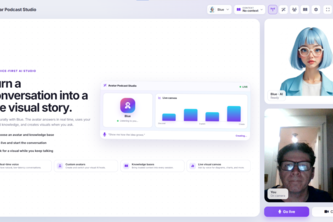
The description states that Avatar Podcast Studio is a responsive web application combining three core experiences:
- A natural, low-latency voice conversation with an animated AI host
- Selectable plain-text knowledge bases providing trusted context
- A live canvas that turns spoken requests into diagrams, roadmaps, comparisons, charts, and concept maps
The system allows users to select an avatar and voice, attach reference material, and go live. The avatar listens, reacts, speaks, and lip-syncs with generated audio.
When a user asks for a visual, the avatar sends an asynchronous tool request to the canvas. The conversation does not stop while the visual is being created; when ready, the host confirms completion and the result appears as interactive HTML, CSS, and SVG.
Users can also generate custom avatar pose sheets with consistent listening, blinking, and speaking states.
Evidence Self-reported by author. No independent verification or data on actual product use.
Positioning & Claim Evolution
The author positions Avatar Podcast Studio as a solution to two separate problems:
- Voice assistants are natural to talk to, but their ideas disappear after being spoken.
- Presentation and diagram tools preserve ideas visually, but interrupt conversation and require manual design work.
The author claims the product creates a workspace where speaking, understanding, and visual thinking happen together, integrating these functions into one responsive web application.
Inference The positioning suggests this is aimed at creators or educators who want to combine verbal communication with visual output in real time. However, no evidence of market research, customer interviews, or competitive positioning data is provided.
Target Customer & ICP
The description does not identify specific target customers or personas. It implies the product is for users who want to "talk ideas into life" and create live visual explanations during conversation.
The author mentions that users can select avatars and voices, attach reference material, and go live — suggesting a user base likely interested in content creation, education, or presentation tools.
Inference Based on the claims, potential ICPs might include educators, podcasters, trainers, or knowledge workers who want to enhance verbal communication with visual aids. However, no evidence of actual customer segments or buyer personas is provided.
Business Model & Pricing Evidence
There is no evidence in the description of any business model or pricing structure. The author does not mention monetization strategies, subscription tiers, freemium models, or sales channels.
The project appears to be a personal prototype submitted for a hackathon and lacks any indication of commercial intent beyond its demonstration.
Evidence Self-reported only; no data on revenue, pricing, or monetization methods.
Technical & Delivery Signals
The author describes building the frontend with React, TypeScript, and Vite, and the backend using Node.js and Express. The application uses:
- OpenAI Realtime API for live voice experience via WebRTC
- GPT-5.6 Terra for visual canvas generation (HTML/CSS/SVG)
- GPT Image for avatar sprite sheet creation
- SQLite for data storage
- Docker for deployment
The system includes authentication, per-session and per-IP quotas, global concurrency limits, and feature switches to protect paid OpenAI capabilities.
Evidence Self-reported technical stack and architecture. No evidence of production scale or performance metrics.
Traction & Maturity Signals
There is no evidence of traction, adoption, or user engagement beyond the author's own description. The project was submitted as a hackathon entry to the OpenAI 2026 hackathon on Devpost and has no stated customer base, revenue, or usage data.
The author notes that the application is responsive, deployable as one Docker service, protected against uncontrolled API usage, and usable by judges through a hosted demonstration — but this does not indicate real-world traction.
Evidence Self-reported; no external validation or metrics on product usage or performance.
Competitive Context
The description does not provide any information about competitors or the competitive landscape. It does not name similar products or describe how Avatar Podcast Studio differentiates from existing tools in voice, AI avatars, or visual collaboration spaces.
Evidence Not evidenced; no mention of market analysis or competitive positioning.
Open Questions & Risks
Several risks and open questions are present based on the self-reported description:
- Single-person development: The team size is listed as one (Patricio Bustamante), which raises concerns about scalability, maintenance, and long-term viability.
- No commercial traction or revenue: No evidence of monetization, customers, or market validation.
- Unverified claims: All statements are self-reported without corroboration.
- Hackathon prototype: The project was submitted to a hackathon, suggesting it may be an experimental or proof-of-concept rather than a mature product.
- No user feedback or testing data: No mention of user interviews, usability studies, or iterative improvements based on feedback.
Inference These factors suggest the project is in early development and lacks commercial readiness or market validation.
Questions the description leaves open
- What specific use cases are you targeting, and how do you plan to validate them?
- Have you conducted any user research or interviews with potential customers?
- Are there any existing users or pilot programs for this product?
- How do you intend to monetize the platform, if at all?
- What is your roadmap beyond the current prototype?
- How do you plan to scale beyond a single developer?
- What are the technical challenges you've encountered in production deployment?
Overall Assessment
There is no evidence of commercial traction, revenue, or customer validation for Avatar Podcast Studio. The project appears to be a hackathon submission with no indication of market demand, monetization strategy, or long-term business model.
The author describes a compelling vision but provides no data on adoption, user engagement, or product-market fit.
Confidence level Low — based entirely on self-reported information with no external validation or evidence of real-world usage or impact.
Assessment Not ready for investment or partnership consideration at this time. Further due diligence would require evidence of traction, revenue, or customer feedback.
User Stories BotA demo video on every pull request
Get a demo video on every new feature
GitHub App that watches your pull requests and records a narrated, captioned demo.
Save time on demo prep and make informed decisions faster with a video walkthrough of every new feature.
Source
Submitted to the OpenAI 2026 hackathon on Devpost. Project home on Devpost. Back to the full gallery on Devpost.
This competitive analysis was produced by top-founders.com (opens in a new tab)
Generated by a language model from this project's public Devpost page — its tagline, the author's own write-up and any built-with tags listed there — as captured in August 2026. Short quotations are the author's words. It is an opinion on the idea as a business, not on the people behind it, and it reflects the description as published then. If the project has moved on, request a correction below. The analysis is not independent research and contains no verified traction, revenue or customer data.
An independent guide by KFG International LLC — not affiliated with, endorsed by, or connected to Devpost or OpenAI.