

Archive position — measured, not model output
0 likes on Devpost
2,263 of the 7,850 archived projects have more likes, and 5,587 share exactly 0 — so this project's #4,745 place in the like-ranked listing is a tie-break inside that group, not a ranking.
Projects (log scale)
Likes on Devpost. ▲ marks this project's group.
Show the figures
| Likes | Projects | Share of archive |
|---|---|---|
| 0 | 5,587 | 71.2% |
| 1 | 1,758 | 22.4% |
| 2 | 284 | 3.6% |
| 3–4 | 132 | 1.7% |
| 5–9 | 75 | 1.0% |
| 10+ | 14 | 0.2% |
 User Stories BotA demo video on every pull request
Get a demo video on every new feature
GitHub App that watches your pull requests and records a narrated, captioned demo.
Save time on demo prep and make informed decisions faster with a video walkthrough of every new feature.
Executive Summary
The description states that JX Ops Agent is an AI-powered tool designed to operate legacy MMORPG server fleets using a Python CLI. It claims to simulate real-world operations including log analysis, incident diagnosis, and fix validation on headless clones. The project was built in one session by Codex with GPT-5.6, based on the author's own private tooling but without reusing any code from that system.
The most important open question is whether this tool can be meaningfully applied beyond the author’s personal use case — particularly regarding its scalability and generalizability to other legacy systems or environments outside of MMORPGs.
This analysis is based entirely on self-reported information provided by the author. No external verification, traction data, revenue figures, customer names, or independent sources are available.
What The Product Actually Is
The description states that JX Ops Agent is a Python CLI tool named jxops, which performs several functions:
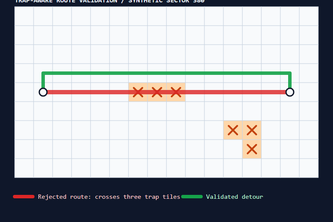
- Route validation: Uses a demo map with trap tiles to validate routes and detect issues like teleporting bots.
- Incident analysis: Reads server logs, identifies problems such as warp loops or region churn, and generates Markdown root-cause reports.
- Bot simulation: Runs swarms of bots modeled as state machines (idle, route, engage, regroup), animated in the terminal with AOI tracking.
- Headless boot sequence playback: Simulates a production-like boot process for validating fixes.
It also includes:
- A map/route engine
- A bot simulator
- An incident analyzer
- Documentation
These components are described as being built from scratch during a single Codex session using GPT-5.6, with no reuse of prior code from the author's private tooling.
The tool is said to be runnable without access to actual game servers or assets — relying instead on terminal output, logs, and SVG rendering.
Inference: The product appears to be a proof-of-concept demonstration rather than a production-ready system. It simulates an AI operator workflow for legacy systems but does not appear to have any live integration with real-world infrastructure beyond its own demo environment.
Positioning & Claim Evolution
The author positions JX Ops Agent as a tool that brings AI automation to legacy MMORPG server operations, specifically targeting users who run private servers and face challenges in maintaining aging codebases.
Key claims from the description:
- The system was originally developed for personal use over years.
- It uses an AI agent to automate tasks like log reading, root cause diagnosis, and fix validation.
- The tool is built using modern AI tools (Codex + GPT-5.6) in a single session.
- It avoids reuse of existing proprietary code by rebuilding everything from specifications.
There is no indication that this product has evolved beyond a prototype or demo stage. The author emphasizes that the project was submitted to a hackathon and that all functionality described is new code created during Build Week.
Inference: This is an experimental, self-contained tool built for demonstration purposes, not yet positioned as a commercial offering or scalable platform.
Target Customer & ICP
The description does not explicitly define target customers or ideal customer profiles (ICP). However, it implies the following:
- Users who operate legacy MMORPG private servers.
- Individuals or small teams managing aging systems where domain knowledge is fragmented.
- Developers or operators working with systems that lack modern tooling or observability.
It also suggests that the author’s own use case — running seven private servers for an old MMORPG — serves as a proxy for potential users.
Inference: The ICP likely includes niche technical users who manage legacy systems and are interested in applying AI to operational challenges, particularly those involving complex, long-running systems with limited documentation or support.
Business Model & Pricing Evidence
There is no evidence of any business model or pricing strategy described. The project is presented as a hackathon submission and a personal passion project.
Not evidenced
Technical & Delivery Signals
The description indicates:
- Built using Python, C++, Lua 4.0, SQL Server, MySQL, SVG rendering.
- Uses Codex + GPT-5.6 for development in one session.
- Includes automated testing and deterministic execution (fixed seed for bot swarm).
- Git-based version control with clear commit history.
- No reuse of prior code from the author’s private tooling.
- The system is designed to be portable: runs on plain Python anywhere.
Inference: The technical stack reflects a mix of legacy and modern tools, suggesting an attempt to bridge old and new systems. The use of AI-assisted development (Codex + GPT) shows a novel approach to rapid prototyping but does not imply scalability or production readiness.
Traction & Maturity Signals
There is no evidence of traction, adoption, revenue, or customer base. The project is described as:
- A hackathon submission.
- Built in one session with no prior history.
- Not connected to any existing fleet or operational system beyond the author’s personal use case.
- Not integrated into live environments.
Not evidenced
Competitive Context
The description does not mention competitors or similar tools. It focuses on the unique aspects of how it was built (AI-assisted, no code reuse) and its application to legacy MMORPGs.
Not evidenced
Open Questions & Risks
- Limited scope: The tool is demonstrated only in a controlled, simulated environment; there is no evidence of real-world deployment or integration.
- Niche applicability: Its focus on MMORPGs may limit broader market appeal unless the core concepts are generalized.
- Dependency on AI tools: Reliance on Codex + GPT-5.6 raises questions about reproducibility, consistency, and long-term viability if those tools change or become unavailable.
- No production integration: The tool is not connected to live logs or systems; it only simulates operations.
- Self-reported maturity: No evidence of performance metrics, scalability tests, or real-world usage beyond the author’s own experience.
Questions the description leaves open
- What specific legacy systems have you tested this against? Has it been validated outside of your private MMORPG fleet?
- How would you scale this approach to other types of legacy infrastructure (e.g., enterprise applications, embedded systems)?
- Can the AI agent be trained or adapted for different domains without rebuilding from scratch?
- What are the limitations of the current architecture in terms of performance, reliability, and maintainability?
- Are there plans to integrate with real-time log streams or live server environments?
- How does the tool handle edge cases or unexpected behaviors that aren’t captured in the demo?
- What kind of support or documentation is planned for users who want to adopt this system?
Overall Assessment
The description presents JX Ops Agent as a proof-of-concept built during a hackathon, with no evidence of commercial traction, revenue, or customer adoption.
It demonstrates an interesting idea around AI-assisted operations in legacy systems but lacks indicators of scalability, generalizability, or market readiness.
Assessment: Early-stage prototype with potential for further development. Not suitable for investment or partnership at this time due to lack of evidence of viability, traction, or commercialization strategy.
User Stories BotA demo video on every pull request
Get a demo video on every new feature
GitHub App that watches your pull requests and records a narrated, captioned demo.
Save time on demo prep and make informed decisions faster with a video walkthrough of every new feature.
Source
Submitted to the OpenAI 2026 hackathon on Devpost. Project home on Devpost. Back to the full gallery on Devpost.
This competitive analysis was produced by top-founders.com (opens in a new tab)
Generated by a language model from this project's public Devpost page — its tagline, the author's own write-up and any built-with tags listed there — as captured in August 2026. Short quotations are the author's words. It is an opinion on the idea as a business, not on the people behind it, and it reflects the description as published then. If the project has moved on, request a correction below. The analysis is not independent research and contains no verified traction, revenue or customer data.
An independent guide by KFG International LLC — not affiliated with, endorsed by, or connected to Devpost or OpenAI.