

Archive position — measured, not model output
0 likes on Devpost
2,263 of the 7,850 archived projects have more likes, and 5,587 share exactly 0 — so this project's #4,634 place in the like-ranked listing is a tie-break inside that group, not a ranking.
Projects (log scale)
Likes on Devpost. ▲ marks this project's group.
Show the figures
| Likes | Projects | Share of archive |
|---|---|---|
| 0 | 5,587 | 71.2% |
| 1 | 1,758 | 22.4% |
| 2 | 284 | 3.6% |
| 3–4 | 132 | 1.7% |
| 5–9 | 75 | 1.0% |
| 10+ | 14 | 0.2% |
 User Stories BotA demo video on every pull request
Get a demo video on every new feature
GitHub App that watches your pull requests and records a narrated, captioned demo.
Save time on demo prep and make informed decisions faster with a video walkthrough of every new feature.
Executive Summary
What the company appears to be
The project described as "Infinite LitRPG" is a self-contained, local story generator for LitRPG (literature-based role-playing game) narratives. It allows users to define the shape of a character's life and then generates content using AI models, with deterministic validation steps to maintain consistency across chapters. The system runs entirely on the user’s machine, without any cloud hosting or account requirements.
What changed
This is a solo developer project submitted for an OpenAI hackathon. It does not appear to have evolved from prior versions or received external investment or traction. It is a prototype built in one week using Codex as an implementation partner and OpenAI models.
Single most important open question
Is there any evidence of user adoption, engagement, or commercial interest beyond the author's own use-case?
What The Product Actually Is
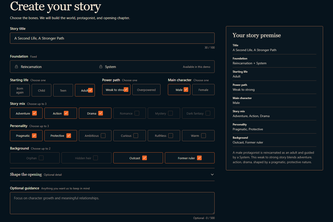
The description states that Infinite LitRPG is a local, bring-your-own-key story creator and reader. It enables users to define key aspects of a character’s life such as age, power path, genre, background, personality, rebirth cause, memory, system focus, and optional name.
It uses:
- GPT-5.6 Terra for generating the starting world
- GPT-5.6 Luna agents to propose character intent
- GPT-5.6 Sol for framing and narrating chapters
The system:
- Compiles stable canonical IDs using deterministic TypeScript
- Validates topology, factions, inventory, relationships, facts, milestones, threat, system rules, and legal opening actions via Terra
- Audits generated content before saving it
- Allows users to:
- Create and switch between multiple books
- Keep reading while generation continues
- Make choices at decision points
- Add custom actions
- Rewrite the latest chapter without changing accepted canon
- Reject or reopen a book
- Export Markdown and reader-safe JSON
Stories are stored locally in SQLite databases and Markdown files. There is no account, payment, analytics, hosted feed, image generation, or mobile app.
Evidence
- The author states: “Infinite LitRPG is a local, bring-your-own-key story creator and reader.”
- The system uses GPT-5.6 Sol, Terra, Luna models with distinct roles.
- It includes deterministic validation logic using TypeScript and SQLite.
- No cloud or hosted components are mentioned.
Not evidenced
- Whether the product has been used by others beyond the author.
- How many users might be using it.
- Any revenue or monetization model.
Positioning & Claim Evolution
The project claims to solve two problems:
- Variation in LitRPG genre: Readers want specific reincarnations, systems, power curves, cast, and worlds — Infinite LitRPG lets them create that personal story without becoming the author.
- Web novel stagnation: Many web novels stop for years before reaching a conclusion; this project explores reader-controlled paths that can continue moving while preserving what already happened.
The positioning is framed around:
- Personalization of narrative
- Reader agency in storytelling
- Preservation of continuity and canon
Evidence
- The author states: “I am solving two problems I see in LitRPG.”
- The system supports user-defined character traits, world-building, and story control.
- It allows for ongoing generation with deterministic validation.
Inference The project positions itself as a tool for personal storytelling within the LitRPG genre — not a platform or marketplace.
Target Customer & ICP
The description does not explicitly state who the target customer is. However, based on its design and use case:
- The primary user appears to be a single individual (the author) who wants to generate personalized LitRPG stories.
- It may appeal to enthusiasts of LitRPG or interactive fiction, particularly those interested in customizing their reading experience.
- There is no indication that it targets publishers, platforms, or communities.
Evidence
- The team size is listed as 1.
- The system runs locally and requires an OpenAI API key.
- No mention of community features or multi-user support.
Not evidenced
- Who else might use this product beyond the author.
- Whether there are any existing users or target segments identified by the author.
Business Model & Pricing Evidence
There is no evidence of a business model or pricing structure in the description. The system:
- Runs locally on user machines
- Uses OpenAI API keys
- Has no hosted components, subscriptions, or payments
- Is open-source under MIT license
Evidence
- The author states: “Stories stay on the user's machine.”
- No mention of accounts, billing, analytics, or monetization.
- Repository is public and licensed under MIT.
Inference This appears to be a free, self-hosted tool, likely intended for personal use or experimentation rather than commercial deployment.
Technical & Delivery Signals
The system uses:
- OpenAI Responses API
- GPT-5.6 Sol, Luna, Terra models with distinct roles
- TypeScript for deterministic validation
- SQLite for local storage
- React + Next.js frontend stack
- Vitest for testing
- Zod for schema validation
- Playwright for browser checks
Key technical decisions include:
- Model outputs are untrusted and parsed through strict schemas
- Canonical state writer commits world delta, knowledge delta, prose, trace, usage, and version atomically
- POV prompts receive only selected character knowledge
- At most three background-character agents run per chapter
- Chapter 350 is terminal; Chapter 351 is blocked before any model call
Evidence
- The author describes the architecture in detail.
- Includes implementation notes from Codex collaboration.
- Mentions offline evals, regression tests, and checks for POV leaks.
Not evidenced
- Performance benchmarks or scalability data.
- Any production deployment or usage metrics.
Traction & Maturity Signals
There is no evidence of traction or user adoption beyond the author’s own development. The project:
- Was built in one week during a hackathon
- Has no revenue, customers, or growth metrics
- Is open-source and self-hosted
- Does not appear to have evolved from prior versions or received funding
Evidence
- Submitted to OpenAI 2026 hackathon.
- Built with Codex as implementation partner.
- No mention of users, downloads, or engagement.
Not evidenced
- Any form of user base, adoption rate, or product usage statistics.
- Whether the tool has been used by others beyond the author.
Competitive Context
The description does not provide information about competitors. However, it implies a niche within LitRPG and interactive fiction, where tools for generating personalized narratives exist but are limited in scope or interactivity.
Evidence
- The author identifies two core problems in LitRPG.
- No direct mention of existing tools or platforms competing with this approach.
Inference
This project likely operates in a space with few established players, possibly overlapping with:
- Interactive fiction engines
- AI-generated narrative tools
- Web novel readers or editors
Open Questions & Risks
- Single-person development: The entire system was built by one person — raises concerns about long-term maintenance and scalability.
- No monetization or business model: No indication of how the project would generate revenue or attract users beyond personal use.
- High dependency on AI models: Reliance on GPT-5.6 Sol, Luna, Terra implies potential instability if those APIs change or become unavailable.
- Limited audience: The tool is self-hosted and requires technical knowledge — limiting its accessibility to non-developers.
- No user feedback loop: No evidence of user testing or iteration beyond the author’s own experience.
Evidence
- Team size = 1
- No mention of users, feedback, or commercial viability
Inference This is a prototype with no clear path to market traction or monetization without further development or community engagement.
Questions the description leaves open
- What inspired you to build this tool? Was there a specific gap in the LitRPG ecosystem that you wanted to address?
- Have you tested this with others, and how did they respond?
- Do you plan to expand beyond local execution or add features like sharing or collaboration?
- How do you envision monetizing or scaling this product if at all?
- What are your thoughts on the long-term viability of relying on proprietary AI models (e.g., GPT-5.6)?
- Are there any plans for hosting, cloud integration, or multi-user support in the future?
Overall Assessment
There is no evidence of a commercial product, traction, or revenue generation beyond the author’s own use-case. The project is a hackathon prototype built by one person and is self-hosted with no monetization strategy.
Confidence Level Low
This is a pre-product concept, not a product in any meaningful sense. It lacks:
- Users
- Revenue
- Market validation
- Scalability or commercial potential
It may be an interesting experiment, but it does not meet the criteria for investment or partnership consideration at this stage.
Evidence
- No revenue, customers, or adoption data.
- No business model or monetization strategy.
- Built in one week as a hackathon submission.
- Self-hosted and open-source with no hosted components.
User Stories BotA demo video on every pull request
Get a demo video on every new feature
GitHub App that watches your pull requests and records a narrated, captioned demo.
Save time on demo prep and make informed decisions faster with a video walkthrough of every new feature.
Source
Submitted to the OpenAI 2026 hackathon on Devpost. Project home on Devpost. Back to the full gallery on Devpost.
This competitive analysis was produced by top-founders.com (opens in a new tab)
Generated by a language model from this project's public Devpost page — its tagline, the author's own write-up and any built-with tags listed there — as captured in August 2026. Short quotations are the author's words. It is an opinion on the idea as a business, not on the people behind it, and it reflects the description as published then. If the project has moved on, request a correction below. The analysis is not independent research and contains no verified traction, revenue or customer data.
An independent guide by KFG International LLC — not affiliated with, endorsed by, or connected to Devpost or OpenAI.