

Archive position — measured, not model output
1 like on Devpost
505 of the 7,850 archived projects have more likes, and 1,758 share exactly 1 — so this project's #608 place in the like-ranked listing is a tie-break inside that group, not a ranking.
Projects (log scale)
Likes on Devpost. ▲ marks this project's group.
Show the figures
| Likes | Projects | Share of archive |
|---|---|---|
| 0 | 5,587 | 71.2% |
| 1 | 1,758 | 22.4% |
| 2 | 284 | 3.6% |
| 3–4 | 132 | 1.7% |
| 5–9 | 75 | 1.0% |
| 10+ | 14 | 0.2% |
 User Stories BotA demo video on every pull request
Get a demo video on every new feature
GitHub App that watches your pull requests and records a narrated, captioned demo.
Save time on demo prep and make informed decisions faster with a video walkthrough of every new feature.
Executive Summary
What the company appears to be
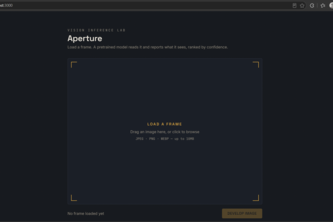
Aperture is a self-reported web application that integrates deep learning computer vision into an interactive camera viewfinder interface. It allows users to upload images and receive real-time classification results from pre-trained PyTorch models (ResNet18, ResNet50, MobileNetV3), with a persistent history of predictions stored in a database.
What changed
The project description indicates this is a personal, solo-built hackathon submission. It does not report any prior commercial activity or product development beyond the initial build.
Single most important open question
Is there evidence of traction, revenue, or customer adoption beyond the author’s own development and demonstration?
Note: This analysis is based entirely on the self-reported, unverified project description provided by the caller. No third-party verification, archived data, or independent sources are available.
What The Product Actually Is
The description states that Aperture is a web-based image classifier using deep learning computer vision. It features:
- An interactive viewfinder interface for uploading images (JPEG, PNG, WebP up to 10MB)
- Real-time inference using pre-trained TorchVision models (ResNet18, ResNet50, MobileNetV3)
- A dashboard showing ranked classification results with confidence percentages and timing
- Persistent storage of past predictions in a database (PostgreSQL or SQLite)
- Input validation to prevent corrupt image files from causing server errors
Inference: The product is built as a decoupled full-stack application using FastAPI for backend and Next.js for frontend, with PyTorch for inference.
Claim vs Fact: The author describes the functionality but does not provide evidence of actual usage or performance in production.
Positioning & Claim Evolution
The description states that Aperture aims to make “deep learning computer vision tangible and visually captivating,” by bringing AI out of the black box and into an interactive camera viewfinder experience. It positions itself as a tool for visualizing machine vision outputs in real time, inspired by optical equipment interfaces.
Inference: The positioning is focused on user experience and accessibility of AI tools, not scalability or enterprise use cases.
Claim vs Fact: This is a self-stated intent; no evidence of market positioning or customer feedback is provided.
Target Customer & ICP
The description does not identify any specific target customer or ideal customer profile (ICP). It describes the tool as a personal project for visualizing AI inference, without indicating whether it targets developers, researchers, or end-users.
Claim vs Fact: The author’s own write-up does not define a customer segment or buyer persona.
Business Model & Pricing Evidence
There is no evidence of any business model or pricing strategy in the description. The project is presented as a personal hackathon submission with no mention of monetization, licensing, or commercial use cases.
Claim vs Fact: No indication of how the product would generate revenue or be sold.
Technical & Delivery Signals
The project uses modern technologies including:
- Backend: FastAPI (Python 3.14), PyTorch/TorchVision, Async SQLAlchemy, Alembic migrations
- Frontend: Next.js 16, React 19, Tailwind CSS, TypeScript
- Database: PostgreSQL or SQLite via Async SQLAlchemy
- Testing: Pytest, Pytest-Asyncio with in-memory fixtures
The author reports handling async event loop conflicts, binary stream validation, and memory leak prevention in the frontend.
Claim vs Fact: These are technical claims made by the developer; no external validation or production deployment details are provided.
Traction & Maturity Signals
There is no evidence of traction, adoption, or user engagement beyond the author’s own development. The project was submitted to a hackathon and described as a solo effort with no prior users or customers.
Claim vs Fact: No data on usage, retention, or growth metrics are reported.
Competitive Context
The description does not reference any competitors or existing solutions in the image classification space. It is unclear whether Aperture competes with other AI vision tools or platforms like Clarifai, AWS Rekognition, or Google Vision API.
Claim vs Fact: No competitive analysis or positioning relative to existing tools is included.
Open Questions & Risks
- Solo development: Only one team member is listed (Ritik-AIML Kumar), suggesting limited scalability or long-term maintenance.
- No commercial traction: No evidence of revenue, customers, or product-market fit beyond a hackathon submission.
- Unproven market demand: The author’s own description lacks any indication of real-world use cases or user feedback.
- Limited scope: The tool is described as a proof-of-concept for visualizing AI inference rather than a commercial-grade solution.
Inference: These are risks based on the lack of evidence for product maturity, market validation, or team capacity.
Questions the description leaves open
- What inspired you to build this beyond the hackathon? Was there any user feedback or demand?
- Have you considered how this would scale beyond a single developer’s environment?
- Are you planning to monetize this product, and if so, what is your business model?
- How do you plan to handle image upload limits, inference latency, or model accuracy in production?
- What are the long-term goals for Aperture? Is it intended as a side project or a commercial venture?
Overall Assessment
There is no evidence of any commercial traction, revenue, or customer base. The project is described as a solo-built hackathon submission with no indication of market validation or product-market fit.
Confidence Level: Low
Assessment: Not ready for investment or partnership consideration based on the provided information. The project lacks demonstrated value, scalability, or commercial viability beyond its initial build.
User Stories BotA demo video on every pull request
Get a demo video on every new feature
GitHub App that watches your pull requests and records a narrated, captioned demo.
Save time on demo prep and make informed decisions faster with a video walkthrough of every new feature.
Source
Submitted to the OpenAI 2026 hackathon on Devpost. Project home on Devpost. Back to the full gallery on Devpost.
This competitive analysis was produced by top-founders.com (opens in a new tab)
Generated by a language model from this project's public Devpost page — its tagline, the author's own write-up and any built-with tags listed there — as captured in August 2026. Short quotations are the author's words. It is an opinion on the idea as a business, not on the people behind it, and it reflects the description as published then. If the project has moved on, request a correction below. The analysis is not independent research and contains no verified traction, revenue or customer data.
An independent guide by KFG International LLC — not affiliated with, endorsed by, or connected to Devpost or OpenAI.