

Archive position — measured, not model output
0 likes on Devpost
2,263 of the 7,850 archived projects have more likes, and 5,587 share exactly 0 — so this project's #5,918 place in the like-ranked listing is a tie-break inside that group, not a ranking.
Projects (log scale)
Likes on Devpost. ▲ marks this project's group.
Show the figures
| Likes | Projects | Share of archive |
|---|---|---|
| 0 | 5,587 | 71.2% |
| 1 | 1,758 | 22.4% |
| 2 | 284 | 3.6% |
| 3–4 | 132 | 1.7% |
| 5–9 | 75 | 1.0% |
| 10+ | 14 | 0.2% |
 User Stories BotA demo video on every pull request
Get a demo video on every new feature
GitHub App that watches your pull requests and records a narrated, captioned demo.
Save time on demo prep and make informed decisions faster with a video walkthrough of every new feature.
Executive Summary
What the company appears to be
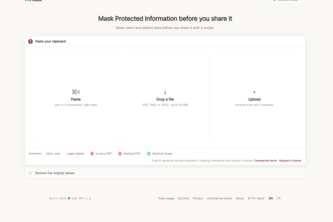
PHI Mask is a self-reported tool that claims to automatically mask protected health information (PHI) and personally identifiable information (PII) from text, images, and PDFs so that users can safely input this data into public AI systems. The author describes it as a compliance-focused solution built for individuals working with sensitive data — such as doctors or lawyers — who want to protect their privacy while using AI.
What changed
The project pivoted from an initial idea focused on token savings in LLMs (based on rtk) to a compliance-oriented tool after discovering issues with the original approach. It now focuses on masking PHI/PII for safe use with public AI, particularly targeting users who work with patient data.
Single most important open question
Is there any evidence of actual user adoption or traction beyond the author’s own development and testing? The description contains no mention of customers, revenue, usage metrics, or market validation — only self-reported claims about functionality and intent.
What The Product Actually Is
The description states that PHI Mask:
- Finds PHI/PII in images, PDFs, or text.
- Masks this data so it can be safely used with public AI.
- Provides a masked version of the content (e.g., “B*** W***”) that allows users to unmask real content later.
- Works offline using Tesseract OCR and regex-based detection.
- Uses GPT-5.6-luna for processing large-scale name/address datasets.
It is described as a tool designed to help users protect sensitive data when interacting with AI systems, especially in regulated environments like healthcare or legal work.
Inference This appears to be a proof-of-concept or early-stage prototype built by one developer (Benson Wong), likely for a hackathon. There is no evidence of commercial deployment or integration into existing workflows.
Positioning & Claim Evolution
The author reports:
- Initially intended to optimize token usage in LLMs but pivoted due to performance degradation concerns.
- Later shifted focus to compliance and safety, driven by personal need (wife as a doctor).
- Positions itself as a tool for protecting private data when using AI — particularly relevant for professionals handling PHI.
Claim
PHI Mask is positioned as a privacy-preserving layer that allows safe interaction with public AI systems without exposing sensitive information.
Inference The evolution suggests the team started with a technical optimization goal but found a more compelling use case in compliance and data protection. However, no evidence exists of strategic positioning or market research beyond personal motivation.
Target Customer & ICP
The description states:
- The tool was built for someone working with patient data (a family medicine doctor).
- Intended to support low-tech users who are concerned about AI but must adapt to using it.
- Targets professionals in healthcare and law firms where compliance is critical.
Inference The primary target appears to be individual practitioners or small teams within regulated industries who need to comply with privacy laws while leveraging AI tools. However, no evidence of actual customer segments or personas exists beyond the author’s own experience.
Business Model & Pricing Evidence
Not evidenced.
The description does not contain any information about:
- Revenue model
- Pricing strategy
- Monetization plans
- Subscription tiers or licensing options
Inference There is no indication that a business model has been developed or tested. The project seems to be in an early prototype phase, possibly intended for internal use or demonstration purposes.
Technical & Delivery Signals
The description states:
- Built offline using Tesseract OCR.
- Uses regex patterns and GPT-5.6-luna for processing large datasets.
- Includes WYSIWYG UI overlay functionality.
- Struggled with OCR artifact tolerance, multi-cultural name detection, and typo handling.
- Was developed during a hackathon.
Inference The tool is technically complex, involving OCR, regex matching, and AI-assisted pattern recognition. However, it's unclear whether this has been scaled beyond a prototype or integrated into broader systems. The reliance on GPT-5.6-luna implies some level of automation but also suggests dependency on external tools.
Traction & Maturity Signals
Not evidenced.
There is no mention of:
- Customers
- Users
- Revenue
- Product adoption
- Market feedback
- Iteration history or product maturity
Inference This appears to be a hackathon submission, not a mature product. No evidence supports any form of traction or commercial viability.
Competitive Context
Not evidenced.
The description does not reference:
- Competitors
- Existing solutions in the PHI/PII masking space
- Market size or competitive landscape
Inference No competitive analysis is provided. The author does not discuss how their solution compares to others, nor whether there are similar tools already available.
Open Questions & Risks
Key risks and open questions based on self-reported information:
- Unverified claims: All features and capabilities are self-reported without independent validation.
- Single-person development: Only one team member (Benson Wong) is mentioned, raising questions about scalability or long-term maintenance.
- Dependency on proprietary AI models: Reliance on GPT-5.6-luna may pose risks related to availability, cost, and control.
- No commercial traction: No evidence of users, customers, or revenue indicates the product has not yet entered the market.
- Offline OCR limitations: The description notes challenges with offline OCR accuracy, which could limit usability in real-world applications.
Questions the description leaves open
- What specific compliance standards does PHI Mask aim to support (e.g., HIPAA, GDPR)?
- Has the tool been tested with actual users from target industries?
- Are there plans for monetization or commercial deployment beyond the current prototype?
- How is the accuracy of PHI/PII detection validated in practice?
- What are the limitations of the offline OCR approach and how do they impact real-world use cases?
- Is there any plan to integrate with existing AI platforms or workflows (e.g., LangChain, LlamaIndex)?
- What is the roadmap for scaling beyond a single developer?
Overall Assessment
Not evidenced.
There is no evidence of:
- Financials
- Customer base
- Product-market fit
- Strategic partnerships
- Market traction or growth indicators
Inference At this stage, PHI Mask appears to be an experimental project with potential but no demonstrated commercial value. It lacks the data needed to assess investment or partnership viability. Further due diligence would require evidence of early adoption, user feedback, or product development milestones beyond the hackathon submission.
User Stories BotA demo video on every pull request
Get a demo video on every new feature
GitHub App that watches your pull requests and records a narrated, captioned demo.
Save time on demo prep and make informed decisions faster with a video walkthrough of every new feature.
Source
Submitted to the OpenAI 2026 hackathon on Devpost. Project home on Devpost. Back to the full gallery on Devpost.
This competitive analysis was produced by top-founders.com (opens in a new tab)
Generated by a language model from this project's public Devpost page — its tagline, the author's own write-up and any built-with tags listed there — as captured in August 2026. Short quotations are the author's words. It is an opinion on the idea as a business, not on the people behind it, and it reflects the description as published then. If the project has moved on, request a correction below. The analysis is not independent research and contains no verified traction, revenue or customer data.
An independent guide by KFG International LLC — not affiliated with, endorsed by, or connected to Devpost or OpenAI.