

Archive position — measured, not model output
0 likes on Devpost
2,263 of the 7,850 archived projects have more likes, and 5,587 share exactly 0 — so this project's #5,920 place in the like-ranked listing is a tie-break inside that group, not a ranking.
Projects (log scale)
Likes on Devpost. ▲ marks this project's group.
Show the figures
| Likes | Projects | Share of archive |
|---|---|---|
| 0 | 5,587 | 71.2% |
| 1 | 1,758 | 22.4% |
| 2 | 284 | 3.6% |
| 3–4 | 132 | 1.7% |
| 5–9 | 75 | 1.0% |
| 10+ | 14 | 0.2% |
 User Stories BotA demo video on every pull request
Get a demo video on every new feature
GitHub App that watches your pull requests and records a narrated, captioned demo.
Save time on demo prep and make informed decisions faster with a video walkthrough of every new feature.
Executive Summary
What the company appears to be
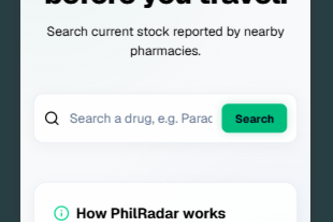
PhilRadar is a self-reported, single-person project that aims to help users locate nearby pharmacies with specific medications in stock. The author describes it as a "Google Maps for medication stock" and claims to have built a working prototype during a hackathon.
What changed
The author states they built a functional two-sided platform (user-facing search + pharmacy dashboard) within a short timeframe, using AI coding agents extensively but also manually managing integration and architecture. The project was submitted to the OpenAI 2026 hackathon.
Single most important open question
Is there any evidence of user adoption or traction beyond the author’s own experience? The description does not indicate whether users exist, have engaged with the product, or if the pharmacy dashboard is being used.
Note: This analysis is based entirely on the self-reported project description provided by the caller. No external verification, revenue data, customer list, or independent sources are available. All claims in this report are labeled as "the author states" and not confirmed.
What The Product Actually Is
The description states that PhilRadar is a tool that allows users to search for medications (e.g., Paracetamol) and see nearby pharmacies with real-time stock status. Users can view whether a pharmacy has the medication in stock, low stock, or is out of stock. It also includes functionality for users to confirm or flag reports to maintain accuracy.
Pharmacies have their own portal where they can register, manage inventory, and update stock information using a shared catalog or by adding new medications.
The author built the frontend with Next.js and Leaflet.js, used Supabase for backend functions including authentication and database storage, and integrated browser geolocation APIs to calculate distances.
Inference: The product appears to be a real-time inventory tracking system for pharmacies, connected to a map-based UI. It is not described as a marketplace or platform with monetization features beyond basic access.
Positioning & Claim Evolution
The author states that the idea came from a personal frustration — trying to find medication after hospital discharge and encountering multiple pharmacies out of stock. This led to the claim that “why should someone have to visit five pharmacies just to find one medication?”
They describe PhilRadar as a solution to this problem, positioning it as a tool for people who want to avoid wasting time walking around looking for medications.
Claim: The product is positioned as a practical utility for patients and caregivers seeking medication availability in real-time.
Inference: There is no indication of broader market positioning beyond solving an immediate need. No branding, messaging, or strategic differentiation beyond the core use case.
Target Customer & ICP
The author describes two main user types:
- Patients/Caregivers who want to locate nearby pharmacies with specific medications in stock.
- Pharmacists/Pharmacy staff who manage inventory through a dashboard.
The target location is specified as Accra, Ghana, though the author notes plans to expand beyond that city.
Inference: The ICP seems narrowly defined around individuals needing quick access to medication and pharmacy workers managing local stock levels. No evidence of segmentation or targeting other demographics (e.g., elderly, chronic disease patients).
Business Model & Pricing Evidence
The description does not mention any pricing model, monetization strategy, or business model. It only describes the core functionality of the platform.
Not evidenced: There is no indication of how the service will be monetized, whether through subscriptions, transaction fees, advertising, or other mechanisms.
Technical & Delivery Signals
The author built the frontend using Next.js and Leaflet.js with OpenStreetMap/CARTO tiles. Backend uses Supabase for authentication and database management. Geolocation comes from the browser API, and distances are calculated via the Haversine formula.
They used AI coding agents during a Buildweek hackathon to accelerate development but emphasized that manual intervention was necessary due to integration issues.
Inference: The tech stack suggests a lightweight, full-stack web application built quickly under time pressure. It is not described as scalable or production-ready beyond the prototype phase.
Traction & Maturity Signals
The author claims to have shipped a complete working product during a hackathon and that all components function together (search, map view, stock status, confirm/flag system, pharmacy dashboard).
However, there is no evidence of:
- Users
- Customer engagement
- Revenue or monetization
- Active pharmacy registrations
- Data on how often users search or update inventory
Absence of evidence: No traction indicators are present in the description.
Competitive Context
The author does not reference any competitors. The project is described as a novel solution to a common problem, but no comparison with existing tools or services is made.
Not evidenced: No competitive landscape or differentiation strategy is described.
Open Questions & Risks
- Single-person development: Only one team member (Theophilus T) is mentioned. This raises questions about scalability and long-term maintenance.
- Prototype-only status: The project was built during a hackathon; no indication of post-hack development or product maturity.
- No traction or adoption data: No evidence of users, customers, or engagement beyond the author’s own experience.
- AI dependency with limited control: While AI helped build the system, the author notes that manual fixes were required for integration — suggesting potential fragility in scaling or consistency.
Inference: The project lacks commercial viability signals and appears to be a proof-of-concept rather than a scalable business.
Questions the description leaves open
- How many users are currently using the platform?
- Have any pharmacies registered or updated inventory?
- What is the plan for expanding beyond Accra?
- Is there any intention to monetize the service, and how?
- How do you intend to ensure data accuracy over time without relying solely on user confirmation?
- Are there plans to integrate with hospital systems or pharmacy chains?
- What are the key challenges in maintaining real-time stock updates at scale?
Overall Assessment
Not evidenced: There is no evidence of revenue, customers, traction, or a clear path to monetization.
Confidence level: Low — based on minimal self-reported evidence and lack of external validation.
The project appears to be an early-stage prototype with strong execution in a short timeframe. However, without signs of user adoption, customer engagement, or business model clarity, it does not yet demonstrate commercial viability or investment readiness.
Conclusion: This is a concept-driven idea with limited evidence of traction or scalability. It may represent a promising direction for further development but lacks the commercial due-diligence signals needed to assess its potential as an investment or partnership opportunity.
User Stories BotA demo video on every pull request
Get a demo video on every new feature
GitHub App that watches your pull requests and records a narrated, captioned demo.
Save time on demo prep and make informed decisions faster with a video walkthrough of every new feature.
Source
Submitted to the OpenAI 2026 hackathon on Devpost. Project home on Devpost. Back to the full gallery on Devpost.
This competitive analysis was produced by top-founders.com (opens in a new tab)
Generated by a language model from this project's public Devpost page — its tagline, the author's own write-up and any built-with tags listed there — as captured in August 2026. Short quotations are the author's words. It is an opinion on the idea as a business, not on the people behind it, and it reflects the description as published then. If the project has moved on, request a correction below. The analysis is not independent research and contains no verified traction, revenue or customer data.
An independent guide by KFG International LLC — not affiliated with, endorsed by, or connected to Devpost or OpenAI.