

Archive position — measured, not model output
1 like on Devpost
505 of the 7,850 archived projects have more likes, and 1,758 share exactly 1 — so this project's #1,996 place in the like-ranked listing is a tie-break inside that group, not a ranking.
Projects (log scale)
Likes on Devpost. ▲ marks this project's group.
Show the figures
| Likes | Projects | Share of archive |
|---|---|---|
| 0 | 5,587 | 71.2% |
| 1 | 1,758 | 22.4% |
| 2 | 284 | 3.6% |
| 3–4 | 132 | 1.7% |
| 5–9 | 75 | 1.0% |
| 10+ | 14 | 0.2% |
 User Stories BotA demo video on every pull request
Get a demo video on every new feature
GitHub App that watches your pull requests and records a narrated, captioned demo.
Save time on demo prep and make informed decisions faster with a video walkthrough of every new feature.
Executive Summary
What the company appears to be
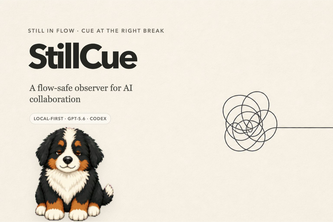
Stillcue is a self-reported project that claims to detect human working states (flow, confusion, frustration, fatigue) in AI conversations using dialogue structure signals and an LLM, then proactively offers a clean restart prompt when needed. It is built as a lightweight tool that runs locally on user machines, with no database or frameworks.
What changed
The author describes a shift from traditional AI tools optimizing output to focusing on the psychological layer of collaboration — detecting working states and intervening at key moments to support human cognition during long conversations with AI.
Single most important open question
Is there any evidence that this concept has traction, adoption or measurable impact beyond the single developer’s own experience?
What The Product Actually Is
The description states that Stillcue is a tool that:
- Reads working state from dialogue logs in real time.
- Detects four psychological states (flow, confusion, frustration, fatigue) using lightweight signals and an LLM.
- Proactively offers a clean restart when the system detects frustration or fatigue.
- Operates locally on user machines without databases or frameworks.
- Uses a Node.js process to tail Codex CLI session logs and compute signals like Jaccard similarity, negation density, message-length collapse, burst tempo, context dumping, session duration, and novelty ratio.
- Delivers interventions only at task boundaries (after replies complete) via a quiet localhost page with a notification system.
It is described as a "watcher", a "two-layer judgment" system, and an "observation room".
Evidence
- The author states: “A deliberately simple architecture — three parts, zero frameworks, zero database, everything on your machine.”
- It uses signals from Codex CLI session logs (~/.codex/sessions/**/*.jsonl).
- Signals include Jaccard similarity, negation density, message-length collapse, burst tempo, context dumping, session duration, and novelty ratio.
- The system uses an LLM to judge states (flow, confusion, friction, or fatigue) with a confidence threshold.
- Interventions occur only at task boundaries and are triggered by a soft notification.
Inference Stillcue is a local, lightweight, state-aware AI conversation assistant designed to improve human-AI collaboration by detecting working states and offering clean restarts.
Positioning & Claim Evolution
The author positions Stillcue as:
- A psychological practice for AI collaboration.
- A tool that recognizes the “human side of the loop” in AI interactions.
- A way to honor flow, detect frustration, and offer a clean restart when needed.
- A shift from optimizing what the AI produces to optimizing the process between human and AI.
The project evolves from:
- A personal frustration with long AI conversations.
- An idea rooted in affect-detection research (AutoTutor, D'Mello, Graesser et al.).
- A desire to build a tool that supports working state awareness rather than just output optimization.
Evidence
- The author states: “The thing that needs a refresh right now is my brain.”
- It builds on decades of affect-detection research.
- The project is framed as a shift from technical optimization to psychological support in AI collaboration.
Inference Stillcue positions itself as a tool for improving the human-AI interaction process, not just the output quality — a niche in the broader AI tools space.
Target Customer & ICP
The description does not explicitly name target customers or define an ideal customer profile (ICP). It implies:
- Developers working with AI models like Codex.
- Users who engage in long, iterative conversations with AI.
- People who experience frustration or fatigue during AI interactions.
Evidence
- The tool is built for users of Codex CLI.
- It targets “long conversations” and “working states” in AI collaboration.
- The author’s background is in psychology and developer tooling.
Inference The ICP likely includes developers, researchers, or knowledge workers who use AI tools for extended problem-solving sessions and are sensitive to the psychological dynamics of those interactions.
Business Model & Pricing Evidence
No evidence of a business model or pricing strategy is provided. The project is described as a personal build, not a commercial product.
Evidence
- The author states: “This project was submitted to the OpenAI 2026 hackathon.”
- It is described as a developer-built tool with no mention of monetization.
- No pricing, licensing, or revenue model is mentioned.
Inference There is no evidence of a business model or pricing structure. The tool appears to be a prototype or personal project.
Technical & Delivery Signals
The author describes:
- A simple architecture: three parts (watcher, two-layer judgment, observation room).
- No frameworks or databases.
- Node.js process tailing Codex CLI logs.
- Lightweight signals computed on each user turn.
- LLM-based state judgment with confidence thresholds.
- Interventions only at task boundaries.
Evidence
- “A deliberately simple architecture — three parts, zero frameworks, zero database.”
- Uses Node.js and JSONL log files.
- Signals include Jaccard similarity, negation density, message-length collapse, burst tempo, context dumping, session duration, novelty ratio.
- LLM only intervenes if confidence is above 0.7.
Inference The technical design is minimalistic and focused on local execution with no external dependencies — a strong signal of a prototype or proof-of-concept.
Traction & Maturity Signals
No evidence of traction, adoption, or user base is provided. The project is described as a single-person build submitted to a hackathon.
Evidence
- Team size: 1.
- Submitted to OpenAI 2026 hackathon.
- No mention of users, customers, or usage metrics.
- No revenue, ARR, or headcount data.
Inference There is no evidence of traction or maturity beyond the author’s own development.
Competitive Context
The description does not reference any competitors. It focuses on the psychological layer of AI collaboration, which is a novel angle but not clearly positioned against existing tools.
Evidence
- No mention of competing products.
- The project is described as addressing a gap in how AI tools optimize for human-AI collaboration.
Inference The competitive context is unclear. It may be a niche or emerging space with no direct competitors mentioned.
Open Questions & Risks
Key risks and open questions include:
- No traction or adoption evidence.
- Single-person development.
- Unproven concept in a crowded AI tools space.
- Risk of over-intervention (e.g., “one wrong interruption ends the relationship”).
- No commercial viability or monetization strategy.
Evidence
- Team size: 1.
- Submitted to a hackathon.
- No mention of users, customers, or revenue.
Inference The project is unproven in terms of real-world adoption and may not scale beyond the author’s own use case.
Questions the description leaves open
- What evidence do you have that people actually experience the working states you’re detecting?
- How do you plan to validate or test the effectiveness of your interventions?
- Have you tested this with users outside of yourself?
- What is your path to commercialization or productization?
- How do you intend to scale beyond a single developer’s use case?
Overall Assessment
Not evidenced.
There is no evidence of traction, revenue, customers, or a clear business model. The project is described as a personal build submitted to a hackathon and lacks any commercial or productization signals.
Confidence Low.
The author’s self-reported account does not provide sufficient evidence to assess viability, scalability, or investment potential. It remains a concept or prototype with no demonstrated market or user validation.
User Stories BotA demo video on every pull request
Get a demo video on every new feature
GitHub App that watches your pull requests and records a narrated, captioned demo.
Save time on demo prep and make informed decisions faster with a video walkthrough of every new feature.
Source
Submitted to the OpenAI 2026 hackathon on Devpost. Project home on Devpost. Back to the full gallery on Devpost.
This competitive analysis was produced by top-founders.com (opens in a new tab)
Generated by a language model from this project's public Devpost page — its tagline, the author's own write-up and any built-with tags listed there — as captured in August 2026. Short quotations are the author's words. It is an opinion on the idea as a business, not on the people behind it, and it reflects the description as published then. If the project has moved on, request a correction below. The analysis is not independent research and contains no verified traction, revenue or customer data.
An independent guide by KFG International LLC — not affiliated with, endorsed by, or connected to Devpost or OpenAI.