

Archive position — measured, not model output
0 likes on Devpost
2,263 of the 7,850 archived projects have more likes, and 5,587 share exactly 0 — so this project's #3,959 place in the like-ranked listing is a tie-break inside that group, not a ranking.
Projects (log scale)
Likes on Devpost. ▲ marks this project's group.
Show the figures
| Likes | Projects | Share of archive |
|---|---|---|
| 0 | 5,587 | 71.2% |
| 1 | 1,758 | 22.4% |
| 2 | 284 | 3.6% |
| 3–4 | 132 | 1.7% |
| 5–9 | 75 | 1.0% |
| 10+ | 14 | 0.2% |
 User Stories BotA demo video on every pull request
Get a demo video on every new feature
GitHub App that watches your pull requests and records a narrated, captioned demo.
Save time on demo prep and make informed decisions faster with a video walkthrough of every new feature.
Executive Summary
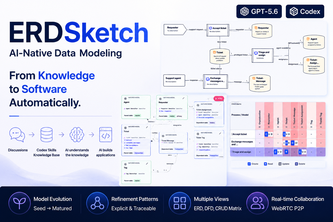
What the company appears to be: ERDSketch is a self-reported DB modeling tool built with GPT-5.6 that supports agile-style data model refinement and generates multiple design views (ER diagrams, DFDs, CRUD matrices). The author describes it as part of a "Knowledge-Centric Development" approach where structured knowledge, rather than prompts, becomes the source of truth for AI-assisted development.
What changed: The project evolved from an earlier tool called UISketch. It reflects a shift in thinking about how AI can be used in software development—moving from prompt-based interaction to structured knowledge management and reuse.
Single most important open question: Is there evidence that the described "Knowledge-Centric Development" approach actually works at scale, or is this a conceptual framework without demonstrated traction?
The description states that ERDSketch is built with GPT-5.6 (noted as an author-declared technology tag), but no revenue, customer adoption, or usage data are provided beyond the self-reported project write-up. The tool supports Markdown, draw.io, SQL generation and real-time peer-to-peer collaboration via WebRTC.
This analysis is based entirely on the self-reported description from the author. There is no independent verification of claims made about functionality, performance, or business model.
What The Product Actually Is
- The description states that ERDSketch is a DB modeling tool built with GPT-5.6.
- It supports "agile style data modeling" and helps developers create database designs step by step.
- It allows users to grow models from seed ideas to mature designs using refinement features.
- It generates multiple views from the same knowledge base, including ER diagrams, Data Flow Diagrams (DFDs), and CRUD matrices.
- It supports real-time peer-to-peer collaboration through WebRTC.
- It integrates with Markdown, draw.io, and SQL generation capabilities.
Not evidenced:
- Whether the tool actually functions as described or whether it's a prototype.
- If any of these features are implemented in a working product.
- The extent to which GPT-5.6 is used in core functionality vs. just being mentioned for branding.
Positioning & Claim Evolution
- The author positions ERDSketch within the broader concept of "Knowledge-Centric Development".
- This approach treats structured knowledge—not prompts—as the single source of truth.
- The tool aims to preserve valuable architectural decisions as reusable assets, avoiding repetition in future discussions with AI.
- The evolution from UISketch suggests a progression toward more sophisticated handling of design knowledge.
- The author claims that this shift reflects how software development will evolve with advances in AI.
Inference:
- The positioning implies a move away from traditional prompt engineering toward structured knowledge management.
- This is presented as a future-oriented strategy, not yet proven in practice.
Not evidenced:
- No evidence of market positioning beyond the author’s own description.
- No indication of how ERDSketch differentiates itself from existing DB modeling tools or AI-assisted development platforms.
Target Customer & ICP
- The description states that ERDSketch supports both experienced engineers and newcomers who need to progressively refine their models.
- It is designed for developers working on database design, particularly those using agile methodologies.
- Collaboration features suggest it targets teams or individuals who work together on data modeling tasks.
Not evidenced:
- No specific customer segments identified beyond general developer audiences.
- No evidence of actual users or target personas.
- No indication of whether the tool addresses enterprise needs or individual hobbyist use cases.
Business Model & Pricing Evidence
- The description does not mention any pricing model, monetization strategy, or business model.
- There is no information about revenue streams, subscription tiers, or commercial licensing.
Not evidenced:
- No evidence of a defined business model.
- No indication of whether the tool will be offered as freemium, paid, open-source, or another format.
Technical & Delivery Signals
- Built with technologies such as AI (specifically GPT-5.6), React, TinyGo, Wails, WebRTC, Markdown, and static HTML.
- The author mentions that the application was largely generated from structured knowledge via Codex sessions.
- Concepts are stored as Markdown documents and organized into a knowledge base with over 270 concepts connected by more than 1,400 relationships.
- A custom Knowledge Compiler generates searchable metadata to allow AI to retrieve relevant knowledge efficiently.
Inference:
- The use of GPT-5.6 implies integration with large language models for AI assistance.
- The emphasis on structured knowledge suggests a system designed for scalability and reusability.
Not evidenced:
- No evidence that the tool is publicly available or functional.
- No details about how the knowledge base is maintained or updated.
- No indication of technical architecture beyond what's described in the write-up.
Traction & Maturity Signals
- The project was submitted to the OpenAI 2026 hackathon on Devpost.
- It started with approximately 25 focused Codex sessions.
- The author claims to have distilled each discussion into reusable Codex Skills and built a knowledge base containing over 270 concepts and 1,400 relationships.
Not evidenced:
- No evidence of user adoption or engagement metrics.
- No indication of whether the tool has been tested in real-world environments.
- No evidence of product maturity beyond its initial development phase.
- No mention of any production deployment or usage outside of hackathon context.
Competitive Context
- The description does not provide information about competitors or existing solutions in the DB modeling space.
- It does not compare ERDSketch to other tools like Lucidchart, Draw.io, or database design platforms such as MySQL Workbench or DBeaver.
- No mention of how ERDSketch fits into current market dynamics or competitive advantages.
Not evidenced:
- No evidence of competitive landscape analysis.
- No indication of differentiation from existing tools in the marketplace.
Open Questions & Risks
- The tool is described as a hackathon submission, suggesting it may be early-stage and unproven.
- There is no evidence of product-market fit or user feedback.
- The reliance on GPT-5.6 raises questions about availability, cost, and dependency risks.
- The claim that structured knowledge improves AI-assisted development lacks empirical validation.
- The lack of any revenue, customer data, or traction signals indicates a high risk of failure to scale.
Inference:
- The absence of real-world testing or deployment suggests limited commercial viability.
- The heavy dependence on AI tools and knowledge structures may not translate into practical utility without further development.
Questions the description leaves open
- What specific problems does ERDSketch solve that existing DB modeling tools do not?
- How is the structured knowledge base maintained, updated, and reused across different projects?
- Is there any evidence of real-world usage or testing beyond the hackathon environment?
- What are the technical limitations of relying on GPT-5.6 for core functionality?
- Can you demonstrate how the tool works in practice? Is it functional or still conceptual?
- How does ERDSketch plan to monetize its offering, and what is the go-to-market strategy?
Overall Assessment
- The description presents a visionary idea around "Knowledge-Centric Development" but lacks evidence of traction, revenue, or product maturity.
- It appears to be an early-stage concept developed during a hackathon, with no indication of commercial viability or scalability.
- Without any data on users, customers, or performance metrics, it is difficult to assess whether ERDSketch represents a viable investment opportunity or partnership candidate.
Assessment: Not evidenced — there is insufficient evidence to support an investment or partnership decision at this time. The project remains conceptual and unproven in terms of commercial execution or market relevance.
User Stories BotA demo video on every pull request
Get a demo video on every new feature
GitHub App that watches your pull requests and records a narrated, captioned demo.
Save time on demo prep and make informed decisions faster with a video walkthrough of every new feature.
Source
Submitted to the OpenAI 2026 hackathon on Devpost. Project home on Devpost. Back to the full gallery on Devpost.
This competitive analysis was produced by top-founders.com (opens in a new tab)
Generated by a language model from this project's public Devpost page — its tagline, the author's own write-up and any built-with tags listed there — as captured in August 2026. Short quotations are the author's words. It is an opinion on the idea as a business, not on the people behind it, and it reflects the description as published then. If the project has moved on, request a correction below. The analysis is not independent research and contains no verified traction, revenue or customer data.
An independent guide by KFG International LLC — not affiliated with, endorsed by, or connected to Devpost or OpenAI.