

Archive position — measured, not model output
0 likes on Devpost
2,263 of the 7,850 archived projects have more likes, and 5,587 share exactly 0 — so this project's #3,961 place in the like-ranked listing is a tie-break inside that group, not a ranking.
Projects (log scale)
Likes on Devpost. ▲ marks this project's group.
Show the figures
| Likes | Projects | Share of archive |
|---|---|---|
| 0 | 5,587 | 71.2% |
| 1 | 1,758 | 22.4% |
| 2 | 284 | 3.6% |
| 3–4 | 132 | 1.7% |
| 5–9 | 75 | 1.0% |
| 10+ | 14 | 0.2% |
 User Stories BotA demo video on every pull request
Get a demo video on every new feature
GitHub App that watches your pull requests and records a narrated, captioned demo.
Save time on demo prep and make informed decisions faster with a video walkthrough of every new feature.
Executive Summary
What the company appears to be: A self-reported, open-source, AI-powered enterprise resource planning (ERP) platform designed for educational institutions and potentially scalable across industries. The project is described as a hackathon submission by a single-member team from Crescent College of Accountancy.
What changed: This is a new product concept submitted to the OpenAI 2026 Hackathon. No prior version or commercial activity is evidenced.
Single most important open question: Is this a viable platform that can be built and deployed at scale, or is it an unvalidated idea?
What The Product Actually Is
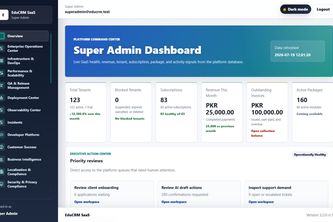
The description states that the project is an AI-powered, multi-tenant ERP platform designed to unify organizational functions such as admissions, finance, HR, learning management, procurement, inventory, and reporting into a single ecosystem.
It claims to support:
- Multi-tenancy
- Dynamic workflows
- Configurable forms and dashboards
- Role-based access control
- AI-assisted operations
- Enterprise analytics
The platform is described as metadata-driven with modular design and extensible APIs. It uses technologies like Apache, PHP, MySQL, JavaScript, and REST API.
Evidence: The author's own write-up.
Confidence: Low — this is a self-reported product description without any demonstration, codebase access, or proof of concept beyond the hackathon submission.
Positioning & Claim Evolution
The project positions itself as:
- A unified digital operating environment for organizations.
- Not another school management system, CRM, LMS, or HR tool.
- An intelligent platform capable of serving educational institutions today and expanding into multiple industries tomorrow.
It emphasizes:
- AI not as an add-on but as an intelligent layer helping users make better decisions.
- A configurable enterprise-grade platform that avoids hard-coded business rules.
- One login, one database, one workflow — a single source of truth.
Evidence: The author's own write-up.
Confidence: Low — claims are made without evidence of traction or real-world adoption.
Target Customer & ICP
The description states:
- The platform is initially designed for educational institutions, but aims to expand into multiple industries.
- It supports small startups and large enterprises with thousands of users.
- It targets organizations managing multiple disconnected systems (e.g., admissions, CRM, finance, HR).
Evidence: The author's own write-up.
Confidence: Low — no evidence of customer validation or market research beyond the hackathon context.
Business Model & Pricing Evidence
No explicit business model or pricing information is provided in the description. The project is described as a hackathon submission, not a commercial product.
Evidence: Not evidenced.
Confidence: Very low — no indication of monetization strategy, licensing, or revenue streams.
Technical & Delivery Signals
The platform is said to be built using:
- Technologies: Apache, PHP, MySQL, JavaScript, HTML, CSS, REST API, PDO, nginx, charts.js
- Architecture: Multi-tenant, metadata-driven, modular, scalable SaaS deployment model
- Features: Dynamic workflows, forms, reports, AI-ready architecture, secure role-based access control
It is described as:
- Configurable without modifying source code
- Supporting public websites, online admissions, audit trails, and enterprise analytics
Evidence: The author's own write-up.
Confidence: Low — no demonstration or live system available for review.
Traction & Maturity Signals
There is no evidence of traction, customers, or revenue. The project is described as a hackathon submission and has no archived history, user base, or performance metrics.
Evidence: Not evidenced.
Confidence: Very low — the only signal is that it was submitted to a hackathon.
Competitive Context
The description does not mention any competitors. It positions itself as:
- A platform that avoids disconnected software.
- An alternative to multiple independent applications (CRM, LMS, HR, etc.)
It implies a multi-industry ERP solution, but no specific competitive landscape is described.
Evidence: Not evidenced.
Confidence: Very low — no competitive analysis or market positioning beyond self-description.
Open Questions & Risks
- Unproven concept: The project is a hackathon submission with no demonstrated product.
- Single-person team: No evidence of development team, engineering capacity, or scalability planning.
- No commercial traction: No customers, revenue, or adoption data.
- AI integration claims: AI is described as an intelligent layer but not demonstrated in functionality.
- Self-reported only: All information is unverified and self-declared.
Evidence: Not evidenced — all are inferred from lack of evidence.
Confidence: High — based on absence of any commercial or technical validation.
Questions the description leaves open
- What specific problems in enterprise software does this platform solve that existing solutions don’t?
- How is the AI layer integrated into workflows and decision-making processes?
- Is there a working prototype or demo available for review?
- What are the technical limitations of the current architecture, especially around scalability and multi-tenancy?
- Has any market research been conducted with potential customers in education or other industries?
- How does the platform ensure data isolation between tenants in a multi-tenant environment?
- What is the plan for monetization and go-to-market strategy beyond the hackathon?
Overall Assessment
Not evidenced — there is no evidence of revenue, customers, traction, or even a working product.
This is a self-reported hackathon project with no commercial viability or demonstrated product-market fit. It is not ready for investment or partnership at this stage.
Confidence: Very low — the only signal is that it was submitted to a hackathon. No evidence of development, traction, or business model exists beyond the author’s own claims.
User Stories BotA demo video on every pull request
Get a demo video on every new feature
GitHub App that watches your pull requests and records a narrated, captioned demo.
Save time on demo prep and make informed decisions faster with a video walkthrough of every new feature.
Source
Submitted to the OpenAI 2026 hackathon on Devpost. Project home on Devpost. Back to the full gallery on Devpost.
This competitive analysis was produced by top-founders.com (opens in a new tab)
Generated by a language model from this project's public Devpost page — its tagline, the author's own write-up and any built-with tags listed there — as captured in August 2026. Short quotations are the author's words. It is an opinion on the idea as a business, not on the people behind it, and it reflects the description as published then. If the project has moved on, request a correction below. The analysis is not independent research and contains no verified traction, revenue or customer data.
An independent guide by KFG International LLC — not affiliated with, endorsed by, or connected to Devpost or OpenAI.