

Archive position — measured, not model output
6 likes on Devpost
35 of the 7,850 archived projects have more likes, and 19 share exactly 6 — so this project's #37 place in the like-ranked listing is a tie-break inside that group, not a ranking.
Projects (log scale)
Likes on Devpost. ▲ marks this project's group.
Show the figures
| Likes | Projects | Share of archive |
|---|---|---|
| 0 | 5,587 | 71.2% |
| 1 | 1,758 | 22.4% |
| 2 | 284 | 3.6% |
| 3–4 | 132 | 1.7% |
| 5–9 | 75 | 1.0% |
| 10+ | 14 | 0.2% |
 User Stories BotA demo video on every pull request
Get a demo video on every new feature
GitHub App that watches your pull requests and records a narrated, captioned demo.
Save time on demo prep and make informed decisions faster with a video walkthrough of every new feature.
Executive Summary
Company: AJÒ Beach
Self-reported basis: The description is entirely self-reported and unverified, as supplied by the project author. No third-party corroboration, archived evidence or independent verification exists for any claim made in this report.
Commercial due-diligence read: The project appears to be a proof-of-concept prototype of an AI-powered beach-planning assistant built as a Progressive Web App (PWA). It combines environmental data, local information and AI agents to help users plan Sardinian beach days. There is no evidence of revenue, customers or product-market fit beyond the author's own account.
Key open question: Is there any evidence that this concept has traction or commercial viability beyond a hackathon prototype?
What The Product Actually Is
The description states:
- AJÒ Beach is an installable PWA.
- It plans, watches and replans Sardinian beach days.
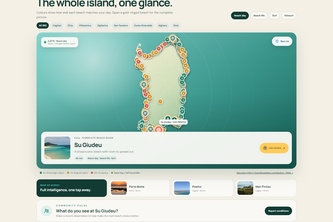
- It integrates 293 mapped beaches with weather, marine conditions, UV, heat, webcam links, crowding, parking, Posidonia risk, local activities and community reports.
- It uses GPT-5.6 via Codex, Next.js, React, TypeScript, Zod, Open-Meteo, Vercel, service workers and Web Notifications.
Inference: The product is a web-based AI agent that dynamically updates beach-day plans based on changing conditions, using structured data inputs and AI reasoning. It is not a chatbot but an agentic system with bounded loops and deterministic fallbacks.
Positioning & Claim Evolution
The description states:
- The product is positioned as a “coastal companion” that protects the whole day, not just another beach directory.
- It aims to be mission-driven and explainable in its signals (crowding, parking, Posidonia).
- It integrates webcam and local experience data for richer planning.
Inference: The positioning is evolving from a simple directory or planner into a dynamic, AI-assisted companion that adapts to real-time conditions. The author emphasizes “mission-driven” and “explainable” signals, suggesting an intent to build trust and clarity in its recommendations.
Target Customer & ICP
The description states:
- It is designed for users planning Sardinian beach days.
- It uses 293 mapped beaches, implying a localized focus on Sardinia.
- It integrates webcam links, local activities and community reports, suggesting a user base interested in local experiences.
Inference: The ICP appears to be leisure travelers or beachgoers in Sardinia who value real-time information and dynamic planning. No evidence of segmentation beyond geography or use case is provided.
Business Model & Pricing Evidence
The description states:
- There is no mention of pricing, monetization or business model.
- The project was submitted to a hackathon, suggesting it is not yet commercialized.
Inference: No evidence of a business model or pricing structure exists in the self-reported description.
Technical & Delivery Signals
The description states:
- Built with Next.js, React, TypeScript, Codex, GPT-5.6, Zod, Open-Meteo, Vercel, service workers and Web Notifications.
- Uses a bounded agent loop with deterministic fallbacks.
- The model receives structured evidence from deterministic tools.
- It caches refreshes that consume zero tokens.
- It separates facts, derived signals and model decisions.
Inference: The technical stack is modern and web-focused. The system is designed to be lightweight and efficient, using a bounded loop and schema validation to avoid unnecessary AI token consumption. This suggests an engineering approach focused on performance and scalability.
Traction & Maturity Signals
The description states:
- It was built for a hackathon (OpenAI 2026).
- It includes a complete 293-beach Sardinian discovery map.
- It has a responsive installable PWA.
- It integrates webcam and local-experience data.
- It supports notifications and one-tap replanning.
Inference: The product is at a prototype or MVP stage, with no evidence of user adoption, revenue, or customer engagement beyond the author’s own account. It has not been commercialized or scaled.
Competitive Context
The description states:
- It is positioned as a “coastal companion” that protects the whole day, not another beach directory.
- It integrates environmental and local data in a way that may differentiate it from generic beach apps.
Inference: No direct competitors are named or described. The positioning suggests a niche within the broader beach-planning or travel-tech space, but no evidence of existing players or market dynamics is provided.
Open Questions & Risks
- No revenue or customer data: The product is not commercialized and has no evidence of traction.
- Limited scope: It is focused only on Sardinia, which may limit scalability.
- Unproven AI agent loop: While described as bounded and tested, the real-world performance of such a system is unknown.
- Hackathon origin: The project was built for a hackathon, suggesting it has not undergone commercial validation or user testing.
Questions the description leaves open
- What is the actual user base or engagement level beyond the prototype?
- How are you planning to monetize this product, if at all?
- What are the data sources for the 293 beaches and their conditions?
- Has the AI agent loop been tested with real users or in production?
- Are there plans to expand beyond Sardinia or into other geographies or use cases?
Overall Assessment
The description states:
- The project is a hackathon submission.
- It has no evidence of revenue, customers or traction.
Inference: At this stage, the product is not ready for investment or partnership. It is a prototype with potential but no demonstrated commercial viability or market fit. Further due diligence would require evidence of user engagement, monetization plans and scalability beyond Sardinia.
User Stories BotA demo video on every pull request
Get a demo video on every new feature
GitHub App that watches your pull requests and records a narrated, captioned demo.
Save time on demo prep and make informed decisions faster with a video walkthrough of every new feature.
Source
Submitted to the OpenAI 2026 hackathon on Devpost. Project home on Devpost. Back to the full gallery on Devpost.
This competitive analysis was produced by top-founders.com (opens in a new tab)
Generated by a language model from this project's public Devpost page — its tagline, the author's own write-up and any built-with tags listed there — as captured in August 2026. Short quotations are the author's words. It is an opinion on the idea as a business, not on the people behind it, and it reflects the description as published then. If the project has moved on, request a correction below. The analysis is not independent research and contains no verified traction, revenue or customer data.
An independent guide by KFG International LLC — not affiliated with, endorsed by, or connected to Devpost or OpenAI.