

Archive position — measured, not model output
6 likes on Devpost
35 of the 7,850 archived projects have more likes, and 19 share exactly 6 — so this project's #39 place in the like-ranked listing is a tie-break inside that group, not a ranking.
Projects (log scale)
Likes on Devpost. ▲ marks this project's group.
Show the figures
| Likes | Projects | Share of archive |
|---|---|---|
| 0 | 5,587 | 71.2% |
| 1 | 1,758 | 22.4% |
| 2 | 284 | 3.6% |
| 3–4 | 132 | 1.7% |
| 5–9 | 75 | 1.0% |
| 10+ | 14 | 0.2% |
 User Stories BotA demo video on every pull request
Get a demo video on every new feature
GitHub App that watches your pull requests and records a narrated, captioned demo.
Save time on demo prep and make informed decisions faster with a video walkthrough of every new feature.
Executive Summary
Company: CareRelay AI
Self-reported purpose: A demonstration platform for coordinating urgent hospital transfers using agentic workflows and deterministic decision-making.
Key commercial signal: Not evidenced.
What changed: The project description shows a self-reported, unverified development of an end-to-end workflow for emergency patient transfer coordination in India. It includes integration of agents, deterministic rules, and human-in-the-loop approval.
Single most important open question: Is there any evidence of real-world usage, clinical validation or traction beyond the demonstration?
This is a self-reported, unverified account of a hackathon project. No revenue, customers, or adoption data are provided. The description states that all clinical details and hospital information are demonstration data.
What The Product Actually Is
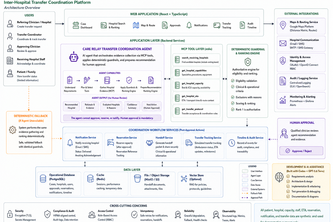
The description states that CareRelay AI is a demonstration platform for coordinating urgent transfers from referring hospitals to suitable receiving facilities in India. It collects and evaluates hospital capability, capacity, route, ETA, and transfer protocol information. It uses:
- A React/TypeScript frontend
- A FastAPI backend with Python
- SQLite database
- OpenAI Agents SDK and MCP tools
- Deterministic eligibility and ranking rules
The system:
- Evaluates hospitals based on medical specialty, procedure capability, bed type, and urgency level
- Removes hospitals that fail mandatory requirements
- Ranks eligible hospitals using a deterministic engine
- Requires clinician approval before action
- Prepares structured SBAR-style handoffs
- Records workflow in a transfer timeline
Not evidenced: Whether the system actually integrates with real hospital systems or has been tested in clinical settings.
Positioning & Claim Evolution
The description states that CareRelay AI was built to explore a better approach to emergency patient transfer coordination, where delays due to manual processes can consume critical treatment windows. It positions itself as an alternative to phone calls and spreadsheets for coordinating transfers.
It claims to be:
- A demonstration platform
- An end-to-end workflow
- A system that explains why hospitals were selected or excluded
- A system with human-in-the-loop approval
Inference: The project evolved from a hackathon idea into a more structured, production-ready prototype. However, this is not confirmed by evidence.
Target Customer & ICP
The description states the target is hospitals in India, specifically those coordinating emergency patient transfers. It focuses on:
- Referring hospitals needing to transfer patients
- Clinicians requiring approval before action
- Healthcare teams managing time-sensitive care
Not evidenced: No specific customer segments, personas or use cases beyond general hospital coordination.
Business Model & Pricing Evidence
The description states that CareRelay AI is a demonstration platform, not a commercial product. It does not mention any pricing model, monetization strategy, or revenue streams.
Not evidenced: No business model or pricing information provided.
Technical & Delivery Signals
The system uses:
- React/TypeScript frontend
- FastAPI backend with Python
- SQLite database
- Google Cloud Run deployment
- OpenAI Agents SDK and MCP tools
- Deterministic rules engine
- Human-in-the-loop approval
- Fallback to deterministic path when AI is unavailable
It includes:
- Evidence-gathering via MCP tools
- Structured handoff generation (SBAR)
- Transfer timeline tracking
- Automated testing (pytest, Playwright)
- Responsive desktop/mobile UI
Inference: The system is designed for resilience and safety, with clear separation between agent orchestration and deterministic decision-making.
Traction & Maturity Signals
The description states that CareRelay AI is a demonstration platform, not a commercial product. It includes:
- 44 passing backend tests
- 14 passing Playwright tests
- Public deployment on Google Cloud Run
- End-to-end workflow demonstration
Not evidenced: No real-world usage, customer adoption, or performance metrics beyond testing.
Competitive Context
The description does not mention any competitors. It is a self-reported project with no reference to existing solutions in the emergency transfer coordination space.
Not evidenced: No competitive landscape analysis provided.
Open Questions & Risks
- Unverified claims: All information is self-reported and unverified.
- No commercial traction: The system is described as a demonstration, not a product in use.
- Limited scope: Only one team member involved (Dhruba Jyoti Kalita).
- Demo-only data: All clinical details, hospital capacity, staff, etc., are demonstration data.
- No regulatory or safety validation: No mention of clinical-safety reviews, privacy compliance, or governance.
Questions the description leaves open
- What is the actual clinical safety and regulatory framework this system would need to comply with?
- Has there been any pilot testing with real hospitals or clinicians?
- How does the deterministic engine handle edge cases not covered in the demo?
- What are the plans for integrating with real hospital systems (e.g., EMRs, capacity management)?
- Is there a roadmap for moving from demonstration to production-grade deployment?
- What is the expected timeline for commercialization or further development?
Overall Assessment
Not evidenced: No financials, traction, or commercial viability data provided.
The project is described as a hackathon demo, not a commercial product. It shows technical capability and thoughtful design around safety and resilience but lacks evidence of real-world usage or business model.
Confidence level: Low — based entirely on self-reported information with no external validation or performance data.
User Stories BotA demo video on every pull request
Get a demo video on every new feature
GitHub App that watches your pull requests and records a narrated, captioned demo.
Save time on demo prep and make informed decisions faster with a video walkthrough of every new feature.
Source
Submitted to the OpenAI 2026 hackathon on Devpost. Project home on Devpost. Back to the full gallery on Devpost.
This competitive analysis was produced by top-founders.com (opens in a new tab)
Generated by a language model from this project's public Devpost page — its tagline, the author's own write-up and any built-with tags listed there — as captured in August 2026. Short quotations are the author's words. It is an opinion on the idea as a business, not on the people behind it, and it reflects the description as published then. If the project has moved on, request a correction below. The analysis is not independent research and contains no verified traction, revenue or customer data.
An independent guide by KFG International LLC — not affiliated with, endorsed by, or connected to Devpost or OpenAI.