

Archive position — measured, not model output
6 likes on Devpost
35 of the 7,850 archived projects have more likes, and 19 share exactly 6 — so this project's #40 place in the like-ranked listing is a tie-break inside that group, not a ranking.
Projects (log scale)
Likes on Devpost. ▲ marks this project's group.
Show the figures
| Likes | Projects | Share of archive |
|---|---|---|
| 0 | 5,587 | 71.2% |
| 1 | 1,758 | 22.4% |
| 2 | 284 | 3.6% |
| 3–4 | 132 | 1.7% |
| 5–9 | 75 | 1.0% |
| 10+ | 14 | 0.2% |
 User Stories BotA demo video on every pull request
Get a demo video on every new feature
GitHub App that watches your pull requests and records a narrated, captioned demo.
Save time on demo prep and make informed decisions faster with a video walkthrough of every new feature.
Executive Summary
Company: Cell Bound
Self-reported basis: The description provided by the project author — unverified, self-reported, and without independent corroboration.
Commercial due-diligence read: Cell Bound appears to be a proof-of-concept tool for training in bone-marrow cellularity estimation, built as a browser-based application with deterministic image analysis and local-first privacy controls. It is not evidenced to have revenue, customers or traction beyond the authors' own account. The single most important open question is whether this project has any commercial viability or path to product-market fit beyond its current educational/academic use case.
What The Product Actually Is
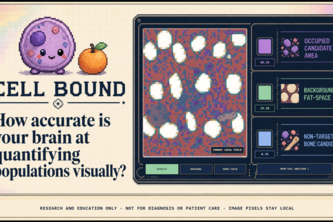
The description states that Cell Bound is a browser-based application that analyzes one representative H&E field locally in the browser. It uses a deterministic engine to separate heuristic image compartments, group recurring visual appearances, and report up to five groups plus "Other" against one fixed ROI denominator. Users can reversibly subtract groups without re-clustering or renormalizing. The tool includes a synthetic marrow-like demo and a pixel-fruit primer for training purposes.
It is built using React, TypeScript, Canvas APIs, and Cloudflare Workers-compatible hosting. It was developed with assistance from GPT-5.6 for interface design, image analysis pipeline, API boundary definition, adversarial testing, documentation, and deployment workflow. The system includes a local fallback so that the analyzer remains usable without an API key.
Inference: This is a browser-based educational tool designed to help trainees reason about bone-marrow cellularity visually, using deterministic algorithms rather than machine learning models for core analysis.
Positioning & Claim Evolution
The description states that Cell Bound explores a “transparent, local-first teaching workflow” that helps trainees reason about occupied area without pretending to diagnose disease. It emphasizes transparency in intermediate steps and deterministic outputs over opaque AI predictions. The tool is positioned as an educational aid, not a medical device or replacement for professional judgment.
It also claims to include strict privacy/model boundaries — meaning that image pixels, filenames, or metadata are never sent to optional models, only validated derived metrics and quality flags.
Inference: Cell Bound positions itself as a transparent, privacy-preserving, deterministic tool for training in pathology, not for clinical use. Its evolution from a hackathon project suggests it is still early-stage and focused on education and research.
Target Customer & ICP
The description states that Cell Bound is intended for training in bone-marrow cellularity estimation, particularly for trainees who may not have access to specialized digital-pathology tools. It is described as a teaching tool, not a clinical diagnostic tool.
Inference: The primary target customer appears to be pathology trainees or educators in hematology or pathology education. There is no evidence of any commercial customer base beyond the authors’ own educational use case.
Business Model & Pricing Evidence
The description states that Cell Bound offers a “free, no-login workflow.” It also mentions that the tool includes a local fallback so it can be used without an API key, and that it does not collect or transmit image data to optional models. There is no mention of pricing, monetization, or revenue streams.
Inference: No business model or pricing evidence is provided. The project is described as free and open-access for educational use only.
Technical & Delivery Signals
The app uses React, TypeScript, Canvas APIs, and Cloudflare Workers-compatible hosting. It was built with Vinext/Vite and uses GPT-5.6 to assist in interface design, image analysis pipeline, API boundary definition, adversarial testing, documentation, and deployment workflow. The system includes a deterministic engine and a local fallback for usability without an API key.
It also includes 18 passing automated tests covering pathological inputs, determinism, API validation, and fallback behavior.
Inference: The technical stack is modern and browser-based, with a focus on deterministic algorithms and privacy-preserving design. It appears to be built with a strong emphasis on reproducibility and usability in constrained environments.
Traction & Maturity Signals
The description states that this is a proof-of-concept project submitted to the OpenAI 2026 hackathon. It includes live versions (original and current) but does not provide any evidence of user adoption, customer base, or revenue. The authors note that it is a research and education tool, not a medical device or replacement for professional judgment.
Inference: No traction or maturity signals are evident beyond the project being a hackathon submission. There is no evidence of product-market fit, customer feedback, or commercial use.
Competitive Context
The description does not mention any direct competitors. It is positioned as an educational tool for bone-marrow cellularity estimation, with a focus on transparency and deterministic analysis. The authors note that specialized digital-pathology tools are not always available, suggesting a niche in training environments where such tools may be lacking.
Inference: There is no evidence of a competitive landscape beyond the general field of pathology education and image analysis tools. No known competitors or market positioning relative to existing tools are described.
Open Questions & Risks
- The project is described as a hackathon submission, not a commercial product.
- No evidence of revenue, customers, or traction.
- The tool is explicitly stated to be for training only and not for clinical use.
- There is no indication that the tool has been evaluated in real-world settings or with actual patients.
- The use of GPT-5.6 raises questions about how much of the system is truly autonomous vs. AI-assisted, and whether this affects reproducibility or auditability.
Inference: The project lacks commercial viability or traction, and its educational focus limits its potential for broader adoption or monetization.
Questions the description leaves open
- What is the intended path from this proof-of-concept to a product that could be used in clinical or training environments?
- Are there any plans to seek approval or validation from medical institutions or regulatory bodies?
- How does the deterministic engine handle edge cases or unusual visual patterns in real-world data?
- Is there any plan to expand beyond bone-marrow cellularity estimation into other pathology domains?
- What are the long-term goals for this project — is it intended to evolve into a commercial product or remain an educational tool?
Overall Assessment
The description states that Cell Bound is a research and education proof of concept, not a medical device or replacement for professional judgment. It is described as a free, no-login tool built for training purposes.
Inference: There is no evidence to support investment or partnership interest at this stage. The project is early-stage, educational in nature, and lacks any commercial traction or revenue model. It may be of interest for academic or research partnerships but does not appear to have a clear path to product-market fit or monetization.
User Stories BotA demo video on every pull request
Get a demo video on every new feature
GitHub App that watches your pull requests and records a narrated, captioned demo.
Save time on demo prep and make informed decisions faster with a video walkthrough of every new feature.
Source
Submitted to the OpenAI 2026 hackathon on Devpost. Project home on Devpost. Back to the full gallery on Devpost.
This competitive analysis was produced by top-founders.com (opens in a new tab)
Generated by a language model from this project's public Devpost page — its tagline, the author's own write-up and any built-with tags listed there — as captured in August 2026. Short quotations are the author's words. It is an opinion on the idea as a business, not on the people behind it, and it reflects the description as published then. If the project has moved on, request a correction below. The analysis is not independent research and contains no verified traction, revenue or customer data.
An independent guide by KFG International LLC — not affiliated with, endorsed by, or connected to Devpost or OpenAI.