

Archive position — measured, not model output
6 likes on Devpost
35 of the 7,850 archived projects have more likes, and 19 share exactly 6 — so this project's #42 place in the like-ranked listing is a tie-break inside that group, not a ranking.
Projects (log scale)
Likes on Devpost. ▲ marks this project's group.
Show the figures
| Likes | Projects | Share of archive |
|---|---|---|
| 0 | 5,587 | 71.2% |
| 1 | 1,758 | 22.4% |
| 2 | 284 | 3.6% |
| 3–4 | 132 | 1.7% |
| 5–9 | 75 | 1.0% |
| 10+ | 14 | 0.2% |
 User Stories BotA demo video on every pull request
Get a demo video on every new feature
GitHub App that watches your pull requests and records a narrated, captioned demo.
Save time on demo prep and make informed decisions faster with a video walkthrough of every new feature.
Executive Summary
What the company appears to be
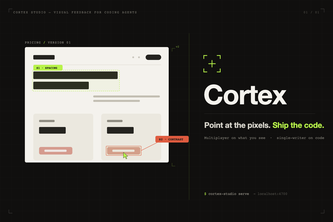
Cortex is a self-reported tool that enables collaborative feedback on UI built by coding agents. It allows team members to annotate agent-generated screens visually on a shared canvas, which then gets translated into code edits applied by the agent. The system uses peer-to-peer connections and local-first architecture.
What changed
The description indicates this was built as part of an OpenAI 2026 hackathon submission. No evidence suggests prior existence or commercial activity beyond this project.
Single most important open question
Is there any evidence of actual usage, traction or revenue from this tool? The description is entirely self-reported and unverified — no customers, users, or monetization data are provided.
What The Product Actually Is
The description states that Cortex is a shared canvas tool that sits between teams and coding agents. It allows visual feedback on agent-built UI through annotations (dragging elements, redlining, sticky notes), which are compiled into precise specs and applied to real code by the agent.
- The agent pushes live screen captures with element maps.
- Teammates annotate visually using a desktop app or browser interface.
- Annotations are compiled into specs that the agent applies to code.
- The system uses peer-to-peer connections for collaboration without hosted servers.
- It includes a local Node process, MCP protocol integration, and a React-based UI with Fabric.js canvas.
Evidence Self-reported by authors. No independent verification.
Positioning & Claim Evolution
The authors claim that working with coding agents has an "asymmetry" — the agent can generate UI quickly but feedback is limited to prose, which they describe as inefficient and unlike how designers work with humans.
They position Cortex as filling a missing gap in the agent workflow by enabling visual feedback loops. They also state that traditional chat-based feedback breaks when more than one person is involved, and that Cortex enables team sessions where everyone marks up UI on a shared canvas.
Evidence Self-reported claims about user pain points and product positioning.
Target Customer & ICP
The description implies the target customer includes:
- Designers
- Product managers (PMs)
- Developers working with coding agents
- Teams collaborating on UI built by AI agents
It suggests that feedback loops break when multiple people are involved in agent-assisted UI development, and that Cortex addresses this.
Evidence Self-reported. No explicit segmentation or customer data provided.
Business Model & Pricing Evidence
There is no evidence of pricing, monetization strategy, or business model in the description.
Evidence Not evidenced.
Technical & Delivery Signals
The system is described as:
- A single local Node process
- Uses MCP protocol over stdio to communicate with agents
- Serves UI via HTTP and WebSocket
- Built with React 19, Fabric.js, Fastify, Playwright, SQLite, Hyperswarm, Automerge, etc.
- Features a "latch" mechanism for synchronous feedback
- Employs peer-to-peer collaboration using Ed25519 keys, encrypted transfers, and CRDTs
- Screenshots are content-addressed and verified before display
Evidence Self-reported technical architecture and implementation details.
Traction & Maturity Signals
There is no evidence of traction, revenue, or adoption beyond the fact that it was submitted to a hackathon. The team size is listed as 4 members, but there is no mention of customers, users, or product usage metrics.
Evidence Not evidenced.
Competitive Context
The description does not provide any information about competitors or market positioning relative to other tools in the space.
Evidence Not evidenced.
Open Questions & Risks
- The entire description is self-reported and unverified.
- No evidence of revenue, customers, or product usage.
- The tool appears to be a hackathon submission with no indication of commercial viability or market traction.
- Technical complexity (e.g., P2P, CRDTs) may not translate into real-world usability without further validation.
- The system relies heavily on agent behavior and protocol adherence — if agents don’t follow expected patterns, the UX breaks.
Inference If this is a prototype or proof-of-concept, it may not yet be ready for commercial use or investment.
Questions the description leaves open
- What specific coding agents does Cortex integrate with?
- Has the system been tested in real-world workflows beyond the hackathon?
- Are there any early adopters or pilot users?
- How does Cortex handle edge cases like DOM refactoring between agent versions?
- What is the current roadmap for monetization or product development?
- Can you demonstrate actual usage of the tool with a live agent session?
Overall Assessment
There is no evidence of commercial traction, revenue, or customer adoption. The project appears to be a hackathon submission with no indication of market readiness or scalability.
Confidence Level Low — based entirely on self-reported description.
Assessment Not ready for investment or partnership consideration without further evidence of product-market fit, usage, or monetization strategy.
User Stories BotA demo video on every pull request
Get a demo video on every new feature
GitHub App that watches your pull requests and records a narrated, captioned demo.
Save time on demo prep and make informed decisions faster with a video walkthrough of every new feature.
Source
Submitted to the OpenAI 2026 hackathon on Devpost. Project home on Devpost. Back to the full gallery on Devpost.
This competitive analysis was produced by top-founders.com (opens in a new tab)
Generated by a language model from this project's public Devpost page — its tagline, the author's own write-up and any built-with tags listed there — as captured in August 2026. Short quotations are the author's words. It is an opinion on the idea as a business, not on the people behind it, and it reflects the description as published then. If the project has moved on, request a correction below. The analysis is not independent research and contains no verified traction, revenue or customer data.
An independent guide by KFG International LLC — not affiliated with, endorsed by, or connected to Devpost or OpenAI.