

Archive position — measured, not model output
0 likes on Devpost
2,263 of the 7,850 archived projects have more likes, and 5,587 share exactly 0 — so this project's #3,966 place in the like-ranked listing is a tie-break inside that group, not a ranking.
Projects (log scale)
Likes on Devpost. ▲ marks this project's group.
Show the figures
| Likes | Projects | Share of archive |
|---|---|---|
| 0 | 5,587 | 71.2% |
| 1 | 1,758 | 22.4% |
| 2 | 284 | 3.6% |
| 3–4 | 132 | 1.7% |
| 5–9 | 75 | 1.0% |
| 10+ | 14 | 0.2% |
 User Stories BotA demo video on every pull request
Get a demo video on every new feature
GitHub App that watches your pull requests and records a narrated, captioned demo.
Save time on demo prep and make informed decisions faster with a video walkthrough of every new feature.
Executive Summary
What the company appears to be
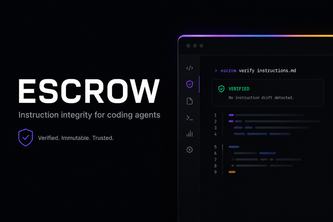
The project described as escrow is a developer tool that interprets repository instructions (e.g., AGENTS.md) using AI and validates them against deterministic evidence in the codebase. It aims to ensure that agent-based workflows do not rely on stale or incorrect documentation.
What changed
The description indicates a shift from treating repository guidance as static documentation to making it testable. The tool uses AI for interpretation but relies on deterministic validation logic to decide whether claims are true.
Single most important open question
Is there any evidence of real-world usage, adoption, or traction beyond the hackathon submission?
What The Product Actually Is
The description states that escrow is a TypeScript and Node.js CLI tool with a local browser interface and GitHub Actions integration, designed to validate repository instructions. It reads files like AGENTS.md and AGENTS.override.md, extracts structured claims using AI (specifically GPT-5.6), and then checks those claims against actual codebase metadata.
It supports multiple output formats including console, JSON, Markdown, HTML, and browser UI. It also offers a preview of restricted repairs but does not allow changes to source code or build files.
Evidence
- Built with: actions, codex, css, git, github, gpt-5.6, html, node.js, ollama, openai, qwen, typescript, vitest, zod
- Uses GPT-5.6 for extracting claims and proposing repairs
- TypeScript validators compare claims against deterministic repository evidence
- Supports GitHub Actions integration
Inference The tool is positioned as a repository instruction integrity infrastructure, not an AI that replaces verification but rather makes unstructured language usable by reliable systems.
Positioning & Claim Evolution
The description states that escrow was inspired by the recurring failure mode where coding agents rely on outdated repository instructions. The authors claim their solution treats these instructions as something worth testing, not just documentation.
They frame it as a tool for agent reliability, aiming to prevent agents from acting on incorrect assumptions due to stale guidance.
Claims made
- “AI interprets the instruction. Deterministic repository evidence decides whether it is true.”
- “The best use of AI in developer tooling is often not replacing verification, but making unstructured human language usable by reliable systems.”
These are self-reported claims about intent and positioning, not proof of traction or adoption.
Inference There is no indication that escrow has evolved from an idea into a product with market feedback or iterative development beyond the hackathon context.
Target Customer & ICP
The description implies that escrow targets developer teams using AI agents in code repositories, especially those working with tools like AGENTS.md. It is aimed at users who want to ensure agent workflows are based on accurate and up-to-date repository instructions.
It also suggests a use case for CI/CD pipelines through GitHub Actions integration.
Evidence
- Designed for developers relying on repository instructions
- Integrates with GitHub Actions
- Targets agent-based workflows
Not evidenced
- No stated customer segments, personas, or specific industries
- No mention of enterprise vs. individual users
- No evidence of target market size or competitive positioning
Business Model & Pricing Evidence
The description does not contain any information about pricing, monetization strategy, or business model.
Evidence
- No mention of revenue streams
- No indication of paid features or tiers
- No reference to licensing or subscription models
Inference This is a self-hosted CLI tool, possibly with optional GitHub Actions integration. If monetized, it would likely be through SaaS or open-source with enterprise support.
Technical & Delivery Signals
The project is built using TypeScript and Node.js, includes a local browser UI, and integrates with GitHub Actions. It uses GPT-5.6 for interpretation, but relies on deterministic validation logic to make final decisions.
It supports Git worktrees, lockfiles, package.json metadata, dependency checks, and path resolution as part of its validation process.
Evidence
- Uses Codex for development planning, implementation, testing, debugging, documentation, and GitHub Action integration
- Supports multiple output formats (console, JSON, Markdown, HTML, browser UI)
- Uses Ollama for local demos while preserving deterministic validation layer
Inference The tool is designed to be safe, avoiding execution of unsafe commands by using temporary Git worktrees and blocking network-capable commands.
Traction & Maturity Signals
There is no evidence of traction, revenue, customers, or adoption beyond the hackathon submission. The project was submitted to the OpenAI 2026 hackathon on Devpost.
Evidence
- Submitted to a hackathon
- Team size: 2
- No mention of users, customers, or product usage
Inference This is an early-stage prototype or proof-of-concept with no demonstrated market traction or user feedback.
Competitive Context
The description does not provide any information about competitors or similar tools in the marketplace.
Evidence
- No mention of existing solutions
- No comparison to other developer tooling
Inference Given its focus on validating repository instructions for AI agents, it may overlap with areas such as developer workflow automation, codebase integrity tools, and CI/CD validation systems. However, no competitive landscape is described.
Open Questions & Risks
- No real-world usage: The tool exists only in the context of a hackathon submission.
- Unproven market fit: No evidence of customer demand or product-market alignment.
- Limited team size: Only two members, which may limit scalability and development speed.
- AI dependency risk: Reliance on GPT-5.6 for interpretation introduces potential inconsistency unless tightly controlled.
- Lack of business model clarity: No indication of how the tool will be monetized or sustained.
Questions the description leaves open
- What specific problems are you solving in real-world developer workflows?
- Have you tested escrow with actual teams or agents in production environments?
- How do you plan to scale beyond the current hackathon prototype?
- Is there a clear path to monetization or commercial viability?
- What is your strategy for handling model hallucinations or misinterpretations?
- Are there any known edge cases where deterministic validation might fail?
Overall Assessment
Not evidenced: No data on revenue, customers, traction, or financials.
This project appears to be a hackathon prototype with no demonstrated commercial viability or market traction. It is not evidenced to have generated any revenue, customer base, or product adoption beyond its own submission.
The tool’s core idea — validating repository instructions using AI and deterministic checks — is conceptually sound but lacks real-world validation or evidence of impact.
Confidence level: Low
Next steps: If this were a live company, further due diligence would require access to user feedback, product usage data, and financials. As it stands, the description provides no basis for assessing commercial potential.
User Stories BotA demo video on every pull request
Get a demo video on every new feature
GitHub App that watches your pull requests and records a narrated, captioned demo.
Save time on demo prep and make informed decisions faster with a video walkthrough of every new feature.
Source
Submitted to the OpenAI 2026 hackathon on Devpost. Project home on Devpost. Back to the full gallery on Devpost.
This competitive analysis was produced by top-founders.com (opens in a new tab)
Generated by a language model from this project's public Devpost page — its tagline, the author's own write-up and any built-with tags listed there — as captured in August 2026. Short quotations are the author's words. It is an opinion on the idea as a business, not on the people behind it, and it reflects the description as published then. If the project has moved on, request a correction below. The analysis is not independent research and contains no verified traction, revenue or customer data.
An independent guide by KFG International LLC — not affiliated with, endorsed by, or connected to Devpost or OpenAI.