

Archive position — measured, not model output
0 likes on Devpost
2,263 of the 7,850 archived projects have more likes, and 5,587 share exactly 0 — so this project's #3,965 place in the like-ranked listing is a tie-break inside that group, not a ranking.
Projects (log scale)
Likes on Devpost. ▲ marks this project's group.
Show the figures
| Likes | Projects | Share of archive |
|---|---|---|
| 0 | 5,587 | 71.2% |
| 1 | 1,758 | 22.4% |
| 2 | 284 | 3.6% |
| 3–4 | 132 | 1.7% |
| 5–9 | 75 | 1.0% |
| 10+ | 14 | 0.2% |
 User Stories BotA demo video on every pull request
Get a demo video on every new feature
GitHub App that watches your pull requests and records a narrated, captioned demo.
Save time on demo prep and make informed decisions faster with a video walkthrough of every new feature.
Executive Summary
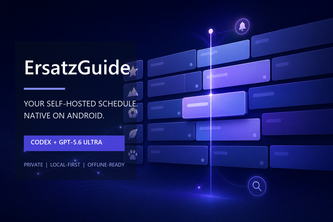
The company appears to be a solo developer project named ErsatzGuide, an Android TV guide application that integrates with ErsatzTV feeds. The author describes it as a "private, local-first" tool designed for users who self-host media servers but want a native-like experience when browsing schedules from their phone.
The product combines M3U playlists and XMLTV schedules into a searchable, offline-capable Android app with reminder functionality. It is built using Kotlin and Jetpack Compose, and emphasizes resilience against data inconsistencies in feed formats.
Key commercial due-diligence read: The description does not contain any evidence of revenue, customers or adoption — only self-reported claims about product features and architecture. There is no indication that this project has moved beyond the prototype or hackathon stage.
Most important open question: Is there any evidence of user testing, feedback loops, or actual usage beyond the author’s own development?
What The Product Actually Is
The description states that ErsatzGuide:
- Combines an ErsatzTV M3U playlist and XMLTV schedule into a local Android guide.
- Provides a timeline, Now & Next, channel schedules, offline search, programme details, and reminders.
- Imports are transactional so failed network refreshes do not erase usable data.
- Has no accounts, ads, analytics, or cloud backend.
- Is written in Kotlin with Jetpack Compose and Material 3.
Inference: The app appears to be a lightweight, privacy-focused Android application aimed at users who self-host media content but desire a more intuitive interface for browsing and managing their guide.
Positioning & Claim Evolution
The author positions ErsatzGuide as:
- A "private, local-first" solution.
- An alternative to traditional TV guides that preserves control and privacy of self-hosted setups.
- Designed for users who find existing home media server interfaces clunky or non-native.
Claim: The app makes browsing schedules from a phone feel like a native TV guide while maintaining the benefits of self-hosting.
Inference: This is a niche product targeting early adopters or power users within the self-hosted media ecosystem. It does not appear to be positioned for mass-market appeal or commercial scalability.
Target Customer & ICP
The description implies:
- Users who operate home media servers (e.g., using ErsatzTV).
- Individuals seeking a better interface for browsing and managing their TV schedules.
- People who value privacy and local-first solutions over cloud-based alternatives.
Not evidenced: No specific customer segments, personas, or market size are mentioned. The ICP is inferred from the product’s architecture and stated use case.
Business Model & Pricing Evidence
The description states:
- There are no accounts, ads, analytics, or cloud backend.
- No pricing model is described.
- The app is open-source or at least publicly available via Devpost.
Inference: If the project remains free and non-commercial, it likely does not have a monetization strategy beyond potential donations or future optional features.
Technical & Delivery Signals
The author reports:
- Built with Kotlin, Jetpack Compose, Material 3.
- Uses Hilt for dependency injection, Room for data storage, DataStore for settings, OkHttp for streaming, WorkManager for refreshes, AlarmManager for reminders.
- Defensive parsing of XMLTV data including handling malformed records and time offsets.
- Transactional imports to prevent loss of usable data during failed refreshes.
- Unit and instrumentation tests covering various aspects of functionality.
Inference: The technical stack suggests a well-structured, modern Android app with attention to robustness and testability. However, this is a solo-developer project; no team or infrastructure beyond one person is evident.
Traction & Maturity Signals
The description states:
- Submitted to the OpenAI 2026 hackathon.
- No mention of downloads, users, or engagement metrics.
- No evidence of revenue, customer acquisition, or retention.
Not evidenced: There is no indication of traction, adoption, or user feedback beyond the author’s own account. The project appears to be in an early-stage prototype or proof-of-concept phase.
Competitive Context
The description does not reference competitors directly. However:
- ErsatzTV is mentioned as a source for feeds.
- Other similar tools may exist in the self-hosted media space, but none are named.
Inference: The competitive landscape likely includes other local-first or self-hosted media server interfaces, though no direct comparison or differentiation is made.
Open Questions & Risks
Key risks identified from the description:
- Solo developer project with no team or external support.
- No evidence of real-world usage, feedback, or iteration beyond a hackathon submission.
- Product may not have evolved past initial concept or prototype stage.
- Lack of monetization strategy or clear path to commercial viability.
Inference: The risk of the project remaining a one-off hack is high. Without traction or user validation, it is unclear whether this will develop into a viable product or service.
Questions the description leaves open
- What was the actual outcome of the hackathon submission? Was there any follow-up or community interest?
- Have you tested the app with real users beyond yourself?
- Are there plans to expand beyond the current feature set, and how would that affect the architecture?
- Is there any intention to monetize the product, and if so, what form might that take?
- How do you plan to handle ongoing maintenance and updates given only one developer?
Overall Assessment
Not evidenced: No financials, funding history, or strategic alignment are provided.
Inference: At this stage, the project appears to be a solo developer experiment with no demonstrated traction or commercial potential. It would not meet typical investment criteria unless there is evidence of user engagement, product-market fit, or a clear path forward beyond the prototype phase.
User Stories BotA demo video on every pull request
Get a demo video on every new feature
GitHub App that watches your pull requests and records a narrated, captioned demo.
Save time on demo prep and make informed decisions faster with a video walkthrough of every new feature.
Source
Submitted to the OpenAI 2026 hackathon on Devpost. Project home on Devpost. Back to the full gallery on Devpost.
This competitive analysis was produced by top-founders.com (opens in a new tab)
Generated by a language model from this project's public Devpost page — its tagline, the author's own write-up and any built-with tags listed there — as captured in August 2026. Short quotations are the author's words. It is an opinion on the idea as a business, not on the people behind it, and it reflects the description as published then. If the project has moved on, request a correction below. The analysis is not independent research and contains no verified traction, revenue or customer data.
An independent guide by KFG International LLC — not affiliated with, endorsed by, or connected to Devpost or OpenAI.